After-Sales Support for Cable Projects: Claims, Replacements and Spares

Quick Answer: After-sales support is negotiated before the order, not after the fault. Define claim evidence, replacement terms and spare quantities in the contract, and a cable problem stays a paperwork problem.
After-sales support for cable projects is the part of the relationship that nobody photographs and everybody eventually needs. The cable is pulled, energized, commissioned — and for the next twenty-five years it is either a quiet asset or the subject of a slow dispute. What decides which is not the cable itself but the machinery around it: how quickly a fault report becomes a factory investigation, what evidence both sides agreed counts, whether a replacement drum moves in weeks or stalls in negotiation, and whether the spares that keep the site running were ordered with the project or scavenged after it. Buyers who treat after-sales as a courtesy usually find it is really a contract discipline, and the ones who write that discipline into the purchase order get to spend their project’s operating years on other things. This guide covers the three pieces of that discipline: the claim process, the replacement terms and the spares plan.
Introduction
After-sales support matters because cables fail for reasons that split cleanly into three groups, and each group needs a different response — per the common causes of cable failure: manufacturing defects, which are the supplier’s responsibility and surface early; transport and storage damage, which is an incoterm question and needs the freight evidence; and installation or application damage, which is nobody’s fault in the transactional sense but still needs an answer, because the site does not care whose fault it was. A supplier who only honors the first group, slowly and reluctantly, has not really offered after-sales support — they have offered a warranty with an escape hatch. The mature version covers all three groups with defined timelines: an acknowledgment window, an evidence protocol, a disposition deadline and a remediation menu that ranges from a replacement drum to jointing accessories flown to site. None of this is generosity; it’s all specifiable, and what is specifiable can be enforced.
Write the Claim Process Before the Claim
The claim process is where good intentions go to die, so it belongs in the contract as a numbered procedure. Four elements carry the weight. Acknowledgment window: the supplier acknowledges a written fault report within a fixed number of business days — three to five is normal — because the first week of a claim decides whether it becomes an investigation or an argument. Evidence protocol: photographs with the drum marking visible, the retained sample lengths from both ends of the suspect section, the laying and pulling records, and the megger or test logs from commissioning; when both sides agreed on the evidence list at order time, nobody can relitigate it at claim time. Investigation route: either the supplier sends an engineer, or the parties agree to a joint third-party inspection — the mechanism documented in the FAT and SAT testing guide applies to claims as well as to acceptance. Disposition deadline: a date by which the supplier states the finding and the remedy. A claim with a deadline behaves like a process; without one, it drifts.
The Claim Playbook in Practice
Run the process on a real-shaped case. A feeder section alarms three months after energization; the site isolates it, photographs the affected drums and their markings, and files the report with the commissioning test logs attached. Under a written protocol, the supplier acknowledges within the window, reviews the batch file for that production run, and either accepts the finding or requests the retained samples. If the evidence points to a manufacturing defect, the remedy is defined: replacement cable for the affected section, ex-works or delivered as agreed, with the original test documentation for the new drums. If the evidence points to installation damage — a pull tension exceeded, a bend radius violated — the honest finding is stated as such, and the value of the process shows: the dispute ends with a technical conclusion the site can act on, not a stalemate. Most claims in practice resolve at the document stage, which is precisely why the document list was written at order time. The escalation path for unresolved cases — joint sampling of the retained lengths, then third-party arbitration — is also part of the playbook, and it is cheaper to write down than to invent mid-dispute.
| Step | What Happens | What the Contract Should Say |
|---|---|---|
| Acknowledgment | Supplier confirms receipt of the fault report | Within 3-5 business days of written notice |
| Evidence | Photos, drum markings, samples, test logs | Evidence list agreed at order time, both ends retained |
| Investigation | Batch review, engineer visit or joint inspection | Route and cost bearer named per finding |
| Disposition | Written finding: defect, transport or installation | Deadline fixed — typically 30 days from acknowledgment |
| Remedy | Replacement, credit or accessories support | Menu defined in advance, not negotiated per case |
| Escalation | Joint sampling, then third-party determination | Named mechanism, cost split stated |
Replacements: What Like-for-Like Must Mean
Replacement terms look simple until the replacement is due, so the contract should pin down three definitions. Like-for-like: the replacement cable matches the original specification — same construction, same standard, same drum markings and the same current test documentation; a “replacement” from a different production era or a renamed compound is not a replacement. Timeline: a replacement window measured from disposition, with a default of four to eight weeks for standard constructions and a stated path for longer leads on custom builds, consistent with the planning logic in the international sourcing mistakes guide, where replacement lead times are the most commonly unbudgeted line. Costs: who pays freight, who pays duties, whether the defective cable returns to the factory or is destroyed locally with photographs — because scrap cable left on site has a disposal cost, and return freight on drums is real money. Buyers running turnkey packages through an EPC-oriented sourcing channel should confirm that the cable replacement terms align with the package schedule, so a replacement drum does not wait behind a milestone that has already closed.
Spares: The Second Order You Place with the First
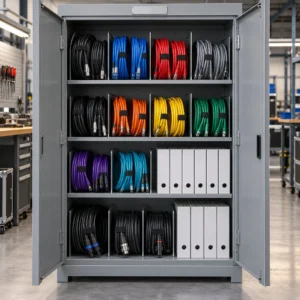
Spares are the quiet half of after-sales support, and the cheapest moment to buy them is with the project. The logic starts at the joints and terminations: the accessories that match the cable’s construction are batch-sensitive, and sourcing a matching joint kit five years later for a custom construction is a project in itself — which is why the accessory set belongs on the original order, listed in the cable accessories checklist. The drum logic follows the pulling plan: one spare drum per critical route, or a defined percentage of the total length, stored with the same temperature and moisture discipline as the installed cable, with the batch documentation filed alongside. For long-lived infrastructure, the deeper question is continuity: will this construction still be producible in ten years, and if the compound or the standard changes, what is the equivalent? Suppliers answer that question differently, and the answer is worth hearing before the first order, not after the second failure. A supplier who treats spares planning as part of the original quotation — quantities, storage guidance, documentation set — has told you how the next decade will look; the RFQ page accepts spares and accessories as explicit lines, which is where they belong.
When a Claim Is Not the Answer
A mature after-sales view includes the discipline of not claiming. Damage from exceeded pull tensions, violated bend radii, glanding overtightened or sheaths cut by tray edges is installation damage, and no claim protocol will convert it into factory liability — the evidence will show it, and the relationship absorbs the friction. The honest alternative is prevention instrumented the same way: pulling tension calculated and logged, bend radii checked against the drum, samples retained and test logs archived, so that when a genuine defect appears, its evidence stands uncontaminated by doubt. The second caution is the unsupported supplier: after-sales promises made by a trading desk that does not control the factory evaporate exactly when needed, which is why the claim process should be signed by the party who runs the production batch file. Support is a property of the manufacturing relationship, not something that rides along on the invoice.
| Item | Planning Rule | Why It Cannot Wait |
|---|---|---|
| Joint and termination kits | One set per joint type plus 10% margin | Batch-matched to the cable construction |
| Spare drums | One per critical route or 3-5% of length | Same batch and documentation as installed runs |
| Storage discipline | Drums stored, rotated and logged like stock | Spares decay as fast as installed cable |
| Documentation set | Batch files, test reports, drawings archived | Future claims and extensions need the baseline |
| Continuity answer | Supplier states producibility horizon | Renamed compounds void like-for-like |
| Claim protocol | Windows, evidence list, disposition deadline | Written rules survive the people who signed them |
RFQ Checklist: After-Sales Lines for the RFQ
Put the support questions in writing:
- Claim acknowledgment window and disposition deadline stated
- Evidence protocol and retained-sample lengths defined
- Replacement terms: like-for-like definition and timeline
- Freight, duty and return-scrap costs allocated
- Joint kits and spare drums quoted with the project
- Documentation set for spares specified at order time
- Escalation route named for unresolved findings
Conclusion
After-sales support for cable projects is a system with three parts: a claim process with windows and evidence rules, replacement terms that define like-for-like and its timeline, and a spares plan bought with the project instead of scavenged after it. Written into the contract, the system turns faults into procedures; left to goodwill, it all too easily turns them into disputes.
Kexingyu Cable Group (KXYE) treats after-sales as part of the order: batch files retained for every production run, replacement terms written like-for-like, joint kits and spare drums quoted with the project, and a claim protocol with deadlines the factory actually keeps — cable supplied for a twenty-five-year service life, not merely for delivery day.