How Many Bending Cycles? Reading Flex-Life Specifications Honestly
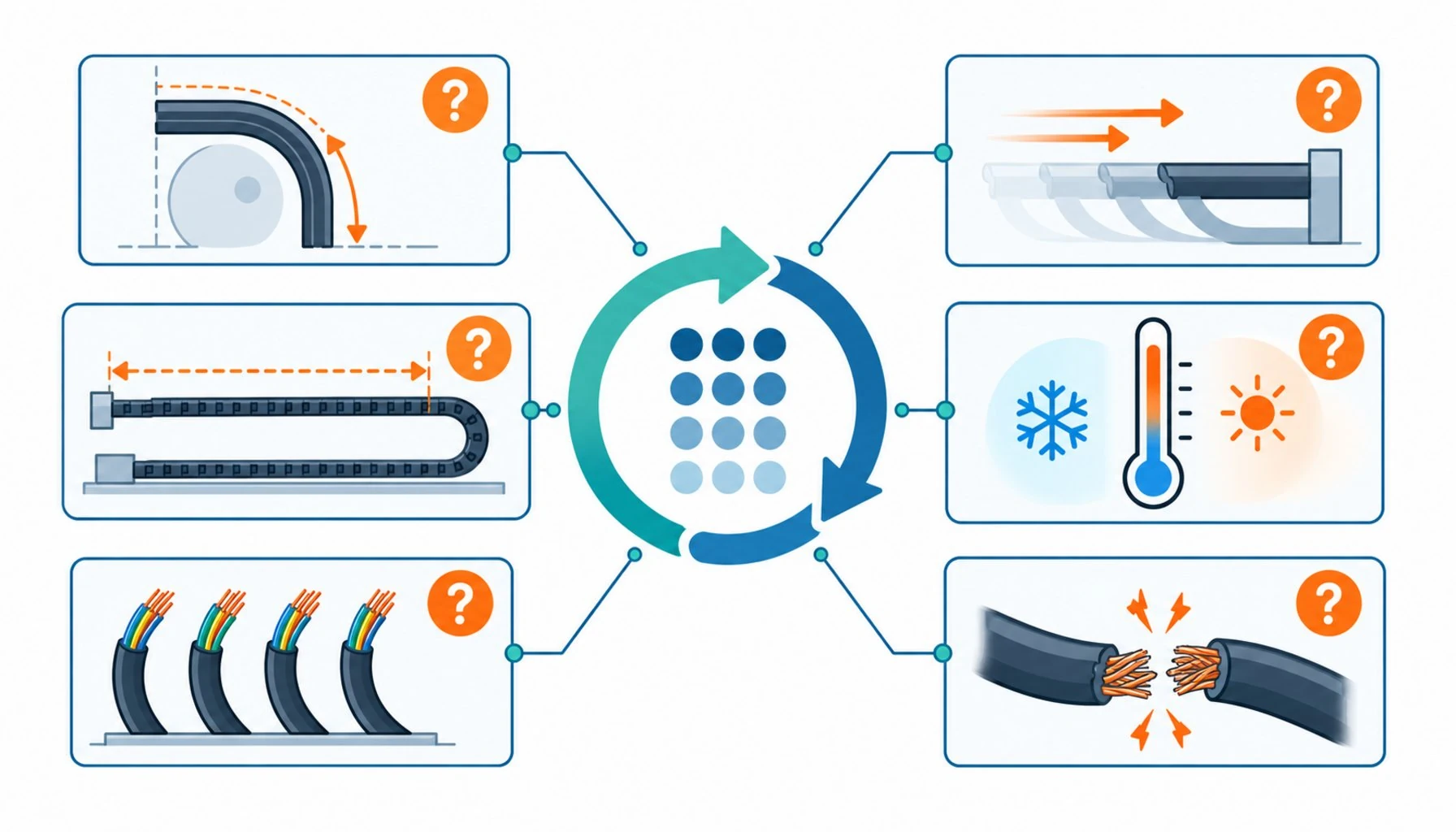
Quick Answer: A flex-life number without its radius, speed and failure criterion is marketing, not data; two million cycles at 100 millimeters can be zero cycles at 30.
Every motion cable datasheet carries the number. Two million bending cycles. Five million. Sometimes ten. Buyers compare the numbers the way they compare price, and the cable with the biggest figure looks like the safest purchase. The uncomfortable truth is that a flex-life claim without its test conditions is close to meaningless, because cycle counts are not properties of cables; they are outcomes of specific tests, and moving any one of the test parameters by a factor of two can move the cycle count by a factor of twenty. Two cables can both honestly claim two million cycles and differ in real service life by an order of magnitude. This guide teaches the reading discipline that closes that gap: what a legitimate flex-life claim states, which variables move the numbers, how test labs actually count a cycle and define failure, and the questions that separate tested data from catalog aspiration. It is written for buyers, project engineers and anyone who has ever signed off on a cycle number without seeing the test behind it.
Introduction
The reason cycle numbers mislead is that flex fatigue has no universal scale. A cable does not carry a fatigue life the way a material carries a density; it accumulates damage that depends on how far it bends, how fast it bends, how it is loaded, how hot it runs and what counts as broken. Change the radius from 100 millimeters to 50 and the stress in the outer conductors can double or worse. Change the speed and you change the heating and the dynamic loading. Change the failure definition from first intermittent continuity to complete open circuit and you add hundreds of thousands of cycles to the same test. Laboratories know this, which is why legitimate test reports read like recipes: radius, speed, load, temperature, travel, failure criterion, sample count. Datasheets often keep only the punchline. The broader failure context is in the common causes of cable failure; here we zoom into the single most quoted and least understood specification in motion cable.
The Variables That Move the Number
Radius first, because it dominates everything. Flex life falls steeply as radius shrinks; a cable tested at 12.5 times its diameter may lose the overwhelming majority of its rated life when asked to run at 7.5 times, which is why honest datasheets publish a curve or a table rather than a single figure. Speed and acceleration second: faster flexing heats the cable and adds dynamic loading, and the cycle count at high speed can be a fraction of the count at the lab’s gentle default. Travel length matters because long travels add cable weight and inertia that short-travel tests never see. Temperature shifts the compound behavior at both ends, cold stiffening the jacket and heat softening the insulation. And the load itself, the cable’s own weight plus any carried tension, decides how much of the bending stress lands on the copper. A claim that survives scrutiny states all of these. A claim that states none of them has told you nothing except that somebody once ran a favorable test. The one exception worth noting: claims on signal cables must also cover the shield, because a braid that cracks mid-life fails the machine long before any conductor does, and shield construction quality separates the tiers described in control versus instrumentation cable.
| Variable | Typical Effect on Rated Cycles | What the Honest Datasheet States |
|---|---|---|
| Bend radius | Dominant factor; halving it can cut life by 10x or more | Curve or table across radii, not a single point |
| Flexing speed | Higher speed means heating and dynamic load, fewer cycles | Test speed in meters per second |
| Travel and layout | Long travel adds weight and inertia loading | Travel length and chain type used in test |
| Temperature | Cold stiffens, heat softens; both shift life | Ambient during test, plus any rating extremes |
| Failure criterion | First fault vs final open differs by large margins | Exact criterion: continuity, insulation or shield |
| Sample size | One survivor is not a statistic | Number of samples and pass rule |
How Test Labs Count a Cycle and Define Failure
The details laboratories treat as essential are the details catalogs omit, and knowing them turns any buyer into a sharp reader. A cycle is usually one full back-and-forth of the test motion, but some reports count single passes, which doubles the apparent number at a stroke; always check which convention the report uses. The monitored parameters decide what failure means: a rigorous test watches every conductor for continuity, the shield for continuity, and insulation resistance throughout, and it calls failure at the first sustained fault on any monitored element, not when the cable finally stops conducting altogether. That distinction alone separates serious data from the flattering kind, because a cable can pass intermittent faults for hundreds of thousands of cycles while its signals are already unusable in a real machine. Sample count is the third tell: a test on three samples that reports the best result is marketing; a test on ten samples with a stated pass rule, such as no failures before the rated count, is evidence. And the strongest reports add the test rig type and a photo, because a chain-tested cable and a rotary-bend-tested cable answer different questions, and construction-level data never substitutes for system-level testing in the geometry the cable will actually occupy.
| Question to Ask | Why It Matters | Green Flag |
|---|---|---|
| At what radius, in diameters or millimeters? | Radius dominates the entire number | Curve or table, or radius matching your duty |
| What speed and travel? | Speed and inertia cut life as they rise | Stated values near your machine's duty |
| What counts as one cycle? | Conventions differ by 2x at a stroke | Full back-and-forth defined in the report |
| What counts as failure? | First fault vs final open differs hugely | First sustained fault on any monitored element |
| How many samples, what pass rule? | One survivor is not evidence | Multiple samples, stated pass rule |
| Tested in a chain or on a bend rig? | System testing answers the real question | Chain test at relevant geometry, photos included |
From Claim to Specification: Using Numbers Honestly
The practical use of flex-life data is a translation exercise. Start from your machine, not from the datasheet: the installed radius at its tightest point, the cycle count per shift, the speed, the temperature range. Then demand data at those conditions, and accept only what arrives with method attached. Where the supplier’s tested points do not reach your conditions, a good laboratory extrapolates with stated assumptions, and a supplier who refuses the extrapolation is being more honest than one who rounds up. Build margin into the specification rather than into the reading of the claim: a cable rated at twice your duty at your radius, by the failure criterion you defined, carries real margin; a cable whose catalog figure equals your duty on unknown conditions carries none. Where the duty also involves sizing decisions, the conductor and dimension logic in the cable size selection guide rounds out the picture. And log field life against the prediction, because a year of your own failure data recalibrates every future purchase better than any datasheet. Buyers who want the deeper skill of reading cable documentation end to end will find the full method in the guide to reading equipment datasheets, of which flex life is just the loudest example.
When Flex-Life Numbers Are Not the Answer
Honest limits: some machines should not be buying flex-life claims at all. Duty with torsion, combined bend-and-twist routes and very small radii live outside the envelope most chain testing describes, and a cycle number earned in pure bending says little there; those applications need geometry-specific testing, and the construction side of that story is told in the torsion cable discussion. Very light duty, meanwhile, needs no million-cycle rating at all, and paying for one is noise. And no cycle number covers installation damage, the week-two failures that no laboratory predicts. The number is one input, the most quoted one, but the duty match and the installation discipline around it decide whether the cable keeps its promise.
RFQ Checklist: Asking for Flex Data That Means Something
Put these lines into the request and watch the quality of answers sort the suppliers:
- Installed radius at the tightest point, stated in the request, data required at that radius
- Cycle duty and target life, with the failure criterion you accept, defined before quoting
- Speed, travel and temperature of your duty, with test conditions required to match
- Sample count and pass rule for the claimed rating
- Chain-tested or rig-tested, with rig details and photos for system-level claims
- Extrapolation policy stated: how the supplier handles duty points outside tested range
Conclusion
A flex-life number is a sentence with most of its words missing until you know the radius, the speed, the sample size and the failure definition behind it. Buyers who read those words before they read the cycle count buy cables that meet their duty; buyers who compare punchlines buy lottery tickets with good packaging. The discipline costs a few questions per purchase and repays them the first time a line keeps running past the two-year mark.
Kexingyu Cable Group (KXYE) publishes flex data with its test conditions attached, radius by radius, and quotes against stated duty rather than against catalog extremes. Send your radius, cycle count and speed through the RFQ page, and we will answer with the tested numbers, the methods behind them and the honest gaps where extrapolation is doing the work.