Car Park EV Cable: Sizing, Provision and What to Freeze Before the Order
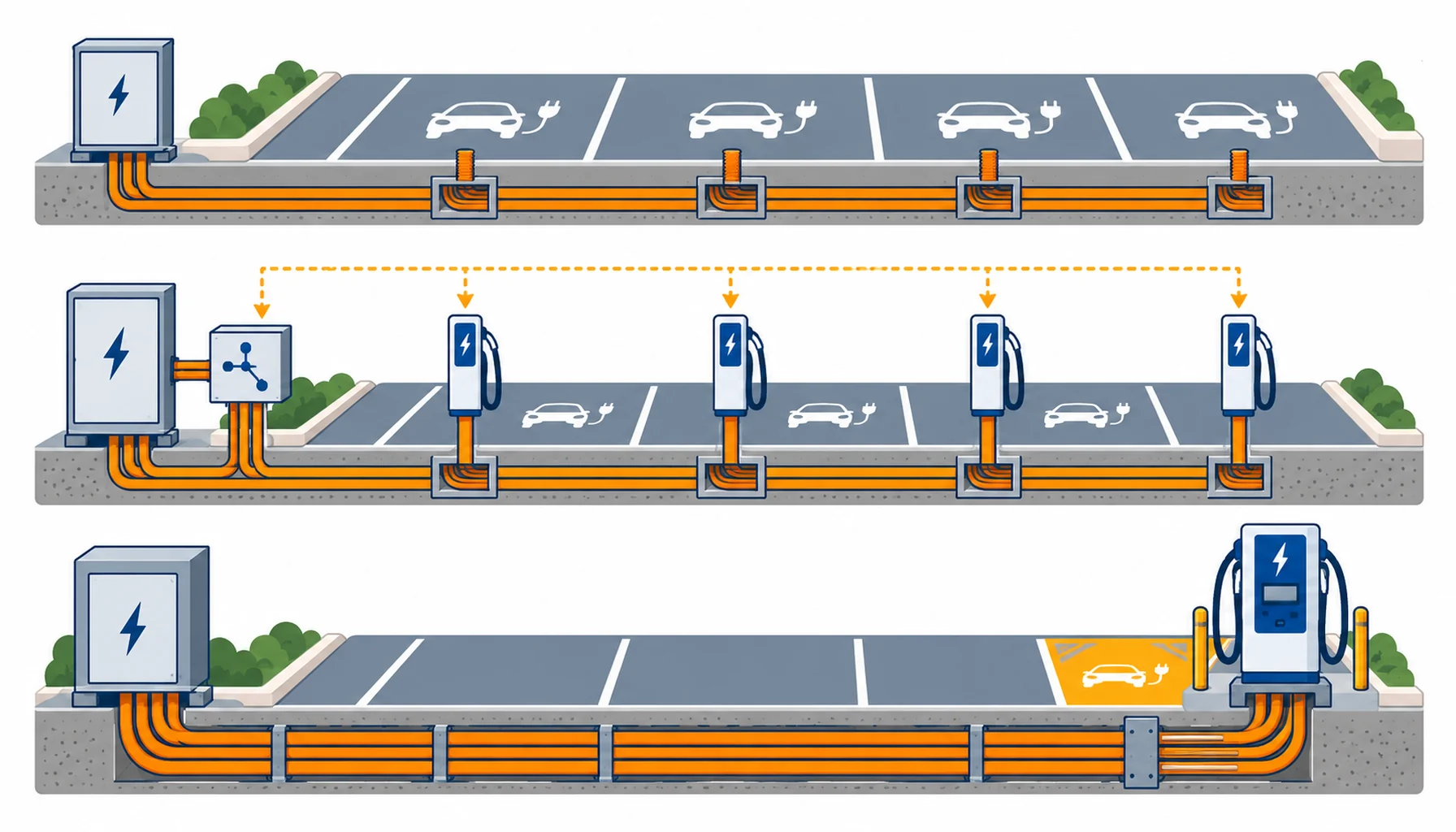
Quick Answer: A car park EV cable package is usually bought twice. The first purchase is the infrastructure that has to be in the slab and the cable route before the deck is finished, long before anyone knows which chargers will be installed. The second is the feed to the chargers themselves. Getting the first purchase wrong costs a new trench through a finished deck; getting the second wrong costs an undersized feed that cannot be upgraded without pulling new cable. Size the incoming capacity, the riser and the ducting for the provision target at handover plus what the site is likely to want in ten years, then procure the chargers separately against that platform.
Introduction
Car park charging at scale is an infrastructure problem before it is an equipment problem. The chargers themselves are bought against a power rating and a connector standard, and most of them can be swapped later. The cable, the ducting, the containment and the capacity behind them cannot, because they run through a structure that is about to be finished, waterproofed, paved or handed over.
That mismatch is where the cost risk sits. Facilities managers inherit a lighting supply, a provision target written into a regulation or a planning condition, and no record of what the ducting was sized for. This guide covers sizing, what to put in the ground early, and what to freeze before the order.
What Makes a Car Park Different from a Building Feed
Nobody charges at the same time, and then everybody does. Residential and workplace charging is dominated by long dwell times and a small number of simultaneous sessions. Retail and short-stay charging is the opposite: short dwell, high turnover, and a peak that follows the site’s busy hour. The cable has to be sized for the second pattern even where the first is what happens on day one.
The supply was usually designed for lighting. A deck lighting load of a few kilowatts looks nothing like thirty 22 kW chargers. Where the building supply has no headroom, the cable package may have to carry a load management signal rather than raw capacity, which changes the control wiring as much as the power wiring.
Fire strategy and ventilation. Enclosed car parks already carry a fire strategy. Adding charging changes the hazard picture, so the route, the tray material and the penetration details have to be agreed with that strategy rather than bolted on afterwards.
Ingress and cleaning. Decks are washed, salted and driven over, so any cable below a certain height has to assume water, grit and impact. That means a higher ingress rating at boxes and a protection decision on the surface runs.
Sizing the Feed: Provision, Diversity and the Two Numbers
There are two numbers in a car park EV cable package and they are frequently confused. The first is provision: the number or proportion of bays that must be able to charge. The second is capacity: the electrical load the supply must carry. Provision targets are typically set by building regulation or planning condition and rise over time, while the capacity that can be brought into the site is fixed by the incoming supply.
The gap between them is closed with load management. Where a site has ten bays provisioned and a supply that will only carry four at full rate, an active load management scheme allocates current between the units based on what the site is drawing elsewhere. That is a legitimate design, but it has three cable consequences to design in rather than discover later.
Feed sizing. The feed has to be sized for the managed maximum, not for the sum of the charger nameplates. Sizing for the sum is the most common over-spend; sizing below what the scheme can allocate strands capacity you paid for. Our notes on cable size selection and on voltage drop calculation cover the order: protective device first, then derating, then volt drop at the far bay.
Derating in a car park. Cable in a duct under a slab, cable in a closed tray with other services, and cable run in a soffit void between levels all carry different derating factors. A deck is often the worst of the three because heat has nowhere to go. Our note on cable derating factors sets out what to declare so the supplier can calculate against the real installation rather than an assumed one.
Diversity for the design case. Charger utilisation is not one hundred per cent at the design hour, so buy the package against a stated diversity assumption the client accepts, and put it on the drawing. A feed sized on an assumption nobody can find is a feed nobody can defend later.
Provision Tiers and What Each One Requires
| Provision tier | Duty | What to Specify | Evidence to Demand | Cost and Lead-Time Driver | How It Fails |
|---|---|---|---|---|---|
| Passive provision | No charger yet, but the bay must be chargeable later without opening the deck | Duct size and spare draw cords per bay, pull pits, containment capacity, a documented route to the board position | As-built duct schedule with sizes, radii and pit positions, plus a recorded pull test on one duct | Excavation and reinstatement, not the duct; this is the tier where cheap saves nothing | A duct undersized for the final cable, or a radius that only the smallest cable will pass |
| Active provision, shared supply | Chargers installed, simultaneous use limited by load management | Feed sized for the managed maximum, control or communications pair to each bay, metering arrangement per unit | Load management scheme document, derived current per bay, commissioning records | The management hardware and the control wiring rather than the power cable | Bay allocations that collapse at the busy hour, or no spare cores for the control signal added later |
| Active provision, dedicated supply | Each bay or pair at full rate, no management constraint | Feed sized on the sum of the units with diversity stated, protection discriminated by bay group | Sizing calculation with diversity, protection co-ordination study | Copper and switchgear; the availability of the incoming capacity is the real constraint | A supply upgrade required after the fact, and a car park out of service during it |
| Rapid and high power bays | Short dwell, high current, often a separate customer for the operator | Feed sized on the charger rating with a stated diversity of one, larger containment, cooling or ventilation co-ordination | Charger datasheet with the actual input current, protection study, thermal assessment of the route | The charger itself and the supply reinforcement, both with long lead times | A route that was designed for the AC case and cannot take the DC feed |
| Retrofit into an existing deck | Bays added where the deck already exists and the supply is unknown | A route survey before pricing; containment fixed where accessible, surface trunking accepted where it is not | Route survey with photographs, existing supply capacity statement, containment condition report | Access and out-of-hours working; the cable is a small part of the bill | A priced route that turns out to need core drilling through a post-tensioned slab |
Distribution Inside the Car Park
Once the feed reaches the deck, the choice is between running cable and running busbar. The trade is not about price per metre; it is about how likely the bay layout is to change. For a bay layout that is fixed at design stage, cable in tray is usually cheaper and simpler. For a deck where bays will be re-marked, extended or reallocated, a busbar run with tap-off boxes lets a bay be added in a day rather than a shutdown. Our note on busway versus power cable sets out where that trade pays, and our busbar tap-off box page covers the accessory that makes it work.
Containment and substrate. Surface containment in a car park is at risk from vehicles, trolleys and cleaning equipment. Keep runs above vehicle height, protect the lower sections mechanically, and choose the tray material for the atmosphere: a below-ground deck with road salt and wash water is not the place for a light untreated finish. Our note on armoured versus unarmoured cable covers where armouring buys protection no tray can give.
Charger feeds and the last few metres. Most installation defects appear on the run from the containment to the unit: a gland not suited to the enclosure, a bend radius tighter than the cable allows, a cable left unsupported so the terminal carries its weight. Specify the bend radius, the support spacing and the gland type, and require the as-built radius to be shown.
Communications. Chargers need a data path for authentication, pricing and load management. Leaving the data run to a later contract is normal, and it is also how decks end up with a second, uglier raceway. Put the data containment in while the deck is being built even if the data cable is bought later. Our network data cables range covers the categories that suit a shared car park, and a commercial AC unit such as the Atlas commercial charger shows the sort of unit that will terminate on the package.
What to Freeze Before the Order
| Decision | What to State | Evidence to Attach | Cost of Leaving It Open |
|---|---|---|---|
| Provision target | The proportion or number of chargeable bays required at handover, plus the figure the site intends to reach later | A bay schedule with the two figures on it | Ducting sized for a target nobody recorded, then re-cut into a finished deck |
| Feed sizing basis | The diversity assumption and the managed maximum the feed is sized for | Sizing calculation with the assumption stated and the derating factors used | Either a feed larger than the supply can ever back, or a feed that strands paid-for capacity |
| Route and containment | Route survey, tray or busbar decision, height above vehicle reach | Route drawing with containment sizes, support spacing and protection zones marked | Installer-led routing on the day, with the customer paying to rework it |
| Duct schedule | Duct size, minimum radius, spare draw cords and pull pits per bay | Duct schedule and a pull test record | Ducts that pass a sample cable and fail the real one |
| Data and control cores | Data containment and control pairs included with the power package | Schematic showing the communication path and load management signal | A second raceway surface-fixed five years later at three times the cost |
| Ingress and impact protection | Ingress rating at boxes and units, mechanical protection below vehicle height | Product data for the enclosure and the protection detail on the drawing | Water in a unit after the first winter of deck washing |
| Metering and ownership boundary | Where the meter sits and where the operator's responsibility ends | A boundary drawing agreed with the operator and the landlord | Disputes every time a unit is added or a tenant changes |
| Spares and labelling | Spare cores, spare ways, spare containment capacity and bay labelling scheme | Schedule with spares stated and a labelling standard | Every later addition reopening the same board and the same tray |
When an EV Cable Package Is Not the Answer
When the constraint is the incoming supply, not the cable. A bigger cable cannot create capacity that the site does not have. If the supply is the limit, the answer is load management, a phased rollout or a supply upgrade, and buying heavier cable simply moves the bill.
When the bays will be reassigned before they are built. Some operators want flexibility over which bays are chargeable, and a fixed cable layout to named bays locks that in. Where that is likely, busbar with tap-offs usually costs less than the rework a fixed layout invites.
When passive provision is being bought as a substitute for a route. A duct with no recorded pull pit, no radius information and no connection to the assumed board position is not provision. It is a hole. The value is in the documented route, not the pipe.
When the charger contract is placed before the platform is designed. Chargers change faster than cable do. Buying units first and sizing the infrastructure around them is how a deck ends up with a feed that matches last year’s product line rather than the site’s load.
RFQ Checklist
- Provision target at handover and the figure the site expects to reach later
- Diversity assumption and the managed maximum the feed must carry
- Derating factors for the actual installation condition of each route
- Duct sizes, minimum radii, pull pit positions and spare draw cords per bay
- Containment type and protection level below vehicle height
- Bend radius, support spacing and gland type for the final run to each unit
- Ingress rating at units and boxes, and the cleaning regime they must survive
- Data containment and any control pairs for the load management signal
- Metering boundary and the responsibility split with the charging operator
- Spares, spare ways and the bay labelling scheme
- Drum lengths, delivery access to each deck level and lifting arrangement
Conclusion
A car park EV cable package is judged by how easily the site can grow. Size the feed on a diversity assumption you have written down, put ducting and containment in for the provision target at handover plus a margin, decide early whether the bay layout is fixed or flexible because that settles the cable versus busbar question, and buy the data path with the power path while the deck is still open. None of it is expensive at design stage and all of it is expensive afterwards.
Kexingyu Cable Group (KXYE) has manufactured cable in Quanzhou since 1996, supplying the armoured, fire-rated and network constructions that car parks need alongside the EV charging systems themselves. Send us the bay schedule, the provision target and the route survey, and we will come back with the feed sizing, the duct and containment schedule and the accessories that suit the deck. A request for quotation is the fastest route.