Cat6A vs Cat8 for Data Centers: Which Cable Belongs in Which Zone
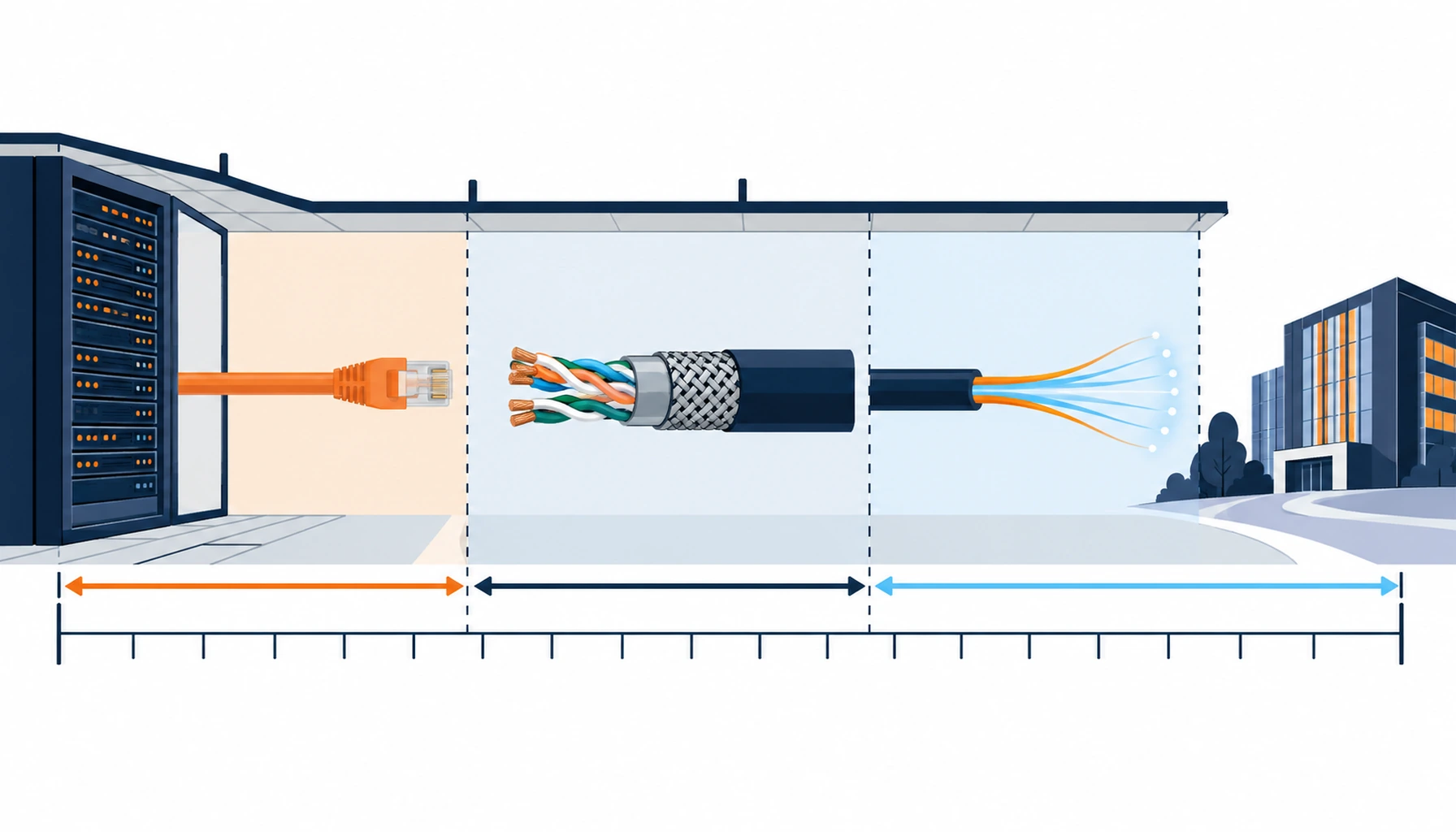
Quick Answer: Cat8 is not a better Cat6A — it is a different tool. Cat6A carries 10G over 100 meters for horizontal runs; Cat8 carries 25/40G over 30 meters for rack-adjacent links.
The cat6a vs cat8 data center question looks like a generation question — newer versus older — and almost every wrong purchase in copper cabling starts there. Cat8 is not Cat6A with better numbers; it is a different design with a different shape: bandwidth raised from 500 MHz to 2000 MHz, but the supported channel shortened from 100 meters to 30, and the construction changed from optional shielding to mandatory full shielding. Those three differences answer the question themselves once the data hall is read as zones rather than as one cable type: the horizontal runs that stretch toward 90 meters belong to Cat6A, and the rack-adjacent links that span a row belong to Cat8 — or, increasingly, to fiber and direct-attach copper that make the comparison moot. The error is deploying one where the geometry of the other applies: Cat8 stretched past its 30 meters silently drops to lower speeds, and Cat6A asked for 25G at distance simply cannot. This guide walks the zones and assigns each its cable.
Introduction
The comparison matters now because AI and storage clusters have pushed server uplink speeds past 10G faster than the horizontal cabling was designed for, and retrofitting is expensive in a live hall. The physics is fixed: Cat6A, standardized at 500 MHz, delivers 10GBASE-T over a full 100-meter channel — the four-connector model that structured cabling was built on. Cat8, standardized at 2000 MHz under TIA and as Class I/II in ISO documents, delivers 25GBASE-T and 40GBASE-T — but only over a 30-meter channel with two connectors, which is why it was conceived for the short-reach zone between a server row and its top-of-rack or middle-of-row switch, not for the building’s horizontal backbone. The demand side keeps rising: as the data center power demand analysis shows, compute density and cabling density rise together, and every added rack multiplies the links that need a home. Reading the two cables as tools for two zones is most of the decision; the zones below walk through it.
Zone One: Horizontal Distribution — Cat6A Territory
Horizontal cabling — from the main distribution area to the zone distribution boxes, and from there toward the rack positions — is defined by distance: 90 meters of permanent link plus patching, the classic 100-meter channel. No copper standard carries 25G at that distance; the choice at 10G is Cat6A, and it remains the workhorse for office floors, interconnect corridors, and any hall where access switches sit more than a rack-row away from the hosts. The Cat6A decision is really a shielding decision — UTP, F/UTP or S/FTP — driven by the electromagnetic environment of the route, alien crosstalk between bundled pairs being the quiet killer at 10G. For the buyer, the specification points are printed on the box: 500 MHz, the appropriate permanent-link test class, and a sheath rating matched to the pathway — and the reading discipline in the datasheet reading guide applies to network cable exactly as it applies to power cable. Where the horizontal run would exceed the 100-meter channel, the answer is not a better copper cable but a different medium — fiber for the long spans, copper for the last stretch.
Zone Two: Rack-Adjacent Links — Where Cat8 Lives
The short-reach zone is the 30 meters or less between a server row and its top-of-rack or end-of-row switch — the densest, most speed-hungry cabling in the hall, and the zone Cat8 was drawn for. Here the trade inverts: the 30-meter ceiling stops mattering because the run is short anyway, and the 2000 MHz of bandwidth becomes 25G or 40G over RJ45-shaped, backward-compatible ports — a migration path that lets 10G hosts step up without replacing the switch fabric wholesale. The construction cost of that bandwidth is real: Cat8 is fully shielded (S/FTP, individually screened pairs), heavier and stiffer than Cat6A, with tighter bend radius management and grounded shield practice at both ends. It also runs warmer per link under PoE loading, and bundle sizes in trays deserve derating attention — the same thermal arithmetic that governs UPS and power sizing in the data hall shows up again in copper bundles. For links shorter than a few meters, direct-attach copper assemblies will usually beat Cat8 on price; Cat8 structured cable earns its keep where field-terminable flexibility and a standards-based channel are wanted across a row or two.
| Zone | Typical Distance | Right Cable |
|---|---|---|
| Server to ToR switch | 1-5 m | DAC/AOC or patch cords — not structured cable |
| Row to row, MoR links | 5-30 m | Cat8 S/FTP — 25/40G short reach |
| Horizontal to zone boxes | 30-90 m | Cat6A — 10G full channel |
| Building backbone, floors | Over 100 m | Fiber — copper geometry exhausted |
| Storage and AI clusters | Rack-adjacent | Cat8 where RJ45 fabric wanted; fiber beyond |
| Office and interconnect | Full channel | Cat6A UTP or shielded per environment |
The Decision Factors Behind the Zones
Four factors move a specific project off the default mapping. Speed roadmap: a hall committed to 25G server uplinks within the switch generation builds Cat8 into the rack-adjacent zone now rather than re-pulling later — recabling a live row costs multiples of the cable. Distance audit: the measured channel lengths decide more than any catalog; many “Cat8 projects” contain runs of 35 meters that quietly negotiate down to 10G, which is why the ladder above starts from distance, and the rack-layout logic in the rack power distribution guide reads the same geometry from the power side. Fabric strategy: where the design goes straight to fiber for anything beyond 10G, Cat8 shrinks to a niche and the budget follows. Shielding and grounding reality: Cat8 without disciplined shield bonding is a 2000 MHz cable performing like a much cheaper one; the hall either commits to that discipline or should stay with unshielded Cat6A where the environment allows. Buyers planning cabling across multi-building sites will find the same zone logic applied to the power layer in the multi-site UPS supplier guide, and the hub that organizes the power layer in the data center power hub.
When Cat8 Everywhere Is Not the Answer
The recurring temptation is future-proofing by uniformity: pulling Cat8 to every outlet so no re-cabling is ever needed. Three costs break the argument. First, the 30-meter ceiling means Cat8 cannot actually serve the horizontal zone, so the “future-proof” run delivers 10G at Cat6A-class performance at a Cat8-class price. Second, the handling penalty is paid on every pull: heavier, stiffer, fully shielded cable in trays built for lighter product, with grounding practice the site must actually maintain. Third, the genuine future of beyond-10G horizontal links is fiber, whose reach and upgrade path copper does not contest — the honest future-proofing strategy pairs Cat6A horizontal with fiber backbone and spends the Cat8 budget only in the short-reach zone where its geometry fits. Uniformity is a procurement convenience, but the zones are an engineering reality — and a cable plan that respects them buys the performance each link actually needs.
| Factor | Cat6A | Cat8 |
|---|---|---|
| Bandwidth | 500 MHz | 2000 MHz |
| Top speed | 10GBASE-T | 25/40GBASE-T |
| Max channel | 100 m, 4 connectors | 30 m, 2 connectors |
| Shielding | UTP to S/FTP by environment | S/FTP mandatory |
| Home zone | Horizontal, office, interconnect | Rack-adjacent, ToR/MoR links |
| Upgrade path | 10G full channel, stable end state | 25/40G short reach, fiber beyond |
RFQ Checklist: Zone Lines for the RFQ
Put the zone logic in writing:
- Channel lengths measured per zone, not assumed
- Speed per link class stated: 10G horizontal, 25/40G short reach
- Cat8 confined to runs of 30 meters or less, two connectors
- Shielding class per environment; grounding practice committed
- Sheath rating matched to pathway and bundle size
- Fiber backbone specified for runs beyond the copper geometry
- Test class named per cable type at acceptance
Conclusion
Cat6A versus Cat8 is not a contest but a division of labor: Cat6A owns the 100-meter horizontal channel at 10G, Cat8 owns the 30-meter rack-adjacent zone at 25/40G, and fiber owns everything the copper geometry cannot reach. Assign each cable to its zone and the cabling plan buys exactly the performance each link needs — once.
Kexingyu Cable Group (KXYE) supplies both ends of the ladder: Cat6A UTP through S/FTP for the horizontal channel, Cat8 S/FTP built to 2000 MHz for the short-reach zone, with datasheets that state what each drum is for — cable specified by zone, not by whatever looks newest.