Cat8 S-FTP Explained: 2000MHz Shielded Cabling for AI Clusters
Quick Answer: Cat8 S-FTP wraps each of four pairs in foil and the whole core in a braid to hold 2000 MHz over 30 meters — the construction that turns 25/40G short-reach links from theory into installed reality.
Cat8 S-FTP cable is the physical answer to a physics problem: how to push 2000 MHz down four copper pairs without the cable talking to itself or to the tray beside it. The name decodes the answer — each pair individually screened in foil, the whole core wrapped in an overall braid, every conductor 23 or 24 AWG copper sized for the insertion loss budget. That construction is why Cat8 delivers 25GBASE-T and 40GBASE-T over a 30-meter channel while carrying the same RJ45 interface the building already knows, and why AI clusters — where hundreds of short, hot, bandwidth-hungry links share trays a few centimeters apart — are its native habitat. But the construction is only as real as the datasheet behind it, and the Cat8 market contains drums labeled Cat8 whose geometry would not pass a Class I test. This guide explains what the S-FTP build does, what the parameter table must show, and how to tell a genuine 2000 MHz drum from a rebranded Cat6A.
Introduction
The demand side explains the construction. AI and high-performance clusters concentrate compute so densely that the leaf switch sits within a few meters of the servers it feeds, and each generation of accelerators raises the fabric speed the copper must carry. At 2000 MHz — four times Cat6A’s spectrum — the enemies are predictable: insertion loss climbs with frequency, crosstalk between pairs and between neighboring cables grows worse as signals get smaller, and return loss punishes every geometry inconsistency in the pair. The S-FTP construction attacks all three: the foil around each pair contains the pair-to-pair coupling inside the cable, the overall braid blocks alien crosstalk from adjacent cables and external interference, and the heavier conductor keeps attenuation inside the budget. The economics track the compute: as the data center demand analysis shows, cluster buildouts are multiplying, and each one buys its short-reach copper by the kilometer. Understanding the construction is therefore not academic — it is how a buyer reads the drum label and knows whether the 2000 MHz claim will survive a field tester.
The Construction, Layer by Layer
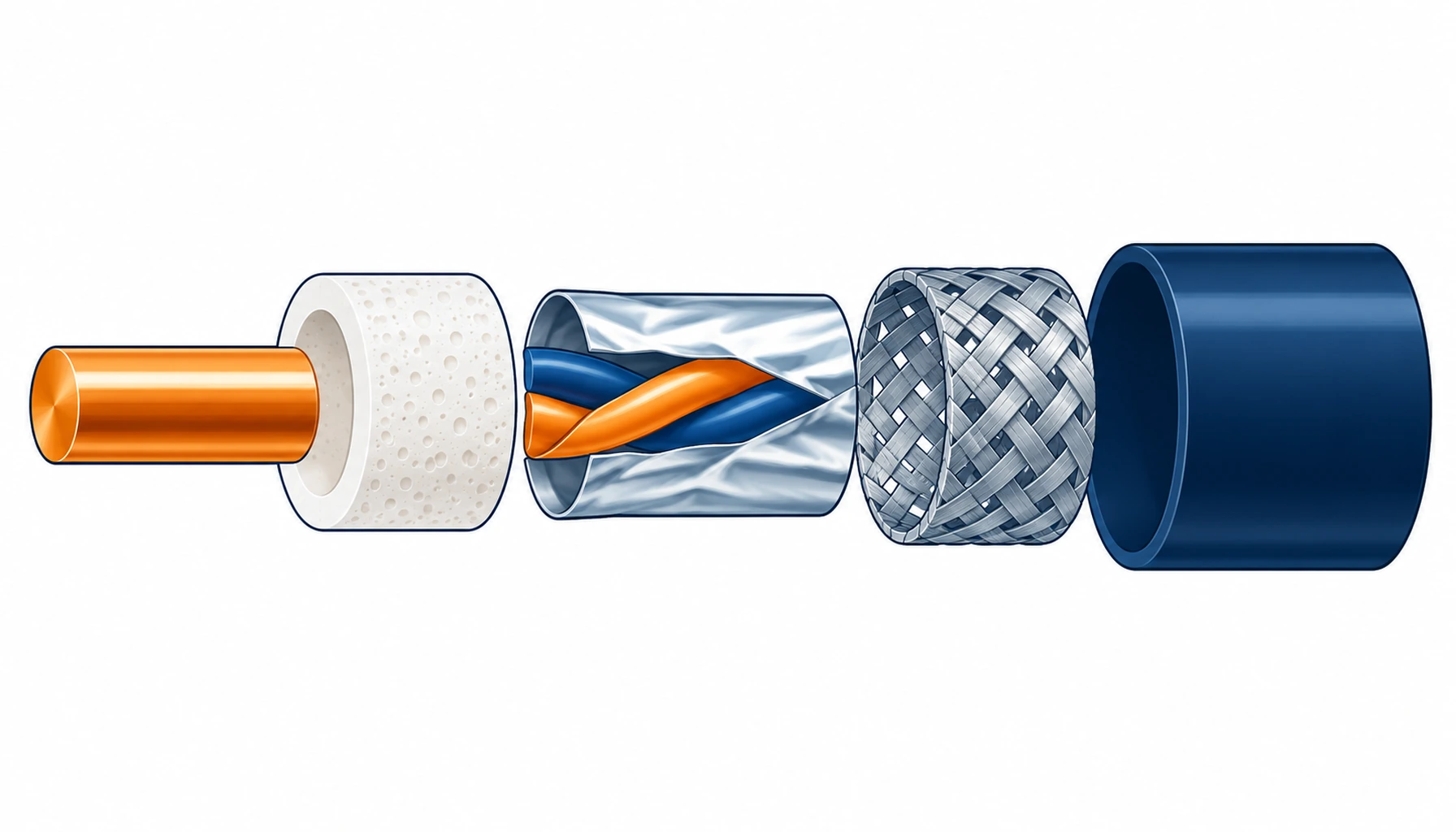
Read a genuine Cat8 S-FTP cable from the inside out. Conductors: solid bare copper, 22-24 AWG depending on the grade — the thicker 23 AWG buys margin on insertion loss, the 24 AWG saves cost and flexibility where the channel is short; the conductor classes mirror the sizing logic buyers know from the datasheet reading guide, where the first line is always the metal. Insulation: foam-skin polyethylene or equivalent, chosen for its low dielectric loss at high frequency — a place where compound choice shows up directly in the parameter table. Pair screening: aluminum foil wrapped around each twisted pair, foil side out, the screen continuous for the whole run; this is the “S” for screened pairs and the first defense against internal crosstalk. Overall braid: tinned copper braid over the four screened pairs — the “FTP” overall shield and the barrier against alien crosstalk from neighboring cables. Sheath: PVC or LSZH per environment, with the rip cord and drain wire that terminate properly. Skip any one of these layers, and the frequency rating on the box stops being a specification and becomes just a label.
The Parameter Table: What 2000 MHz Must Show
A real Cat8 datasheet states its numbers per frequency, not as a single headline. The rows that matter: insertion loss in dB per 100 meters at reference frequencies up to 2000 MHz — the attenuation budget the 30-meter channel lives inside; NEXT and PS NEXT — near-end crosstalk per pair and power-sum across all four, the numbers the pair foil exists to protect; return loss — the echo of geometry problems, worst where twists transition or the screen laps; alien crosstalk margin, which the braid underwrites; and propagation delay and delay skew, which four-pair transmission needs balanced. Conductor grade, screen construction and sheath compound are stated per part number, so a 23 AWG drum and a 24 AWG drum of the same brand are ordered as different articles, not discovered as such. Verification closes the loop: a permanent-link field test to the Cat8/Class I limits on the delivered drums — sample per batch — is the acceptance step that turns the parameter table into evidence, and the certification discipline behind it is the same one documented in the power cable certifications checklist.
| Layer | What It Does | Failure If Missing or Fake |
|---|---|---|
| Conductor | 23/24 AWG solid copper carries the loss budget | CCA or thin copper fails insertion loss at 2000 MHz |
| Insulation | Low-loss foam PE keeps dielectric loss down | Generic compound inflates attenuation |
| Pair foil screens | Contain pair-to-pair NEXT inside the cable | NEXT collapses; 25/40G will not train |
| Overall braid | Blocks alien crosstalk and external EMI | Tray-adjacent links corrupt at speed |
| Drain and termination | Bond shields to ground at both ends | Unbonded shields radiate and couple noise |
| Sheath | PVC or LSZH per pathway environment | Wrong rating fails the hall's fire code |
23 AWG or 24 AWG: Choosing the Grade
The conductor grade is the practical ordering decision, and it maps to channel and thermal reality. The 23 AWG grade carries lower insertion loss per meter, buying margin for channels that approach the 30-meter limit, for higher ambient temperatures in packed aisles, and for PoE loads that heat bundles; it is the default for AI cluster rows where every meter of margin counts. The 24 AWG grade trims cost and stiffness for the shortest links — a few meters between row and switch — where the loss budget is slack and handling matters more. Neither grade forgives a channel that exceeds 30 meters; both assume the shielding discipline of bonded screens at both ends. Bundle arithmetic closes the decision: dense trays of shielded cable under PoE run warmer, and the derating logic that sizes power distribution per rack in the rack power distribution comparison applies to the copper bundles sharing the same pathway. Certifications complete the picture: UL, ETL and CE marks per market — the verification chain described in the China equipment certification checklist applies to network cable exports exactly as to power products.
When Cheaper Cat8 Is Not the Answer
The Cat8 market’s quiet hazard is construction substitution: drums labeled 2000 MHz built with thinner copper, foamed-PVC in place of engineered insulation, foil only where the spec wants foil and braid, or braids of aluminum where tinned copper is specified. Each substitution passes a casual look and fails a field tester at 2000 MHz — and it fails after installation, when the labor is spent. The countermeasures are unglamorous and effective: conductor verified as solid bare copper, not copper-clad aluminum (a scrape test and an ohmmeter settle it), parameter tables stated per frequency and per part number, sample permanent-link tests on the delivered batch, and a supplier whose batch files survive an audit. In a hall where a single fabric tier outage costs more than the whole cabling line item, the saving from a substituted construction ends up among the most expensive money in the project.
| Parameter | What It Tells You | Red Flag |
|---|---|---|
| Insertion loss | Attenuation per 100 m up to 2000 MHz | Only a single-frequency figure stated |
| NEXT / PS NEXT | Pair-to-pair isolation, power-summed | Missing at high reference frequencies |
| Return loss | Geometry consistency across the pair | Worse than class limit anywhere |
| Conductor | 23 or 24 AWG solid bare copper | "Copper" unqualified; CCA suspicion |
| Screen build | Foil per pair plus overall braid | Foil-only construction sold as S-FTP |
| Certification | UL, ETL, CE per market | Self-declared class, no listed mark |
RFQ Checklist: Cat8 Lines for the RFQ
Put the construction in writing:
- S-FTP construction explicit: foil per pair plus overall braid
- Conductor grade per part number: 23 or 24 AWG solid copper
- Parameter tables per frequency to 2000 MHz, per reel
- Sheath compound per pathway: PVC or LSZH named
- Certification marks listed per destination market
- Sample permanent-link test to Class I limits on delivery
- Batch files and drum markings retained for acceptance
Conclusion
Cat8 S-FTP is a layered construction doing a layered job: solid copper conductors sized for the loss budget, screened pairs containing their own crosstalk, an overall braid holding the tray’s noise out, and a parameter table that proves all of it per frequency to 2000 MHz. Specified and verified layer by layer, it carries 25/40G across the AI cluster’s short-reach zone with the RJ45 simplicity the hall already operates.
Kexingyu Cable Group (KXYE) builds Cat8 S-FTP to the full construction: 23/24 AWG solid bare copper grades, foil-screened pairs under a tinned copper braid, parameter tables stated per frequency, and UL/ETL/CE certification per market — shielded cabling whose datasheet and drum say the same thing.