Collaborative Robot Cabling: Compact, Safe and Human-Adjacent
Quick Answer: A cobot hides its cables inside slim, smooth arms and works beside people — so its cabling must fit tight radii and compact joints, keep the exterior clean, and behave predictably in a safety-rated system.
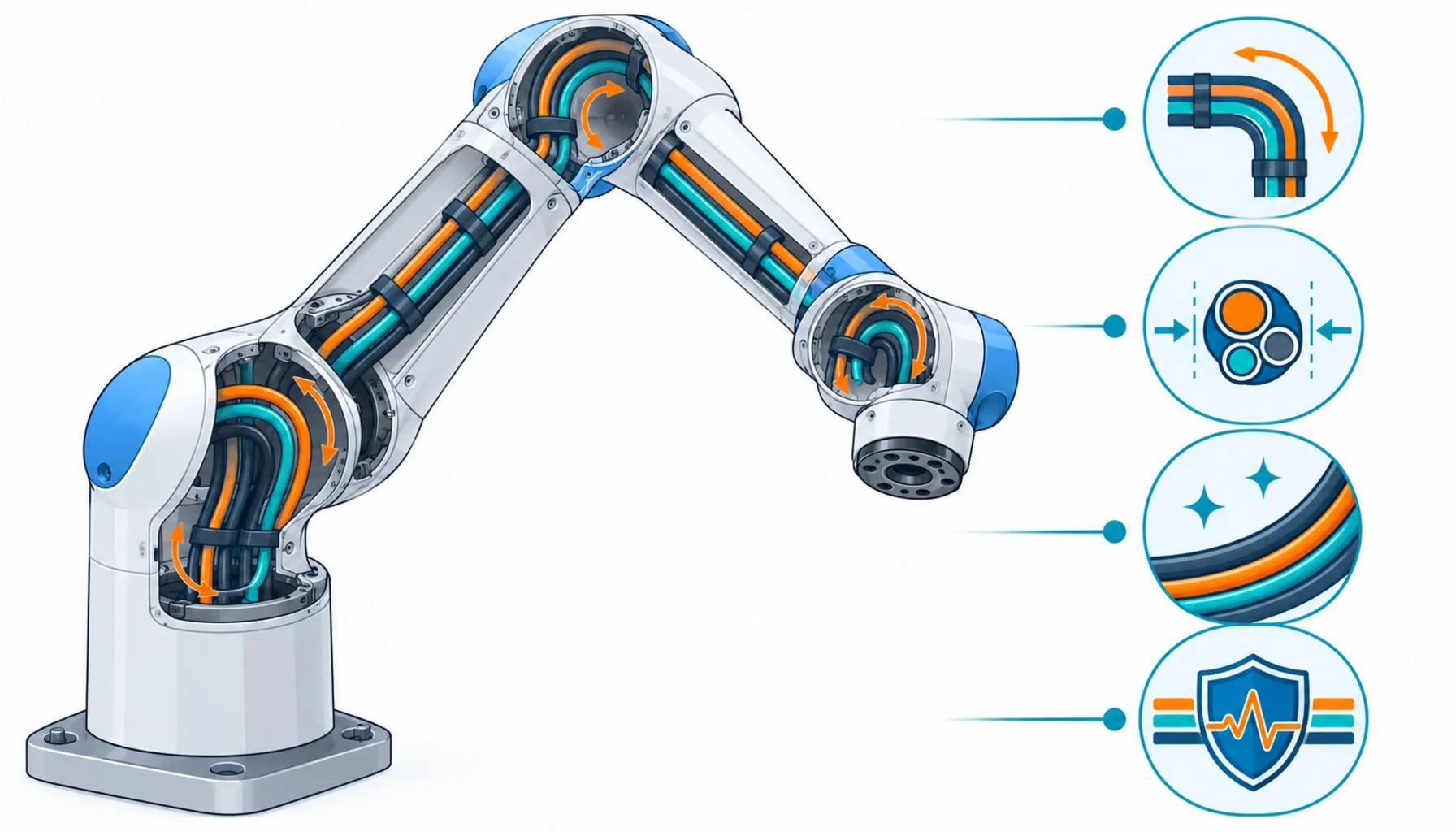
Collaborative robots changed the geometry of automation, and cabling felt it first. Where a six-axis industrial robot wears its dress pack outside like a backpack, a cobot hides everything inside a smooth arm that looks, from the outside, like it has no cables at all. Where an industrial robot works behind a fence, a cobot works at arm’s reach from a person, which means its entire design — including its wiring — sits inside a safety case that must be argued, tested and documented. And where an industrial robot’s joints have generous cavities, a cobot’s joints are compact by definition, folding their internal harness through radii that ordinary robot cable refuses. The result is a distinct cabling discipline: smaller, neater, more integrated, and more demanding per millimeter than the industrial robot harness it superficially resembles. This guide covers what collaborative robot cabling actually demands — geometry, joint routing, exterior rules, signal quality and the safety context — and how to specify it without the assumptions that leak over from industrial practice.
Introduction
Cobots earn their classification from the risk assessment, not the appearance: force and speed limits, safety-rated monitoring, and a design philosophy that assumes human proximity. For the wiring, that philosophy translates into three structural facts. First, the harness lives inside the arm — every joint routes a bundle through a compact cavity, and the cable has no option but to fit. Second, the exterior must stay smooth: exposed sleeves, zip ties and cable glands change the robot’s contact geometry and snag risk, which matters when people share the workspace. Third, the electrical system carries the safety layer — safety-rated monitored stop circuits, speed monitoring signals, force sensing — alongside the ordinary power and encoder circuits, and those safety signals are the least tolerant wiring in the arm.
The motion physics do not soften for cobots. The joints flex the internal harness through millions of cycles like any robot, and the failure habits documented in the common causes of cable failure apply fully — they just happen in a smaller, less accessible space, where a harness replacement means opening joints rather than re-dressing an external pack.
Geometry: The Binding Constraint
In industrial robot cabling, the environment is often the binding constraint — spatter, coolant, dust. In cobots, geometry is. The arm is slim by design intent; the joint cavities are the smallest volume the engineers could defend; and the internal harness must thread all of it while flexing through every axis motion. Three consequences follow for cable selection. Bend radius requirements are tighter than industrial practice — the joint routing often demands radii well below what standard robot cable tolerates, which is why ultra-fine, high-flex constructions with compact profiles dominate this segment. Cable diameter itself is a specification: a harness that is two millimeters too fat for the joint channel does not fail in service, it fails at assembly, and the redesign cost lands on whoever specified it. And the routing path needs engineered relief — service loops at the joints, strain relief sized for the axis motion — because a harness that is merely short enough will transmit joint loads straight into its terminations.
The practical discipline is to treat the internal routing as a designed system: obtain the joint channel dimensions and motion ranges from the robot builder, calculate the flex duty at each joint, and select cable diameter and construction against both. This is the same geometry-first thinking that drag chain work demands, compressed into a smaller envelope, and the sizing starts with honest dimension data the same way conductor sizing starts with honest load data.
| Challenge | Why Cobots Are Different | Cable Specification Response |
|---|---|---|
| Tight joint radii | Compact joint cavities flex the harness harder than industrial arms | Ultra-fine stranding, high-flex constructions, verified small-radius ratings |
| Diameter limits | Joint channels are sized to the millimeter; no room for oversizing | Compact cable profiles; diameter stated and verified before ordering |
| Smooth exterior requirement | Human-adjacent workspace: snag points and contact geometry matter | Internal routing; no external sleeves, ties or protruding glands on the arm |
| Safety-critical signals | Speed, force and stop monitoring ride the same internal loom | Shielded, segregated safety circuits with disciplined grounding |
| Application add-ons | Grippers, cameras and tools hang off a compact wrist interface | Tool-side harnesses matched to wrist motion and payload power |
The Safety Context: Wiring Inside a Certified System
A cobot’s collaborative credentials rest on its safety functions, and those functions are electrical: monitored speed, force or torque limits, safety-rated stops, sometimes skin or proximity sensing. The wiring that carries those signals is not ordinary signal wiring — it is part of a safety function whose failure modes are analyzed in the robot’s risk assessment, and the documentation and segregation expectations follow accordingly. Practical rules for anyone extending a cobot with tooling or external axes: safety circuits stay shielded and segregated from power, their grounding follows the same one-point discipline described for control and instrumentation circuits, and modifications to the safety wiring void the collaborative classification until the risk assessment is revisited. The certification dimension matters at integration time too — the cobot system’s compliance case consumes the same kind of documentation discipline outlined in the certification checklist process, with the wiring in the evidence trail.
The human-adjacent context also shapes the mechanical rules. A cable tie protruding from a cobot arm is a snag point at human height; a rough gland edge is a laceration risk in a workspace people touch. The smooth-exterior requirement is a safety requirement wearing a tidiness costume, which is why cobot builders enforce it even when a quick external sleeve would solve a routing problem cheaply.
Tooling and the Wrist Interface
Most cobot applications live or die at the wrist: grippers, vacuum arrays, small cameras, force sensors. The tool-side harness is therefore a design element, not an accessory. It must match the wrist’s motion — the last two joints flex it constantly — and its power and signal content must suit the payload interface rather than the nearest convenient connector. Vision-guided picking, the most common cobot application after simple handling, adds the signal-integrity requirements of moving camera cable into a compact bundle; the physics are the same as any moving vision cable, covered in the dedicated guide, but the cobot’s small envelope leaves less room for the generous service loops that make signal cabling forgiving. Where the tool harness crosses from the moving wrist to the fixed world — through a dress pack, a chain or a raceway on the cell frame — the motion rules of whichever delivery system applies take over, and the compact cobot cable meets the larger application’s environment. Specifying that junction honestly, rather than assuming the cobot’s gentle industrial setting extends to the whole cell, is where most integration cabling succeeds or fails.
| Check | What to Pin Down | Why It Decides the Outcome |
|---|---|---|
| Joint geometry | Channel dimensions, flex radii and motion ranges per joint | Diameter and radius ratings are binding constraints, not preferences |
| Flex duty | Cycles per day per joint over the robot's service life | Internal harness replacement means opening joints — plan for life |
| Safety circuits | Which monitored signals ride the loom, with segregation and grounding | Safety functions are only as reliable as their wiring |
| Exterior rules | No protruding glands, sleeves or ties on the arm surface | Human-adjacent contact geometry is a safety requirement |
| Tool interface | Wrist harness content: power, signals, data — with wrist motion matched | The wrist is where most cobot cabling actually fails |
| Documentation | Flex test data at cobot radii, traceability, change control | The compliance case consumes the paper like the robot consumes cycles |
When Cobot Cabling Rules Are Not the Answer
Honesty about scope keeps this guide useful. The rules here address cable that lives inside and immediately around collaborative robot arms. They do not cover the applications cobots are put to: a cobot tending a machine inherits that machine’s coolant and chip environment at the wrist; a cobot in a lab inherits cleanroom-style documentation expectations; a cobot on an electronics line inherits ESD discipline. Application environment always outranks robot class when the two disagree. They also do not cover the cell’s fixed electrical installation, which remains governed by building codes and the engineer of record. And for industrial robots behind fences, the standard robot cabling practice — external dress packs, larger radii, industrial jackets — is usually the better fit. Match the cabling to the application and the risk assessment, not to the robot’s brochure.
RFQ Checklist: What to Send the Cable Supplier
Put the arm’s reality in writing before quotes come back:
- Robot model and joint data: channel dimensions, flex radii, motion ranges, cycles per day
- Cable diameter limits per section, stated in millimeters
- Safety circuit inventory: which monitored signals ride the internal loom
- Exterior constraints: what may and may not appear on the arm surface
- Tooling: wrist harness content and the motion it must survive
- Application environment beyond the arm: coolant, ESD, cleanroom or hygiene requirements
- Proof: flex test data at the actual radii, batch traceability, documentation for the compliance case
Conclusion
Collaborative robots shrink the cabling problem rather than simplifying it: tighter radii, millimeter-bound diameters, a smooth exterior that is actually a safety requirement, and safety-critical signals sharing the smallest loom in robotics. Specified against real joint geometry and real flex duty, cobot cabling disappears into the arm and stays there for the robot’s life. Specified by catalog analogy, it becomes a joint-opening repair waiting for month nine.
Kexingyu Cable Group (KXYE) supplies compact high-flex cable constructions for collaborative robotics and supports builders with geometry-based selection, shielded safety circuit design and batch traceability. Describe your arm and its application through the RFQ page, and we will respond with constructions sized to the joint channels, not the catalog.