7 Cable Specification Mistakes in Data Center Projects
Quick Answer: The costliest cable specification mistakes are systematic: sizing to nameplate, ignoring grouping derating, skipping separation, inconsistent fire specs and deferring documentation — every one preventable on one page. Cable rarely fails at the electrical theory. It fails at the specification shortcuts taken months before installation: the derating that got skipped, the fire class copied from the wrong project, the termination hardware nobody bothered to schedule. All of those decisions live on one or two pages of the specification. That is where this article stays.
Introduction
Data center cable specs usually get written under time pressure, copied from a predecessor project, and reviewed by people whose attention is on the switchgear and the UPS. So the big equipment gets engineered and the cable just gets bought. The difference shows up years later as a hot spot on a thermography scan, or a feeder nobody can trace in the as-built. Seven mistakes cause most of this trouble, and each is cheap to prevent and expensive to find in service.
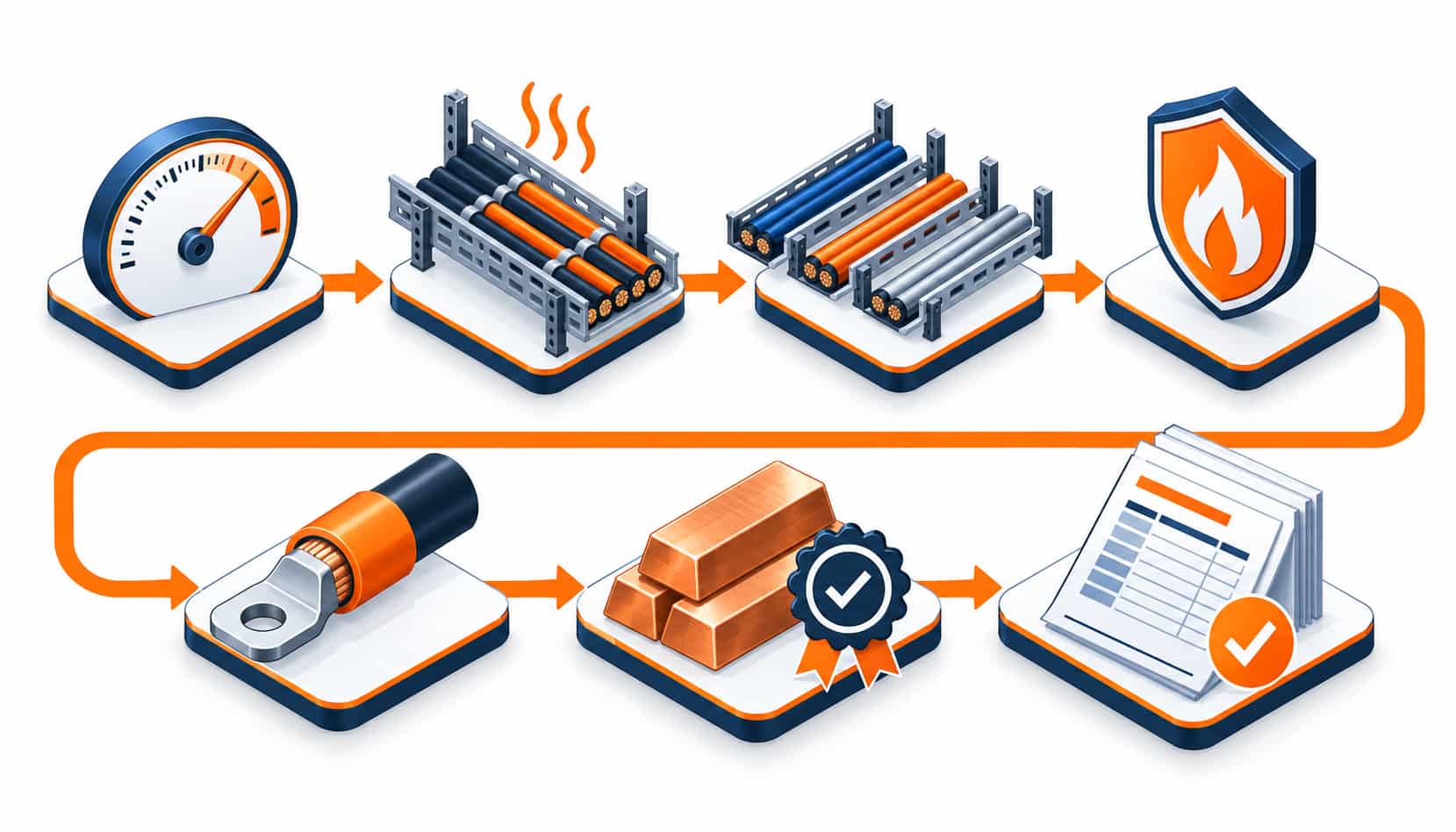
| Mistake | Typical Symptom | The Fix |
|---|---|---|
| 1. Sizing to nameplate | Warm feeders after first load growth | Size to measured load plus stated growth |
| 2. Ignoring grouping derating | Hot spots on densely packed trays | Honest grouping factors per tray section |
| 3. No separation planning | MV, LV and data tangled in one route | Separation scheme fixed in the spec |
| 4. Inconsistent fire spec | Wrong cable family in occupied zones | Fire performance mapped per area |
| 5. Weak termination detail | Joint failures, wrong glands at handover | Schedule accessories with the cable |
| 6. Copper-price-only buying | Thin conductor, unverifiable metal | Price linkage plus batch certificates |
| 7. Documentation last | As-built myths at commissioning | Records due with each delivery |
Mistake 1: Sizing to Nameplate Instead of Measured Load
A nameplate describes the first day, not the fifth year. A UPS sized to its nameplate input ignores battery recharge peaks, efficiency curves at part load, and the modest but relentless growth every data center sees. The feeder that carries exactly nameplate current at commissioning becomes the constraint of the whole power train the first time load creeps up. So size the cable to measured or calculated load, including recharge contribution and a stated growth allowance. The sizing arithmetic, voltage drop and margin logic are worked through in our cable size selection guide.
Mistake 2: Ignoring Grouping and Ambient Derating
Data center trays are dense by design, and density is a thermal decision. A feeder rated 400 A in free air is not 400 A in a bundled group on a warm tray. The correction factors are not negotiable; they are the difference between a design and a fire investigation. Usually the mistake enters through copied tables — factors taken from a different ambient, or ignored entirely because “the tray is ventilated.” Specify per tray section: grouping factor, ambient, installation method, and the resulting derated ampacity shown next to the circuit load. Put the arithmetic in the document instead of leaving it to optimism.
Mistake 3: Skipping Separation Between Cable Types
Medium-voltage feeders, low-voltage distribution, control pairs and structured data cabling all want the same real estate, and without a separation scheme they get it — to the data cabling’s permanent regret. Standards and physics both argue for defined distances, barriers or segregated containment: induced noise, fault energy, maintenance access. Fix the scheme in the specification before the trays are ordered, not when the first interference ticket arrives. The failure modes that poor separation accelerates — insulation stress, induced heating, early aging — are catalogued in our guide to common causes of cable failure.
Mistake 4: Inconsistent Fire Performance Specification
Copied specs often confuse two different properties: flame retardancy, where the cable stops burning, and fire resistance, where the cable keeps working during a fire. Data centers need the first everywhere and the second on defined life-safety and critical circuits. Get them mixed up and you end up putting expensive fire-resistant cable in storerooms while a life-safety feeder burns through in minutes. Insulation families get swapped casually too. The trade-offs between XLPE and PVC, including fire behavior, are compared in our XLPE versus PVC guide, and the LSZH decision boundary is set out in LSZH versus fire-retardant cable. Map fire performance per area — hall, electrical room, plenum, occupied zone — and state the standard and class for each.
Mistake 5: Under-Specifying Terminations and Accessories
The cable arrives; the failure surface is at its ends. Glands that don’t match the gland plate, lugs that don’t match the breaker terminals, heat-shrink kits left “by others,” tracer wire unspecified on armored runs — each is a small gap in the spec that turns into a site-day delay or a joint failure later on. Accessories are engineered items, not hardware-store line items, and the scheduling discipline is laid out in our cable accessories checklist. Specify glands, lugs, kits and clearances with the cable, matched to the actual equipment they land on.
Mistake 6: Buying on Copper Price Alone
Copper is most of a power cable’s cost, so a bid that undercuts the market by a visible margin has found the money somewhere. Maybe the conductor sits at the tolerance floor. Maybe it’s copper-clad aluminum where nobody is checking, or batch weights that quietly shrink. The defense is procedural, not hopeful: require batch copper certificates and weight-per-kilometer verification, and stabilize the commercial side with copper price linkage so neither party is speculating on the metal. Supplier-side verification depth is covered in our power cable manufacturer checklist. A price that looks too good usually is.
Mistake 7: Leaving Documentation Until Commissioning
As-builts reconstructed at handover are fiction with a title page. Route deviations, field substitutions and length corrections only survive if somebody records them when they happen. So treat documentation as a delivery condition: each batch ships with test reports keyed to circuit IDs, each installed route gets its label and record that week, and the as-built closes the project because it was never open. The procurement-side timing that keeps cable documents synchronized with the master schedule is discussed in cable sourcing delays and EPC timelines.
| Check Item | Requirement | Why It Matters |
|---|---|---|
| Load basis stated | Measured load + recharge + growth, per circuit | Nameplate is day one; the spec is for year ten |
| Derating visible | Grouping, ambient, method shown per tray section | Hidden derating is invented derating |
| Separation scheme fixed | Distances, barriers, containment per cable family | Trays are ordered once; the scheme must precede |
| Fire map per area | Retardant vs resistant, class and standard per zone | Copied fire specs protect the wrong circuits |
| Accessories scheduled | Glands, lugs, kits matched to landing equipment | The ends fail first if left unspecified |
| Metal verification | Batch certs, weights, price linkage in the contract | Price alone tells you nothing about copper |
When Value Engineering Is Not the Answer
Every one of these mistakes has a value-engineering origin story. The derating was “conservative enough,” the fire-resistant class got substituted, the certificates were traded for a discount. Yet cable is roughly a mid-single-digit share of a data center’s capital cost while participating in one hundred percent of its uptime — which makes the tray the worst place in the project to learn that a saved percentage was really a deferred outage. If value engineering must touch the cable scope, point it at logistics and delivery phasing. Never at the conductor, the derating or the fire class.
RFQ Checklist: A Specification That Survives Procurement
Make the seven fixes enforceable by writing them into the RFQ. Include:
- Load basis per circuit: measured load, recharge contribution, stated growth
- Derating table per tray section: grouping, ambient, method, result
- Separation scheme with distances, barriers and containment per family
- Fire-performance map: class and standard per area, retardant vs resistant
- Accessory schedule matched to the equipment each end lands on
- Batch copper certificates and weight-per-kilometer verification rights
- Copper price linkage clause across the delivery calendar
- Test reports per batch, keyed to circuit IDs, due with each delivery
- Route labeling and as-built update obligations stated as delivery conditions
- Measured routed lengths — not floor-plan estimates — as the quantity basis
Conclusion
The seven mistakes share one property: they are all decided on paper, months before anyone touches a tray. That is also what makes them cheap to fix. One disciplined page of specification, reviewed once with fresh eyes, prevents all seven.
Kexingyu Cable Group (KXYE) reviews customer specifications against these failure modes before quoting, supplies batch certificates and verified copper content with every delivery, and holds copper price linkage across the project calendar — so the specification that leaves your office is the one that arrives on site.