Specifying 800V DC Busway for AI Racks: Ratings, Verification and Lead Times
Quick Answer: An 800V DC busway carries the same copper as an AC busway of the same rating but very different electrical conditions — no current zero crossing, so an arc does not extinguish on its own, and clearances and creepage distances that follow from that. Buy it on declared short-circuit withstand and measured temperature rise, not on a general product certificate.
Busway is the part of an 800V hall that gets ordered first and questioned last. It is a passive component, it looks like the AC busway everyone has installed for twenty years, and it is routinely treated as a commodity. That is exactly why it turns up in commissioning arguments: the items that decide whether a DC busway run is safe are not visible on a photograph or a price list.
Introduction
In a conventional data hall the busway is an AC product with a long history, well-defined short-circuit ratings, standard tap-off boxes and a mature accessory range. That is the subject of our comparison of busway versus power cable, and for an AC hall the buying process is settled.
A DC busway at 800V inherits the mechanical form of that product and almost none of its electrical history. Direct current has no natural zero crossing, so an arc drawn at a tap or a joint does not self-extinguish at the end of a half cycle — it has to be forced out by the device design. Insulation coordination is different. Monitoring is different, because an unearthed DC system fails silently. And because the product category is young, the evidence a supplier can actually produce is thinner than the paperwork from an AC line. Buying DC busway is therefore a specification exercise, not a catalogue selection. Where the busway sits in the wider migration is set out in our note on 800V DC data center power.
The Three Ways to Distribute Power Along a Rack Row
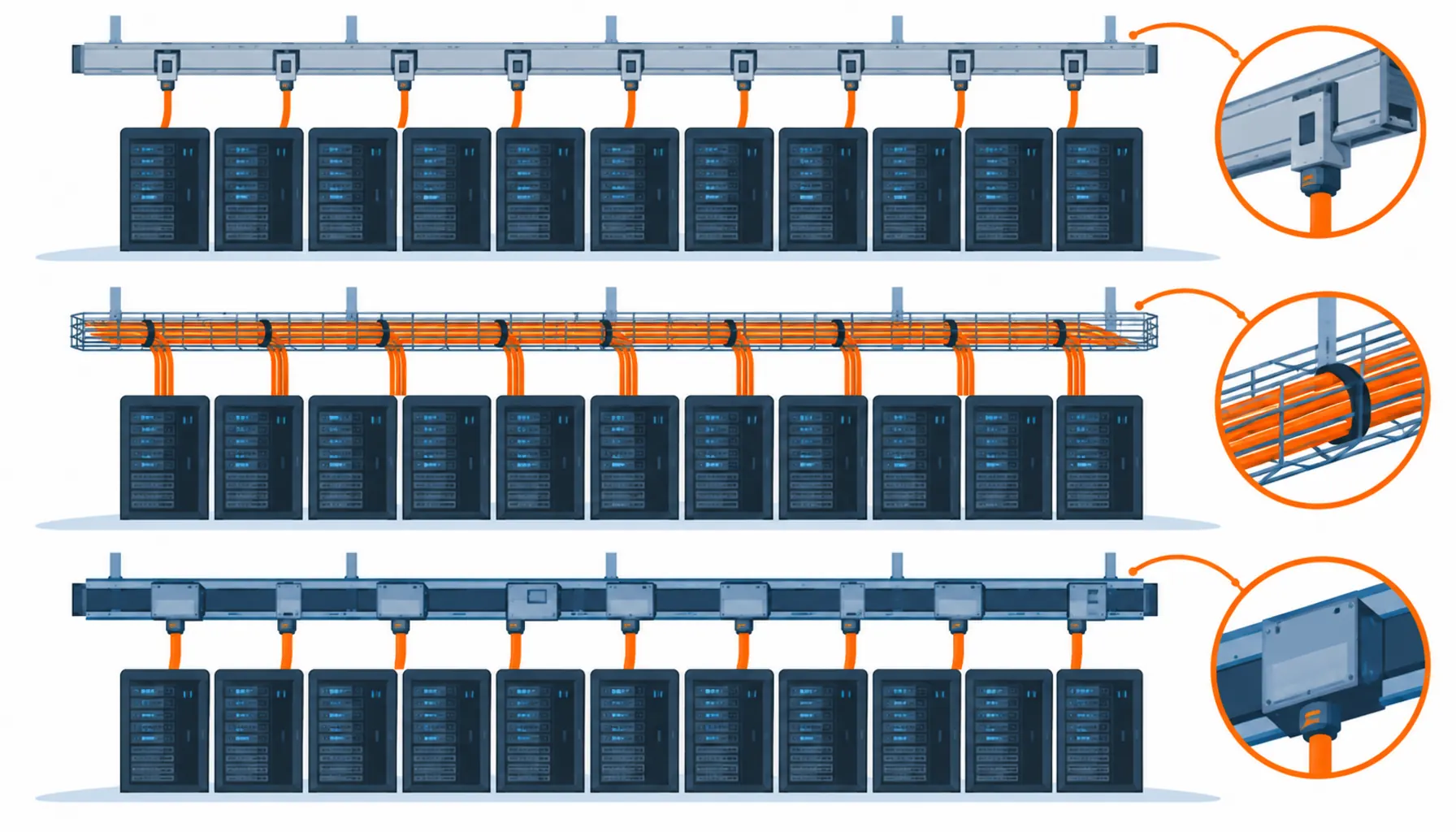
The busway decision is rarely taken in isolation. It sits inside a wider choice about how power reaches the rack, and the comparison below is the one that belongs in the budget discussion, because the three routes differ more in verification burden than in list price.
| Option | What You Must Declare | Evidence That Actually Matters | Cost and Lead Time | Risk If It Goes Wrong |
|---|---|---|---|---|
| DC busway | DC voltage class, short-circuit withstand per tap, IP rating, ambient and grouping | Temperature rise at rated current on the actual assembly, plus withstand test basis | Six to ten weeks typical, but only from a short list of DC-capable suppliers | An unverifiable withstand figure that only surfaces as a commissioning dispute |
| Cable and tray | Conductor size, insulation class, derating for fill and grouping, support spacing | Routine test data, conductor resistance, batch traceability | Three to six weeks, many suppliers, lowest entry price | Copper volume and installation labour rise quickly as density climbs |
| AC busway retrofit | Whether the existing product is genuinely rated for DC, not just for the voltage | Documented DC rating with the test basis, not an AC certificate | Fastest if stock exists, but rarely genuinely adaptable | An AC-rated device used in DC service — the arc does not clear and the failure is not graceful |
What Actually Changes at 800V DC
The mechanical engineering of a busway run does not change much. The cross-section for a given current is broadly the same as AC at the same RMS value, the support spacing is set by the same short-circuit forces, and the tap-off principle is unchanged. What changes is everything to do with how the run behaves when something goes wrong.
The first change is arc behaviour. On an AC system the current passes through zero twice per cycle, which gives a breaker or a contactor a natural opportunity to extinguish an arc. Direct current does not offer that, so a DC-rated device has to stretch and cool the arc deliberately. That is a device-design problem, and it is why a busway and its tap-off units cannot simply be relabelled — the tap-off device is where the DC rating has to be real.
The second change is insulation coordination. An earthed AC system and an unearthed DC system stress insulation differently, and creepage and clearance distances follow from the rated voltage and the pollution degree rather than from habit. When the distribution layer is rated for 800V but energized at a lower voltage, those distances are set by the rated figure — which is the whole point of rating high and energizing low.
The third change is that faults hide. An unearthed DC system can sustain a single ground fault without tripping, which is deliberate and useful, but it means the fault is only discovered by insulation monitoring rather than by a breaker operation. If the specification does not name the monitoring scheme and the alarm thresholds, the busway is being bought without the instrument that makes it observable.
Why the Breaker Order Comes Before the Busway Order
This is the sequencing error that shows up most often on high-density fit-outs. DC-rated protective devices at these currents come from a much smaller supplier base than busway, and their lead times run past the busway rather than alongside it. Placing the busway order first because it is the bigger line item leaves the breaker as the last arrival on site, and the run cannot be energized without it.
The practical rule is to short-list the DC protection first, confirm the DC rating in writing, and only then release the busway order with the tap-off current ratings matched to the devices that are actually coming. A busway ordered against a nominal current with no declared fault level will come back with a withstand figure nobody can verify, and a tap-off box selected before the breaker is a guess about the device that will sit inside it.
The tap-off hardware itself is a conventional product — our busbar tap-off box range is a standard example of the category. What is not conventional is the DC rating evidence behind it, which is the thing to request in writing.
What to Freeze in the DC Busway Specification
Because the category is young, the specification carries more weight than it would on an AC project. Each item below is something a supplier can quietly leave to a default unless it is written down.
| Specification Item | What to State | Evidence to Demand | Cost of Leaving It Open |
|---|---|---|---|
| Voltage class versus operating voltage | Rated for the destination voltage, energized at the phase one voltage | Type test at the rated class, not the operating class | The run has to be replaced when the voltage rises |
| Short-circuit withstand per tap | Declared withstand at every tap-off point, not just at the head of the run | Test basis and the coordination study it came from | Unverifiable figures and a dispute at energization |
| Temperature rise at rated current | Measured on the actual assembly, at the hall ambient, at the installed grouping | Test report naming the assembly and the current | Derating assumptions that do not survive contact with the installed layout |
| Tap-off device DC rating | The device type, its DC rating and its fault behaviour | Device type test for DC service, not an AC equivalent | A tap that cannot clear a DC arc when it is asked to |
| Insulation monitoring | Monitoring philosophy, device type, alarm thresholds, response procedure | Scheme drawing and device data | A ground fault that stays invisible until it becomes a trip |
| Ingress protection and environment | IP rating against the actual hall conditions, including liquid-cooling proximity | Test certification for the stated IP class | Condensation or coolant mist finding its way into a live run |
| Route, support and fire-stop | Support spacing, expansion provision, penetration fire-stop detail | Structural and fire-stop certification | Supports designed for the wrong short-circuit forces |
When a DC Busway Is Not the Right Purchase
Busway wins in dense, repeatable, high-current runs. It loses where those conditions are not present, and the three cases below should stop the enquiry before it starts.
Low or uncertain density. Where the rack power is moderate or the fit-out plan is still moving, cable and tray is cheaper, more forgiving of change, and available on shorter lead times from many suppliers. Cable also lets you re-route a row without the same level of re-engineering, which matters on a hall whose density profile is genuinely unknown. The derating arithmetic that governs cable in these layouts is covered in our note on cable derating factors.
A retrofit onto an AC busway inventory. Existing AC busway is not a DC product, however similar it looks and however convenient it would be to reuse. The rating has to be documented for DC service with the test basis attached, and in most cases it is not. Accepting an AC certificate as a substitute is how a hall ends up with a distribution layer whose arc behaviour was never qualified.
No monitoring capability on site. An unearthed DC run that nobody monitors is a run that fails without warning. If the facility cannot staff insulation monitoring and act on its alarms, the safer purchase is a distribution approach whose failure modes are visible. The wider rack-level picture is in our overview of high density rack cabling.
The common thread is that a DC busway is not a commodity upgrade of an AC busway. It is a new product class with a shorter evidence trail, and it should be bought on declared ratings and measured performance rather than on the shape and the price of the equivalent AC item.
RFQ Checklist for an 800V DC Busway Package
Send the electrical consequences and the installation conditions, not just the amperage. Each enquiry should carry:
- Rack power per row and per hall, with the density profile across fit-out phases
- The rated voltage class for the distribution layer and the voltage it is energized at
- Current per feed and the fault level you are designing each tap-off point against
- Number and spacing of tap-off points, with the device type that will sit in each
- Hall ambient, grouping and whether the run is adjacent to liquid-cooling infrastructure
- IP rating required, and the actual condition it is being specified against
- Insulation monitoring scheme, alarm thresholds and the response procedure
- Support spacing, expansion provision, vertical rises and fire-stop requirements
- Test documentation: temperature rise at rated current on the actual assembly, withstand test basis, conductor resistance
- Certification for the destination market and the edition of each standard applied
- Delivery schedule with dates, and the spares position for tap-off devices
Conclusion
A DC busway is bought on three things: the declared short-circuit withstand at every tap, temperature rise measured on the actual assembly at the ambient you will run at, and a tap-off device whose DC rating is documented for DC service. Everything else about the run — the cross-section, the support spacing, the mechanical design — is close enough to the AC product that it holds no surprises. The differences all sit in the failure behaviour, which is exactly the part a price list does not show.
Sequence matters as much as specification. Short-list the DC protection first, match the tap-off ratings to the devices that are actually coming, and only then release the busway order with the rated voltage written into it rather than the operating voltage. Kexingyu Cable Group (KXYE) supplies the power, control and mineral insulated cable ranges that feed these halls — WDZ-YJY, WDZN-YJY, BTTZ, BBTRZ, NG-A (BTLY), KVV and YJV — together with busbar tap-off boxes, distribution cabinets and medium voltage switchgear, from a single factory group, with copper price linkage available on project-scale orders. Send your row layout, fault level and rated voltage and we will return a distribution schedule with the evidence package itemised; the fastest start is a request for quotation.