Europe's Data Center Expansion: CBAM, Energy Rules and Cable Procurement
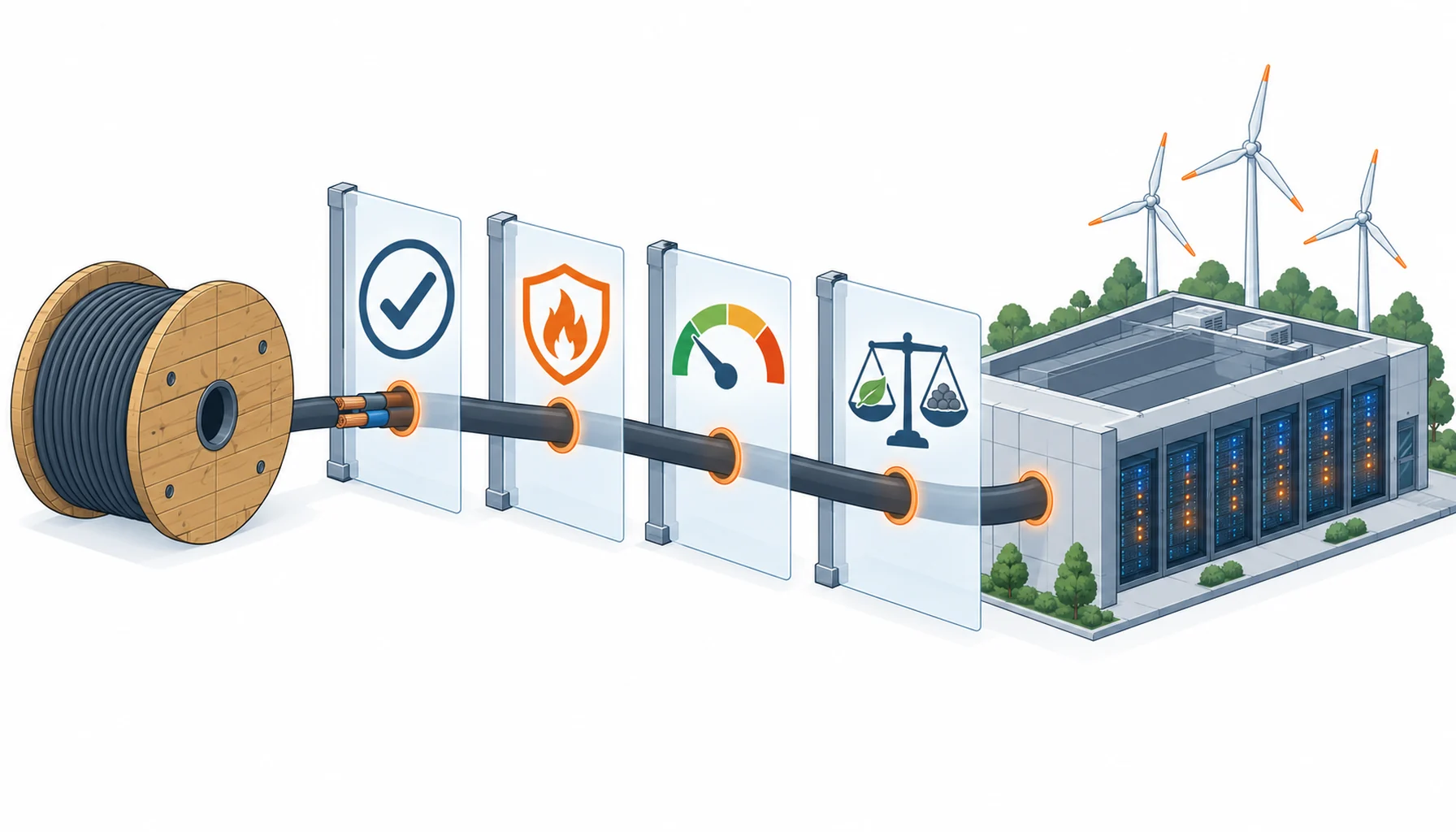
Quick Answer: Europe’s data center growth buys cable through the world’s densest regulatory stack — CE and CPR files, energy-efficiency directives and CBAM carbon costs all attach to the drum before the price does.
Europe builds data centers the way it builds everything: deliberately, rule-first, and with the compliance file as much a part of the project as the concrete. The expansion itself is real — hyperscale campuses across the Nordics, Frankfurt, Dublin, Madrid and the edge metros, pushed by cloud growth and sovereignty concerns. But what makes Europe distinctive for a cable supplier is the regulatory stack wrapped around every drum. CE marking and the Construction Products Regulation sit on the product, energy-efficiency directives sit on the buildings, and the Carbon Border Adjustment Mechanism attaches a carbon price to imported inputs at the border. None of these rules stops imports; all of them reshape who can compete and at what cost. This guide reads the stack from the buyer’s side — what European data center procurement actually requires, and how a foreign factory builds a file that survives it.
Introduction
The demand frame is continental: Europe sits in the global analysis of data center power demand growth as a mature but expanding market, with the Nordics selling renewable power and cold air, Frankfurt and Dublin holding the enterprise core, and sovereignty policy seeding capacity across more member states. The cable bill follows the standard hall architecture — MV intake, LV distribution, UPS strings, and the LSZH interiors whose fire-performance trade-offs run through LSZH vs fire-retardant cable — but the procurement environment is the deepest in this series. The CE chain and CPR fire-class logic belong to the compliance guides of this series, and the energy-efficiency layer sits on top of them. A European buyer’s first questions aren’t about price per meter; they’re about the file, the declaration and the embodied carbon. Suppliers who answer those questions before quoting are the ones the RFQs reach.
The Rule Stack: What Attaches to Every Drum
Four layers attach to cable entering a European data center project. First, product compliance: CE marking under the applicable directives, harmonized standards, and — for cable classified as a construction product — CPR declared fire performance, with the class-of-fire evidence that consultants name in specifications. Second, the energy-efficiency frame. European directives push data centers toward measured efficiency and renewable alignment, which doesn’t regulate cable directly but shapes the electrical architecture — higher-efficiency distribution, heat-recovery designs and the redundant-but-optimized topologies that change cable runs and sizes. Third, procurement discipline: the consultant-gated submittal culture mapped in the standards guide, where the file decides eligibility before price enters. Fourth, CBAM: the carbon border mechanism pricing the embodied emissions of imported inputs — and cable’s input base, copper and aluminum smelting, is exactly where the carbon accounting lands. None of the four is optional; together they define the market’s real specification.
| Layer | Instrument | Effect on the Cable Order |
|---|---|---|
| Product compliance | CE marking, harmonized standards, CPR fire classes | Declared fire performance named in the specification |
| Energy efficiency | EU efficiency directives and reporting | Architecture shifts: optimized runs, heat-recovery designs |
| Procurement culture | Consultant submittals, technical files | File completeness decides eligibility before price |
| Border carbon | CBAM on imported inputs | Embodied-carbon data becomes a quote line item |
CBAM in Practice: The Carbon Line in the Quote
CBAM’s mechanism is straightforward and its procurement effect is not trivial: importers of covered goods report and pay for embodied emissions, with the cost tied to the carbon intensity of the production route. Cable sits inside this story through its inputs — copper, aluminum and the energy that refines them — and through the data center supply chain’s rising attention to embodied carbon alongside operational efficiency. For a foreign supplier, the practical consequences are three. Documentation: production-route energy data becomes part of the file, because the importer’s CBAM declaration needs it. Pricing: the carbon cost lands somewhere in the landed cost, and quotes that pretend otherwise simply move the surprise downstream. Positioning: a factory with genuinely lower-carbon production — cleaner grid electricity, efficient smelting contracts, recycled metal content — converts the regulation from a tax into an argument. The discipline here is the same evidence culture the CE chain established: an undocumented claim doesn’t exist, and the sourcing-mistake catalog of international power equipment sourcing mistakes now includes the carbon number nobody verified until the border did.
What European Buyers Actually Reward
Behind the rules, European data center procurement rewards a recognizable profile. File completeness first: the technical file, declarations of performance and test evidence assembled to the consultant’s format — the certification discipline of the power cable certifications checklist applied at continental depth. Architecture literacy second: buyers optimizing for efficiency directives prefer suppliers who discuss cable as part of the energy design — sizes, runs, losses — rather than as a bill of quantities, the systems logic of one-stop power equipment sourcing applied to the electrical family. And calendar credibility third: European construction runs on integrated schedules where the transformer and switchgear family’s lead times shape milestones, and cable that arrives late inherits the blame for a slipped energization. The recurring theme is that Europe’s rules don’t change what a good supplier does. They formalize it, price the carbon, and make the file the product’s first page.
| Stage | Action | Classic Trap |
|---|---|---|
| File assembly | CE, CPR and test evidence in consultant format, before RFQ | Evidence chased after the shortlist closed |
| Carbon data | Production-route emissions documented for CBAM declaration | Carbon numbers unverified until the border priced them |
| Architecture input | Cable sizes, runs and losses discussed as energy design | Quoting a bill of quantities into an efficiency conversation |
| Calendar | Delivery aligned with the electrical family's milestones | Cable quoted as an isolated commodity |
| Retention | Framework terms across member-state programs | Treating each country as a fresh, unconnected market |
When Rules Are Not the Same as Walls
Two cautions keep the Europe story honest. The regulatory stack is heavy but not hostile. CE, CPR, efficiency directives and CBAM are all navigable with documentation and discipline, and they filter out the suppliers who would fail on quality anyway — a prepared factory reads the stack as its competitive moat, not its barrier. And the market rewards patience. European procurement cycles run long, consultant relationships compound slowly, and the supplier expecting fast wins burns out before the first framework. Enter with the file complete, the carbon data honest and the calendar real, and the rule stack that stops competitors becomes the reason the program keeps you.
RFQ Checklist: Europe Lines for the RFQ
Put the market’s questions in writing:
- CE marking and CPR declared fire performance listed per family
- Harmonized-standard test evidence in consultant format
- Production-route carbon data packaged for CBAM declaration
- Efficiency-relevant parameters stated: sizes, losses, runs
- Delivery calendar aligned with the electrical family milestones
- Framework terms across member-state programs
- Embodied-carbon and recycled-content claims documented, not asserted
Conclusion
Europe’s data center expansion buys cable through the world’s densest regulatory stack — product compliance, energy-efficiency design, consultant-gated procurement and a carbon price at the border — and each layer formalizes what disciplined suppliers already do. The market rewards file completeness, architecture literacy and carbon honesty; it filters everything else at the submittal, the audit or the border.
Kexingyu Cable Group (KXYE) serves Europe with the posture the stack demands: CE and CPR files assembled to consultant format, production-route carbon data packaged for CBAM, cable discussed as part of the energy design, and calendars held to the electrical family’s milestones — supply built for a market where the file is the first page of the product.