Buying Explosion Proof Robot Cable for Hazardous Areas: Certification, Zones and What to Specify
Quick Answer: Start by accepting one uncomfortable fact: there is no such thing as an explosion proof robot cable in the sense most buyers mean. Certification belongs to the equipment and the assembly, and a cable is a component inside it. What a cable supplier can do is provide a construction with the right properties, state the parameters a hazardous area assessment needs, and keep them constant. Buying on a certificate claim alone is how projects lose a month.
Introduction
Robots are moving into refineries, paint plants, grain handling, battery rooms and pharmaceutical powder handling, and every one of those environments comes with a hazardous area classification. The classification is written for the plant, not for the machine, and it usually reaches the robot as a zone number on a drawing.
The general moving-cable rules still apply, and the dust and impact duty on a site machine is covered in our note on construction robot cable. What changes here is that the machine may not be allowed into the room at all unless the whole installation route is defensible.
What the Zone Actually Tells a Buyer
A zone describes how often a flammable atmosphere is expected to be present. Gas areas run from a continuous risk through an occasional one to a short-lived one, and dust areas follow the same pattern with their own numbers. The practical consequence for procurement is stark: a zone with a continuous or frequent risk usually excludes an uncertified robot altogether, and no cable choice changes that.
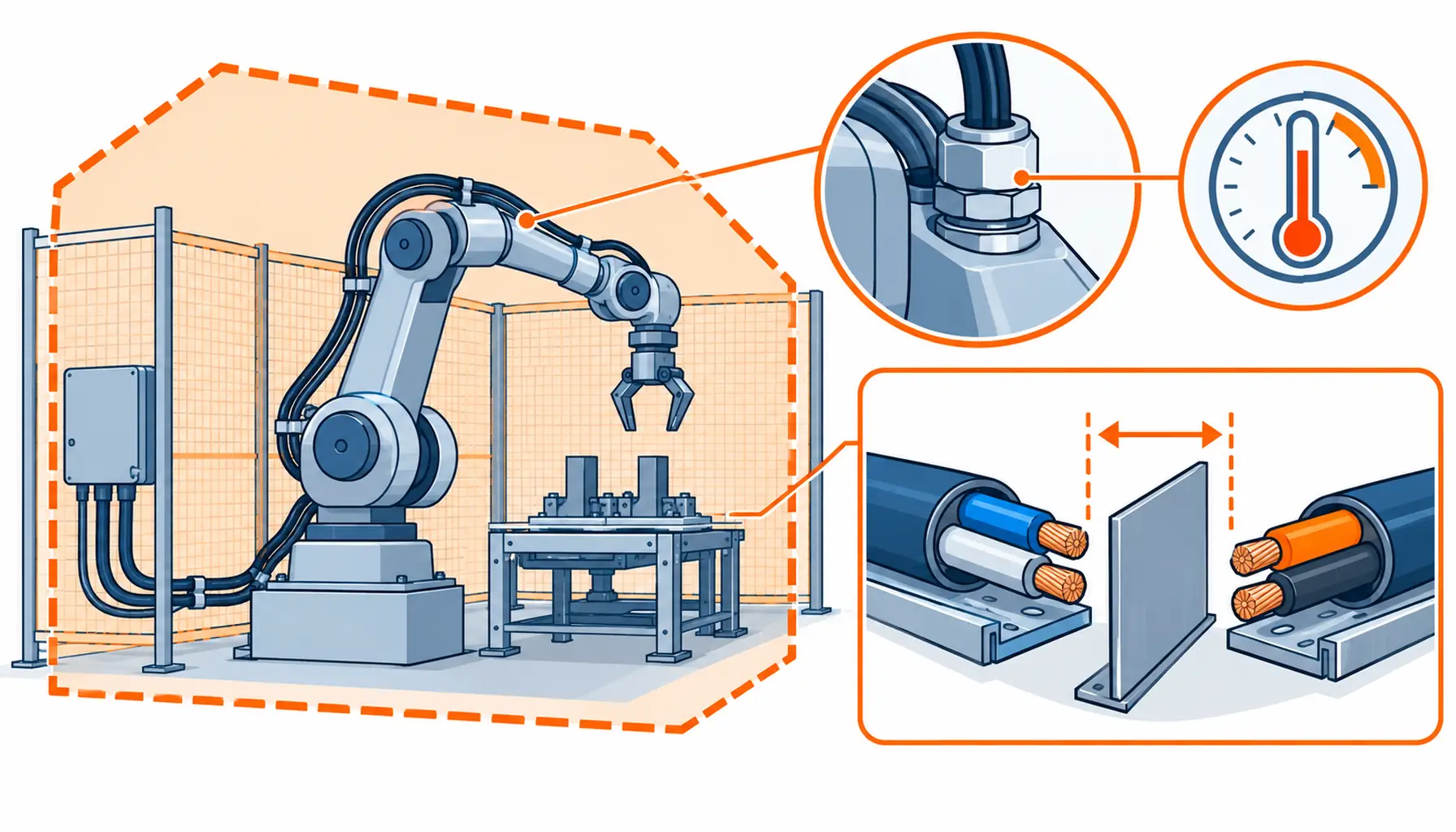
The second figure that matters is the temperature class. Everything in the area has a maximum surface temperature it is allowed to reach, and that limit applies to a cable as it does to a motor. A joint or a termination that runs warm is a surface temperature source, which is why termination quality is a safety item here rather than a reliability item. What happens when that interface degrades is set out in our note on why robot connectors fail.
The third is the gas or dust group, which decides whether a gap or a spark can ignite the specific atmosphere present. None of these three figures can be inferred, so the first line of any RFQ should be the zone, the group and the temperature class as they appear on the area drawing.
Three Realistic Procurement Routes
The first route is a certified machine running inside the zone. Everything on the machine, including the harness, the terminations and the glands, sits within a certified system, and the buyer’s job is to check that every component’s certificate covers the application. This is the most expensive route and the only one that allows the robot to be inside a frequently hazardous area.
The second is exclusion. The robot stays outside, the hazardous process is reached with a tool, a wand or a remote actuator, and the machinery area is unclassified. Most industrial robot deployments in hazardous plants take this route because it is far cheaper than certifying the machine, and the harness is then an ordinary industrial one.
The third is elimination of the ignition source rather than containment of it. Circuits limited in energy cannot ignite the atmosphere, and that is the basis of intrinsic safety. It is common for sensors, instrumentation and control signals, and it changes the cable specification rather than removing it: energy-limited circuits need their own separation, their own colour convention and a documented set of cable parameters that the loop assessment uses.
The Cable Properties That Actually Matter Here
Separation comes first. Where an energy-limited circuit shares a route with a power circuit, the assessment has to consider the consequence of a fault between them, and the usual answer is to keep them apart or to use a construction that maintains the separation. Buyers who ask for one harness covering both are asking for a problem, which is why the harness on a hazardous area machine is often two harnesses.
Mechanical protection comes second. A Zone 1 installation normally means steel conduit or armour, and the cable inside it has to be able to be pulled through without damage and replaced without cutting the conduit open. That is a diameter and stiffness decision as much as a materials one, and it interacts badly with a tight bend radius on a compact arm.
Static is the third. In dust areas, charge accumulation on a non-conductive surface is a genuine ignition route, and it is one of the few cases where the sheath compound and its surface resistance become a safety property rather than a durability one. If the area assessment names static as a concern, that requirement has to reach the cable specification explicitly.
Temperature and chemical exposure come together. A cable that runs warm in an insulated enclosure while surrounded by hydrocarbon vapour is the case the temperature class is written for, and oil and solvent resistance is a separate property that belongs on the same line of the RFQ. The families built for those exposures are gathered in the special wire and cable range, and oil exposure specifically is covered under oil resistant cable constructions.
Maintenance in a Hazardous Area Changes the Design
Opening a gland or a connector in a classified area is a controlled activity. It needs a permit, a gas test and, in many plants, the equipment isolated first. That turns a five-minute cable check into a planned operation with its own paperwork, and it changes what a good design looks like: fewer connectors inside the zone, more of the harness routed to a safe area where it can be inspected, and a labelling scheme that lets a technician work from a drawing instead of from memory.
Ask the maintenance team where they would want to open the machine, then set the split points to suit. A harness that divides at the boundary of the classified area is worth more in service than one that saves a connector in the design.
The Decision Table: Four Procurement Routes and What Each One Costs
| Route | What to specify | Evidence to demand | Cost and lead time | Where it fails |
|---|---|---|---|---|
| Certified machine inside the zone | Zone, group, temperature class and every component's scope | Certificates covering the assembly, not loose parts | Highest cost, longest lead time | A certificate that covers the machine but not the harness |
| Robot excluded, remote tooling | Reach, tool interface and the boundary of the classified area | An area drawing showing where the robot sits | Lowest cost, standard lead time | A reach that puts the harness inside the zone after all |
| Purged or pressurised enclosure | Purge pressure, alarm logic and the cable entries | A purge system certificate plus an entry schedule | High cost, specialist lead time | A cable entry that is not part of the purge assessment |
| Intrinsically safe circuits | Cable parameters, separation and the colour convention | A parameter sheet plus the loop assessment | Moderate cost, standard lead time | Energy-limited and power circuits sharing one harness |
| Conduit or armour with certified glands | Conduit size, bend radii, gland type and entry temperature | Gland certificates matched to the cable diameter | Moderate cost, standard lead time | A gland that fits the cable but not the application |
What to Freeze Before the Order
| Item | What to state | Evidence to attach | Cost of leaving it open |
|---|---|---|---|
| Zone and group | The zone, the gas or dust group and the extent of the area | The area classification drawing for the room | A machine that cannot be energised on site |
| Temperature class | The maximum surface temperature permitted | A temperature rise record at the worst-case load | A joint that runs warm enough to void the assessment |
| Circuit type | Which circuits are energy limited and which are not | A loop assessment listing every circuit | Separation that has to be redesigned after installation |
| Separation | How far apart the circuits run, or how they are shielded | A construction drawing showing the separations | A fault between circuits that the assessment never covered |
| Cable parameters | Capacitance and inductance per metre, and resistance | A parameter sheet from the supplier | A loop that cannot be justified with the cable as built |
| Mechanical protection | Conduit or armour type, size and the pull path | A route drawing with bend radii and pull points | A cable that cannot be pulled or replaced in the conduit |
| Gland and entry | Gland type, thread and the entry temperature limit | Gland certificates matched to the cable diameter | A certified gland fitted to a cable it was not assessed for |
| Static control | Whether charge accumulation is named in the assessment | A sheath surface resistance statement where required | An ignition route nobody specified against |
| Chemical and oil exposure | Which hydrocarbons, solvents or powders reach the harness | A resistance statement for each agent named | A sheath that degrades in a way the zone assessment missed |
| Change control | What triggers a reassessment, and who approves a change | Written terms with a named approver | A certified assembly quietly becoming an uncertified one |
When an Explosion Proof Robot Cable Specification Is Not the Answer
When the robot does not have to be inside the zone. Exclusion is cheaper than certification by a wide margin, and it is usually available. Before writing a hazardous area harness specification, check whether a longer reach, a tool change or a remote actuator removes the machine from the classified area entirely. That single question has saved more project budget than any cable choice.
When the certificate claim cannot name the scope. A supplier who offers an explosion proof cable but cannot state the zone, group and temperature class it is assessed for is offering a description rather than a certificate. The realistic documentation a cable maker can supply, and what has to be generated by the machine builder, is set out in our note on robot cable certification.
When the harness is being asked to cross the boundary. A single harness that carries power into the zone and signals out of it puts certified and uncertified requirements in one jacket. Split it, even if that means two harnesses and a second gland plate, because the alternative is an assessment that depends on a construction nobody can verify after a repair.
When the environment is aggressive but not classified. Many buyers describe an area as explosive when what they mean is hot, oily and filthy. Welding cells, foundries and heavy process areas need heat, oil and abrasion resistance rather than a zone certificate, and those requirements are covered in our note on welding robot cable. Submerged and wet process areas have their own logic, set out in our note on ROV cable.
RFQ Checklist
- Zone, gas or dust group and temperature class quoted from the area classification drawing
- Every circuit listed as energy limited or not, with the separation proposed for each pair
- Cable capacitance, inductance and resistance per metre supplied as a parameter sheet
- Temperature rise record requested at the worst-case load inside the enclosure
- Conduit or armour type and size stated, with bend radii and pull points on a drawing
- Gland type, thread and entry temperature limit given, with certificates matched to the diameter
- Sheath surface resistance statement requested wherever static is named in the assessment
- Chemical, oil and solvent exposures listed individually with a resistance statement each
- Marking scheme agreed, including circuit identification at both ends of every run
- Change control terms written down, with a named approver and a notice period
Conclusion
In a hazardous area the cable is bought on four things: the zone and group it sits in, the temperature class it must not exceed, the separation the circuits need, and the mechanical protection the route requires. The certificate that matters belongs to the machine, and a supplier who understands that will give you parameters and documentation rather than a slogan. Start there and the procurement gets shorter.
Kexingyu Cable Group (KXYE) has supplied oil-resistant, armoured and special cable since 1996, and can provide the construction data, parameter sheets and consistency that a hazardous area assessment needs from a component supplier. Send us the area drawing, the circuit list and the temperature class, and we will return suitable constructions and the documentation we can supply; the fastest route is a request for quotation.