Festoon Cable: Choosing Cable for Festoon Systems and Cable Trolleys on Site
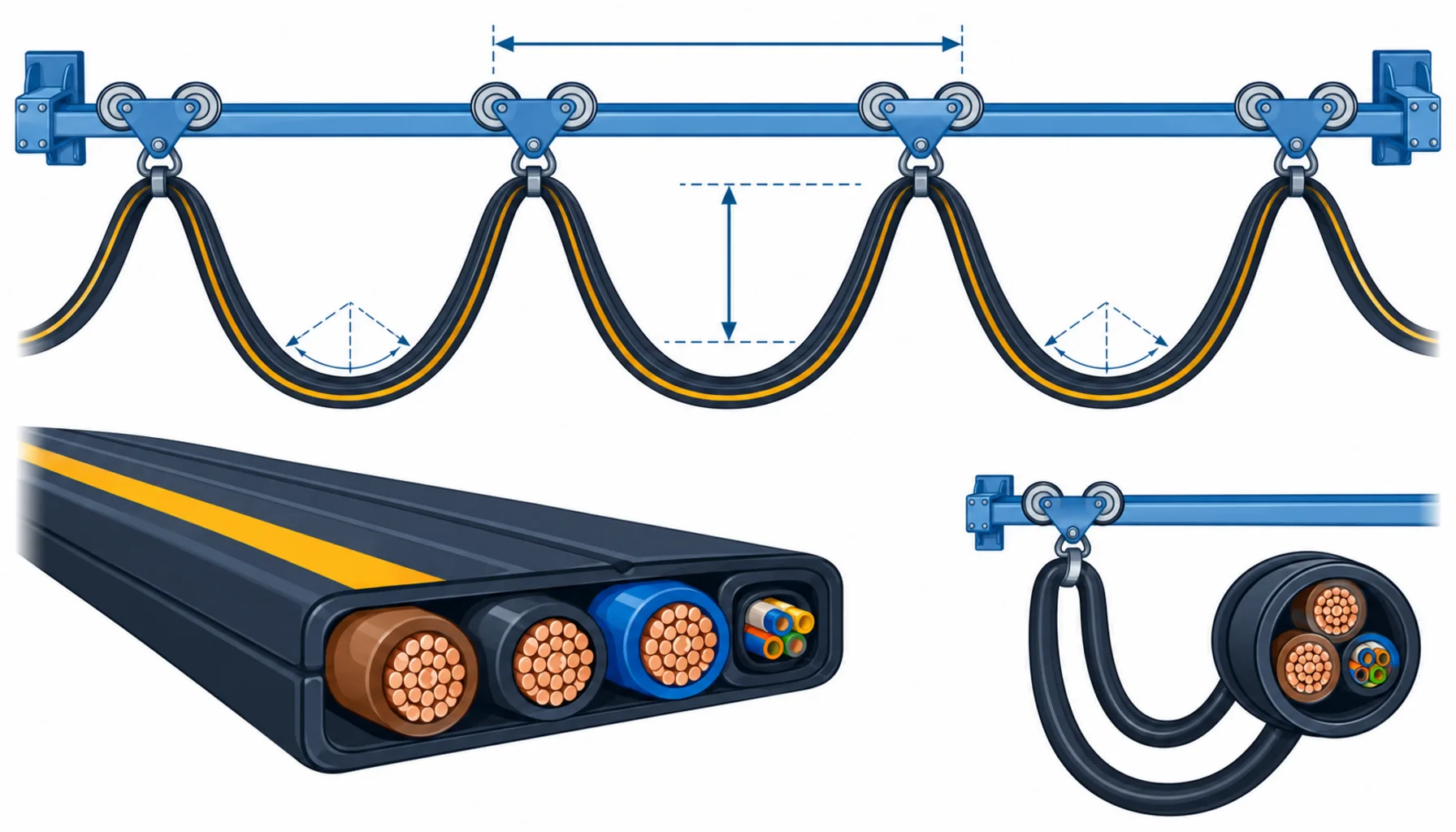
Quick Answer: Festoon cable is selected around the trolleys, not the load table. The saddle profile decides flat or round, the trolley spacing decides the loop length, and the saddle curve decides the bend radius the cable bends at tens of thousands of times. Get those three numbers into the RFQ, choose a construction with flex cycle evidence at that radius, and the festoon runs for the life of the gantry; skip them and the loops pull, foul and crack within a season.
Introduction
Festoon systems are the simplest moving cable system in construction: cable hangs in loops between trolleys that ride a track, folding and unfolding as the load travels. The simplicity is deceptive. Everything that goes wrong with a festoon traces to three numbers measured on the trolleys, and a cable bought without them is a cable specified for a system that does not exist.
This guide covers the site festoon procurement: flat versus round, loop geometry, flex life, weather, and the interface between the cable and the hardware it lives in.
What Festoon Duty Does to Cable
Fixed-radius bending. Every loop folds at the trolley saddles, at a radius the trolley manufacturer chose, thousands of times a week. The cable bends at exactly one radius all its life, which is why that radius is the most important number in the order.
Hanging weight. The loop hangs from its top clamps, and the cable’s own weight is tension at the clamp. Longer loops mean more weight at the clamp and more sag clearance needed underneath.
Outdoor exposure. Site festoons live in sun, rain and winter cold. The outer face of a hanging loop takes the sun continuously, and UV is what cracks the jackets that were not specified for it.
Constant small handling. Trolleys are serviced, cable is re-seated after faults, and the terminations at both ends see every one of those interventions.
Flat or Round: The Profile Decision
The saddle decides it. Flat festoon cable hangs flat, stacks in the loop without twisting, and presents a broad face to wide saddles; most power festoons on gantries, hoists and crane rails take flat for exactly these reasons. Round cable suits light festoon runs, cylindrical saddles and short travels where loop behaviour is less critical.
The mistake to avoid is substituting one for the other because stock was closer. Round cable on flat saddles rocks and chafes; flat cable in cylindrical saddles twists in the loop and works at the clamps. Where the system carries power and data together, a composite flat construction keeps the elements in one sheathed profile; our note on the flat festoon composite cable covers that design, and weather-resistant flat options are covered in our note on weather-resistant flat cable.
| Construction | Duty | What to Specify | Evidence to Demand | Cost and Lead-Time Driver | How It Fails |
|---|---|---|---|---|---|
| Flat power festoon cable | Hangs in loops, folds at saddle radius every travel | Profile to the saddle, bend radius rating, flex cycle life, core count with headroom, weather-rated sheath | Flex cycle test at the trolley radius, flat profile dimensions, UV and cold data | Made to order in continuous lengths; footage multiplies with trolley count | Jacket cracking on the outer face, conductor fatigue at the clamps, loops that twist |
| Composite flat festoon | Power plus data or control in one hanging profile | Element schedule, bend performance of the data element, screen separation, profile to the saddle | Data element performance after flexing at radius, composite construction drawing | Composite designs carry an engineering premium; one drum run replaces three | Power running while the data element degrades quietly |
| Round light festoon cable | Light runs, cylindrical saddles, short travel | Fine-stranded conductor, round profile to the saddle, weather rating, loop length to the spacing | Flex test data, continuity per length | Stock lines are common; matching beats upgrading | Rocking in wide saddles, twist in the loop, clamp wear |
| Control and pilot elements | Carried in the festoon, safety-related | Core schedule, screen or pilot arrangement, terminations at both ends | Core identification and continuity records | Small cost inside the order, large cost when missing | Intermittent safety circuits, misidentified cores at re-termination |
Loop Geometry: The Numbers Nobody Measures
Loop length comes from trolley spacing and travel. The loop must fold completely at the closed end and hang with clearance at full extension. The working rule is spacing plus travel margin divided among the loops, with sag sized so the cable never pulls taut; the exact figure belongs on the system drawing, and the supplier should confirm the cable’s behaviour at that loop, not a generic one.
Sag clearance is a safety dimension. Loops that hang too deep into walkways or plant paths get hooked, cut and climbed on. Undersized loops pull at the clamps. State the clearance available under the track, and let it discipline the loop count.
Clamp position is a specification item. The top clamp takes the loop’s weight for its whole life. Wider clamps with a supportive profile, matched to the cable, are worth more than a heavier sheath; our note on cable damage and wear patterns shows what clamp damage looks like before it becomes a failure.
Flex Life: What the Rating Should Say
A festoon bends at one radius for its whole life, so the flex cycle rating at that radius is the entire quality argument. Ask for the cycle count survived at the declared radius, on the actual construction, with the bending method stated. A “highly flexible” claim without that test is a description; our note on cable bending cycle life explains what the testing should cover, and Class 6 conductor construction is the baseline stranding for any cable that folds this often.
The broader comparison between constructions that flex and constructions that travel in guided systems is covered in our note on continuous flex versus drag chain cable, and the same physics applies here with the radius set by trolleys instead of a chain.
Trolley and Track Hardware: The Other Half of the Order
The festoon cable fails at its interfaces, which makes the trolleys, clamps and end terminations part of the cable procurement even though someone else may supply them.
Trolleys. Check the saddle width against the cable profile with the actual parts, not the catalogue, and inspect used trolleys for wear before reusing them with new loops. Worn saddles are the most common reason a correct cable “fails early”.
Clamps. The top clamp holds the loop’s weight forever. Match its width and profile to the cable, fit it to the stated torque, and include a spare set in the order, because clamps are what site crews lose first.
End terminations. The strain relief at the fixed end and the moving end decides where conductor fatigue starts. Factory-fitted ends remove the question; if the ends are fitted on site, the gland and strain-relief specification belongs in the delivery documents with the cable schedule.
Track condition. A track that has sagged or bent feeds the trolleys a side load that no cable survives. Include a line check of the track in the same shutdown as the cable replacement, and the two investments protect each other.
Weather and the Outer Face
A hanging loop presents one face to the sun for its whole life, and UV checking on that face is the most visible ageing on any site cable. Specify UV-stabilised sheath compounds for outdoor festoons, and read the declaration rather than the colour: black compounds are not automatically UV rated, and some coloured compounds outperform black ones.
Cold matters in the same loop. A cable that folds at the saddle radius in winter needs cold-flex performance at the site’s real minimum temperature, which is a compound property, not a stranding one. State the minimum service temperature in the RFQ and expect the cold-flex test result back with the quotation. Rain and washdown affect the terminations more than the run, so the gland specification carries that duty.
What to Freeze Before the Order
| Decision | What to State | Evidence to Attach | Cost of Leaving It Open |
|---|---|---|---|
| Trolley profile | Saddle width and curve, flat or round, per system | Trolley drawing or measurements | A cable that rocks, chafes or twists in its own saddles |
| Loop geometry | Trolley spacing, travel stroke, loop length, sag clearance | System drawing with the loop stations marked | Loops that pull taut, foul the structure or hang into traffic |
| Bend radius and flex life | Saddle radius, and the cycle count expected per year | Flex cycle test at the declared radius | A season of cracking instead of years of service |
| Core schedule | Power, control and pilot cores with sizes | Core schedule matched to the system drawing | Re-termination, or a safety circuit that cannot connect |
| Weather exposure | Sun on the outer face, rain, minimum temperature | UV and cold-flex declarations | Outer-face cracking in the first summer |
| Terminations | Clamp profile, gland types, factory-fitted ends | Termination schedule matched to the trolleys | Clamp failures on correct cable |
Lead Time and Cost Structure
Festoon cable is made to order in continuous lengths cut to the loop count, typically two to five weeks, and the footage grows with every trolley added, which is why the trolley count belongs in the quotation rather than being discovered at installation. Composite and weather-specific constructions sit at the longer end of that range.
On cost, copper and the flex-rated construction set the unit price, and the honest comparison is against replacement cycles rather than against a cheaper cable that will not survive the radius. Where the festoon carries data, the composite route costs more per metre and less per system, because it replaces three parallel runs and their trolleys with one. Copper movement is worth a basis clause on long festoon orders, for the same reasons as any moving-duty line.
Incoming Inspection
Before the loops are hung. Check the delivered footage against the loop schedule, run continuity on every core, and lay a sample loop at the saddle radius to confirm it hangs and recovers without kinking. Verify the profile against the trolley drawing while the trolleys are still on the ground.
After the first weeks. Inspect the outer face for UV checking, the clamps for wear, and the loop shape for twist. Early findings at the clamps are a fitting adjustment, not a cable defect, and catching them in week two is the cheapest maintenance the system will ever get.
A Loop Maintenance Routine Worth Writing Down
Festoon systems reward a short written routine more than any other site cable system, because their failures develop visibly over weeks. Three checks on a monthly cycle cover most of it.
Walk the loops. Look at the outer face for UV checking, at the loop shape for twist, and at the sag for loops that have gone shallow, which means the clamp has slipped or the loop has stretched.
Check the clamps and trolleys. Worn saddles, loose clamp bolts and flat trolley wheels show up here, while they are still a fifteen-minute fix.
Test the cores. Continuity on the control and pilot cores, and insulation on the power cores, catches the conductor fatigue that starts at the clamps before it stops the hoist. Write the results on the board, because a trend line is what turns this routine into diagnosis instead of superstition.
When a Festoon Cable Specification Is Not the Answer
When the trolleys are worn. Worn saddles and flat trolleys destroy correct cable on schedule. Overhaul the hardware with the cable order or the new loops inherit the old failure.
When the loops foul because the track sagged. A festoon on a track that has lost its line fights the geometry every cycle. Straighten the structure first.
When a reel system fits better. Long travels at high speed with tight clearances sometimes suit a motorised drum better than loops. Changing the system is cheaper than fighting its cable.
When the fault is at the ends. Termination failures that repeat at the same clamp are a clamp profile problem. The cable was never the suspect.
RFQ Checklist
- Trolley saddle profile, width and curve radius, per system
- Trolley spacing, travel stroke and the resulting loop length
- Sag clearance available under the track
- Flex cycle test at the declared radius, with the cycle count
- Core schedule: power, control and pilot, with sizes
- UV and cold-flex declarations for the exposure
- Composite element schedule where data rides the same festoon
- Clamp profile and gland specification, factory-fitted where offered
- Continuous footage per the loop count, with tolerance
- Copper basis with validity window, and delivery against erection
Conclusion
Festoon cable is bought well when the trolleys lead: measure the saddles, fix the loop geometry, demand flex cycle evidence at the real radius, and buy the terminations with the cable. The festoon then runs quietly for years, which is all a festoon ever promises.
Kexingyu Cable Group (KXYE) has manufactured cable in Quanzhou since 1996, including flat, composite and weather-resistant festoon constructions with factory-fitted ends and flex test documentation. Send us the trolley drawings and loop schedule, and we will come back with the construction, the evidence and a delivery plan against your erection date. The fastest route is a request for quotation.