Lithium Battery Gigafactories: Automation's Fastest-Growing Cable Customer
Quick Answer: Battery gigafactories are the fastest-growing downstream for drag chain cable per QYResearch, and the combination of chemical exposure, long runs and three-shift duty explains why.
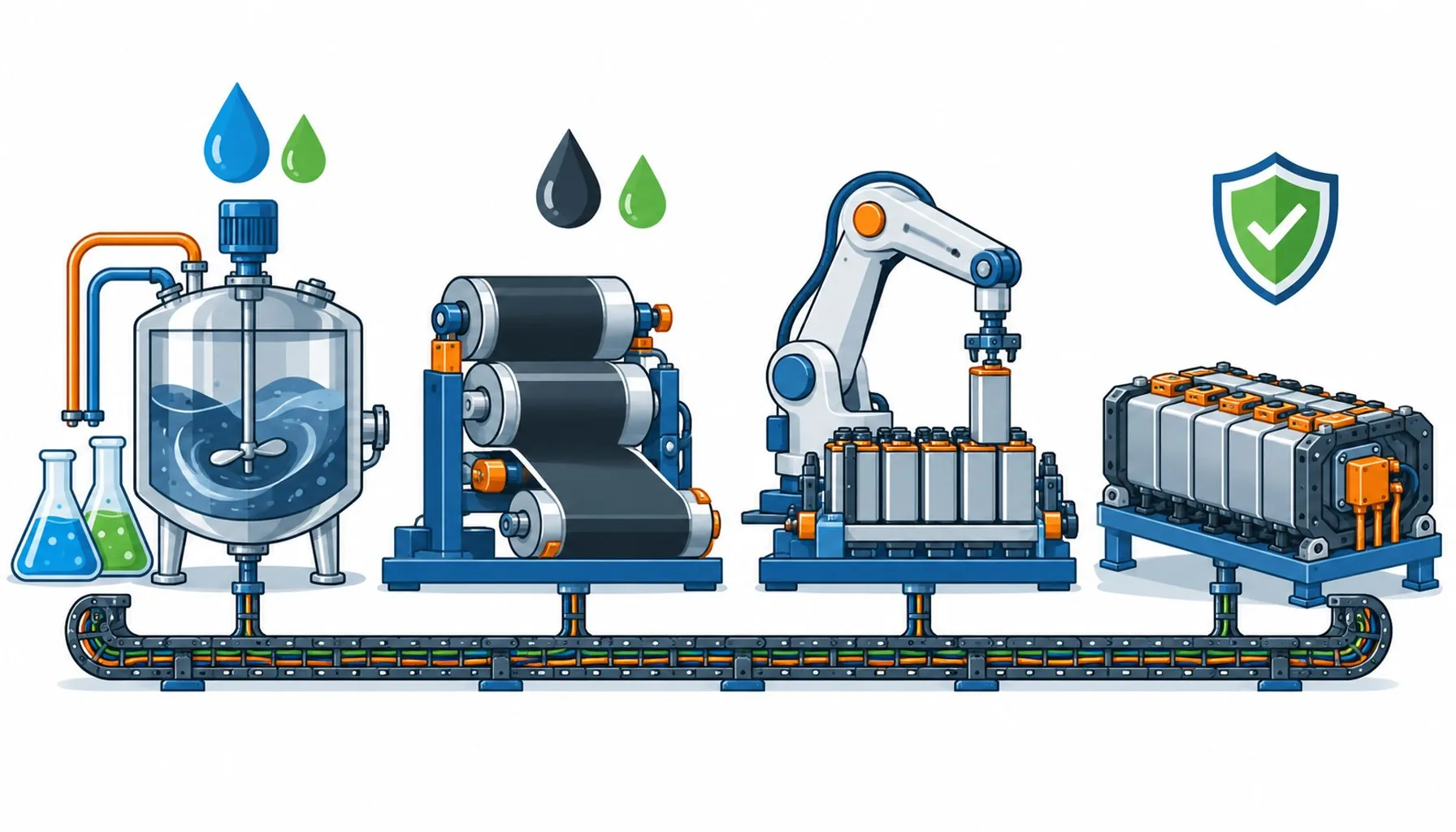
A gigafactory is an argument made of concrete and conveyor. Its product, the lithium-ion cell, must be made at enormous scale, at tolerances measured in microns, in an environment where the process materials attack everything organic, under a duty cycle that runs three shifts without sentiment. The automation inside it, mixing, coating, calendering, stacking, winding, assembly and formation, is some of the longest continuous motion machinery ever built, and market research now identifies it plainly: QYResearch’s 2026 analysis names battery equipment as the fastest-growing downstream segment for robot drag chain cable. This article explains what the machines do, what they do to cable, and why the gigafactory cable conversation differs from every other automation conversation.
Introduction
The scale is the headline. Gigafactory construction has proceeded across China, Europe and North America faster than any comparable industrial build-out in decades, and each plant packs kilometres of continuous process lines into its halls. The cable-specific market data quantifies the pull: QYResearch projects the global robot drag chain cable market growing from roughly USD 850 million in 2026 to USD 1.24 billion by 2032, with battery equipment the fastest-growing downstream, while LP Information’s 2026 review of robot flexible drag chain cable puts that segment on a path from about USD 333 million to USD 536 million over the same window. IFR’s World Robotics 2026 counts global industrial installations at roughly 600,000 units for 2025, and the electronics-adjacent sector that includes battery plants is among its fastest-growing components.
What makes the gigafactory a distinct cable customer is not volume alone but the character of its duty. The three features that define it, chemistry, length and pace, each break a different assumption in standard cable specification, and together they produce failure modes that generic “flex cable” was never tested for. The battery chemistry background behind the process is covered in the comparison of LiFePO4 and other battery chemistries.
Chemistry: The Process Fights the Jacket
Battery manufacture moves aggressive materials through the air of its own halls. Electrode slurry carries solvents that soften or swell ordinary polymer jackets. Electrolyte, the cell’s own working fluid, is aggressive toward a wide range of compounds and finds its way to the floor, the gutter and the cable run wherever a cell leaks or a line washes down. NMP, the solvent that carries electrode coating, adds its own attack profile. A cable jacket that shrugs off machine oil can fail in months against these exposures, and the failure is insidious: swelling, embrittlement, then cracking at the flex points, months before anyone connects the dots. The selection logic that matches compound to chemical exposure follows the same discipline set out in the analysis of why cables fail on machines, applied here to chemicals rather than oils.
The consequence for specification is that compound data moves from footnote to headline. Gigafactory cable buyers ask for immersion or exposure test results against the actual process chemicals, not generic oil-resistance ratings, and the suppliers who maintain chemical compatibility libraries for PUR, TPE and specialty compounds win arguments that price cannot reopen.
Length and Pace: The Machine Is a Kilometre Long
The second feature is geometry. Gigafactory process lines are extraordinarily long, and their motion is continuous: electrode lines transport material through coating, drying and calendering in one unbroken flow; cell assembly lines carry jigs through stacking and winding at line speed. Cable carriers on these machines run tens of metres, far beyond the short runs of a robot cell, and the carrier chain itself becomes a system: gliding surfaces, intermediate guidance, fill factor and separation all affect cable life. Long carriers also mean long cables, and long cables mean voltage drop,shield length effects and drum-handling logistics that the electrical sizing in the guide to cable size selection must absorb.
The third feature is pace. Three-shift operation is standard, and the formation and aging sections add thermal load to the environment. A gigafactory’s motion cable does not rest; it accumulates duty at a rate that turns a marginal flex rating into a scheduled failure. Batch consistency becomes a safety issue as well as a quality one, because a fleet of identical carriers whose cables were made in different batches will age unevenly, and the maintenance plan built for one batch will not fit the next. The power infrastructure feeding these lines, from rectifiers to formation circuits, follows the planning logic in the industrial power distribution checklist.
| Zone | Machinery and motion | Cable duty profile | Deciding requirement |
|---|---|---|---|
| Electrode (mixing to calendering) | Long transport lines, coating and drying ovens | Solvent and slurry exposure, heat, long carriers | Chemical compatibility of jacket compound |
| Cell assembly (stacking, winding) | Fast gantries, precision stacking cells | High cycles, tight radii, dust from active material | Flex life at real radius plus particle tolerance |
| Formation and aging | Formation racks, transfer automation, thermal rooms | Heat, electrolyte traces, round-the-clock duty | Thermal and chemical margins, batch consistency |
| Module and pack assembly | Heavy handling robots, busbar and film work | Heavy payloads, long travels, mixed signal bundles | Load-rated constructions with shielded data cores |
What Buyers Should Demand, and Suppliers Prepare
The zone table hides one further wrinkle worth surfacing: fire behaviour. A plant full of lithium cells treats fire performance as a plant-level question, and cable jackets participate in that answer. The trade-offs between flame retardance, smoke and halogen content are set out in the comparison of LSZH versus fire-retardant cable, and where runs leave the building or cross yards between halls, the mechanical protection decision follows the reasoning in the guide to armoured versus unarmoured constructions. The battery management systems that monitor the product ride on signal cable whose integrity the comparison of BMS versus EMS roles frames.
When the Gigafactory Story Is Not the Answer
The gigafactory cable conversation rewards three behaviours. Chemical evidence first: exposure testing against the plant’s actual process chemicals, by name, with post-exposure flex results rather than before-exposure ratings. Construction stability second: a plant built over years, in phases, wants the same cable from first phase to last, because maintenance plans and spares inventories assume it. And documentation depth third: batch records that map each drum to its test data, so a failure investigation can trace the cable’s history in minutes. Suppliers who can deliver all three, and the market data suggests demand will keep pulling for them through 2032, occupy the fastest-growing corner of the motion cable business.
| Decision | Why it matters in this plant | Practical handling |
|---|---|---|
| Chemical exposure testing | Process chemicals defeat generic oil ratings | Test against named solvents and electrolyte, post-exposure flex |
| Long-carrier system design | Carrier chain quality governs cable life at length | Specify gliding, guidance and fill factor with the cable |
| Batch consistency | Phased builds and mixed batches age unevenly | Lock constructions; map batch records to every drum |
| Fire behaviour at plant level | Cells change the fire-safety calculus | Choose jacket chemistry with the plant's fire strategy |
| Peak-duty sizing | Three-shift pace turns margins into schedule | Size for real duty hours; plan refits before failures |
RFQ Checklist: Cable for a Battery Plant Project
Three cautions. First, growth projections describe the market, not a project; cable suppliers should qualify with the equipment makers and EPCs who build these plants, because plant owners buy what the line builders specified. Second, chemistry varies by cell design, and a cable proven against one plant’s electrolyte recipe is not automatically proven for another; test data should name the chemicals. Third, not every battery plant is a gigafactory: pilot lines and pack-only assembly run far milder duty, and applying full gigafactory specification to them wastes money that the duty never asked for.
Conclusion
Send these so the quote matches the process, not the brochure:
- Process zone and the chemicals present: solvents, slurry components, electrolyte traces
- Carrier length, speed and duty hours per day, three shifts stated if true
- Actual bend radius and carrier system details, including guidance and fill
- Ambient and thermal environment, including formation and drying zones
- Fire-safety strategy for the plant, so jacket chemistry aligns
- Signal set: drive power, positioning, BMS and safety communication cores
- Phase plan for the build, since construction stability must span years
- Chemical exposure test evidence requested by name of chemical