Procuring Cables and Switchgear for High-Altitude Data Centers: Derating, Clearances and What to Specify
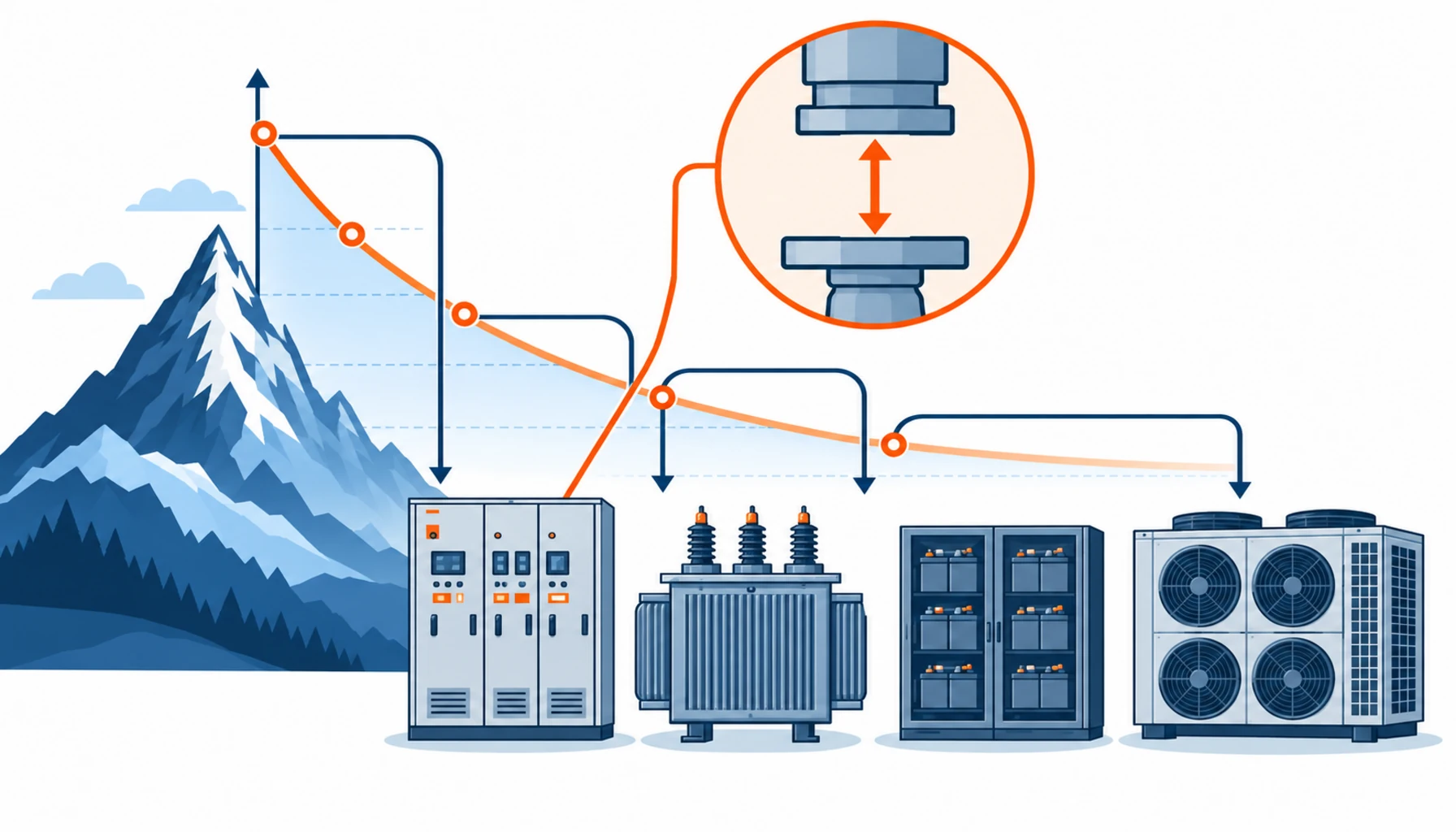
Quick Answer: Altitude buys you cooler air and thinner air, and the thinner air is the problem. Air density falls roughly one percent for every hundred metres, and with it the cooling available to every piece of equipment and the dielectric strength of every air gap. That converts directly into derated ratings and larger clearances, which is a costing exercise that belongs in the enquiry rather than in a conversation at commissioning.
Introduction
A data center at 2,500 m is not a data center at sea level with a different view. The equipment inside it is working in air that is roughly a quarter thinner, and every rating that was established in a factory at low altitude has to be corrected before it can be claimed on site.
The correction is well defined in the standards, precisely because high-altitude installations are common in mining, rail and hydro projects. What makes data centers different is the density of equipment per square metre and the low tolerance for a derating surprise. Our note on cable derating factors covers temperature and grouping; this note covers the altitude term, a separate correction that applies to equipment as well as to cables. Where the site is also hot, the two corrections stack, and the combined effect is larger than most budget allowances anticipate.
What Altitude Actually Changes
Three physical effects drive the whole procurement consequence.
Cooling capacity falls. Convection depends on air density, so a fan moving the same volume moves less mass at altitude. Switchgear, transformers, converters and batteries all lose cooling, and the loss is specified in the equipment standard as a correction above a reference altitude.
Dielectric strength falls. The breakdown voltage of an air gap drops with pressure, so the same physical clearance that is adequate at sea level may be inadequate at altitude. The standards handle this by requiring the insulation level to be verified at the site altitude, which in practice means either higher rated equipment or larger clearances for the same voltage class.
Creepage and clearance assumptions weaken. Pollution, condensation and altitude act together on the external insulation of bushings, terminations and cable accessories, and a design that assumes sea-level air density has a margin at altitude that is usually negative.
Two secondary effects matter as well. Ultraviolet radiation is stronger at altitude, degrading polymer sheaths and non-metallic enclosures unless the material is selected for it, and the temperature swing between sun and shade is wider, which is a mechanical fatigue input for outdoor runs and for anything with a gasket.
The Decision Table: Four Ways to Deal With Altitude, and What Each Costs
The table compares the commercial strategies. Most projects use the first two together and discover the third too late.
| Strategy | What You Are Buying | What to Specify | Evidence You Should Receive | Cost and Risk Shape |
|---|---|---|---|---|
| Derate the standard product | The same equipment, rated lower, with the site altitude stated in the order | The site altitude, the correction standard and the derated ratings you intend to claim | Calculations applying the standard correction, with the altitude value and method shown | Lowest equipment cost; the risk sits in whether the derated figure still serves the load |
| Buy the higher rating at sea level | Equipment one rating step up, so that after correction it meets the design duty | The required rating after correction, and the altitude at which it has to be delivered | Type test data at the higher rating, plus the correction applied to it | Clear and defensible; costs a rating step on switchgear, transformers and busway |
| Altitude rated or adapted product | Equipment built or modified for the site, with larger clearances or reinforced insulation | Site altitude, insulation level required, and the external insulation conditions | Design verification for the site conditions, not a catalogue correction | Manufacturing premium and longer lead time; usually right above about 3,000 m |
| Increase cooling instead | More airflow, larger heat exchangers or liquid cooling, to restore the lost margin | The heat rejection required at site air density, and the electrical cost of delivering it | Thermal calculations at the site density, with the fan or pump duty stated | Operates on the cause, but adds parasitic load that itself has to be derated |
What Each Change Means for the Order
Four items on a high-altitude project look different from the same items at sea level.
Switchgear ratings get a second number. The order should carry the rated value and the value to be claimed at site altitude, with the correction method named. A specification that states only the rated figure leaves the correction to whoever notices. The standard is covered in our note on IEC 62271, and the equipment in our note on KYN28 medium voltage switchgear.
Insulation coordination becomes a design item. Where the site is above the altitude at which the standard product’s clearances hold, the answer is a higher insulation level, larger clearances, or both. The decision carries a rating-step cost, and it is much cheaper before the switchgear is ordered than after a commissioning test shows a marginal withstand.
The cable changes for reasons other than current. Current carrying capacity barely changes with altitude, because it is set by the temperature rise in the conductor and the surrounding air, but the external insulation requirement, the sheath material and the cold temperature performance all change. The range built for high altitude routes is described in our note on plateau region weather resistant cable.
Cooling and battery duty have to be restated. Batteries lose capacity and life at low pressure and low temperature at once, and the inverter or UPS charging them is itself derated. A battery autonomy figure needs to be derived at site conditions rather than quoted from a sea-level datasheet.
Where High-Altitude Programmes Fail
Altitude discovered late. The site altitude comes from the first survey, but it does not always reach the equipment specifications. Where it arrives after the switchgear is ordered, the buyer is negotiating a variation on equipment already in manufacture.
Derating applied to one package and not to the next. Switchgear corrected, busway not, and cable assumed to be unaffected. The three then disagree about the capacity of the same circuit. A single derating basis covering all packages is cheaper than three partial ones.
Cooling margin spent twice. The thermal design is derated for altitude, and then the electrical design claims the full nameplate figure. Where the two are done by different parties, the mistake is common and it surfaces as a hot room rather than as a calculation error.
Maintenance access assumed to be the same. High-altitude sites are remote, and a unit that needs a specialist crew flown in is a different maintenance proposition from one that does not. That belongs in the evaluation, not in a later discussion about service levels.
What to Freeze Before the Order
| Item | What to State | Evidence to Attach | Cost of Leaving It Open |
|---|---|---|---|
| Site altitude | The design altitude in metres, and whether it is the site figure or the highest equipment location | A survey or design basis statement with the altitude recorded | Corrections applied to the wrong base, or a variation raised after manufacture |
| Derating method | The standard and the correction approach to be applied, referenced in the specification | A worked example showing one rating corrected from sea level to site | Three packages derated three different ways, and a circuit whose capacity nobody can state |
| Insulation level | The rated insulation level required at site altitude, and how it is to be verified | Type test data and a design verification for the site conditions | A commissioning withstand test that passes only because the test conditions were mild |
| Clearance and creepage | Minimum clearances for the voltage class at site altitude, with the external insulation condition | Drawings showing air clearances and creepage distances against the requirement | Equipment that cannot be certified without modification after arrival |
| Cable sheath and jacket | Sheath material, UV performance, low temperature performance and ozone resistance required | Material data and type tests for the sheath compound | Sheathing that cracks in the first seasons, on a route that is hard to rework |
| Cooling duty | Heat rejection required at site air density, for each equipment package | Thermal calculations at site conditions, with fan or pump duty stated | A room that runs hot in the first summer, with the electrical design already fixed |
| Battery and UPS duty | Autonomy and capacity at site temperature and pressure, not at reference conditions | Discharge data corrected to site conditions, with the correction shown | Autonomy figures that hold on paper and not on site, discovered during a real outage |
| Service and spares | Maintenance model, spares holding and the response time achievable at the site | A service agreement with the site location and access constraints stated | An equipment selection that is cheap to buy and expensive to keep running |
When Derating Is Not the Answer
Where the derating has been used to justify a smaller order. A derated rating is a smaller number, and it is tempting to buy the smaller equipment and quote the sea-level figure in the capacity plan. The two have to be the same number, and the one that matters is what the site can deliver.
Where the correction is used as an excuse for a margin. Applying a heavy altitude correction at 1,200 m and then adding a further safety margin produces equipment costs that no one can justify. The correction should follow the standard and the project margin should be stated separately.
Where altitude is treated as a cable problem. Cable current ratings are the least affected item on the list. The equipment that loses cooling and the clearances that lose dielectric strength are the real issues.
Where the outdoor installation was not considered separately. An outdoor switchyard at altitude sees UV, temperature swing and pollution that an indoor switchroom does not, and treating the two as one scope leaves the outdoor items under-specified. Our note on data center cable selection covers how the route environment feeds back into the cable choice, and the busbar position is set out in our note on busbar tap-off boxes.
RFQ Checklist
- Site altitude stated in metres, and applied to every package on the enquiry
- Correction standard named, with a worked example attached to the specification
- Rated value and site-claimed value stated separately for switchgear and transformers
- Insulation level required at site altitude stated, with the verification route
- Air clearance and creepage requirements given as numbers, for the voltage class in use
- Cable sheath compound specified for UV, low temperature and ozone at the site
- Cooling duty stated at site air density, for each equipment package
- Battery and UPS autonomy derived at site conditions, with the correction documented
- Derating basis aligned across switchgear, busway and cable so the circuit has one capacity figure
- Outdoor and indoor equipment treated as separate environmental scopes
- Service model and spares holding agreed against the site’s access and response reality
- Equipment datasheets checked for a stated altitude limit rather than an assumed one
Conclusion
Altitude is one of the few design inputs that is known on day one and still manages to miss the specifications. The correction itself is not difficult; the problem is that it applies to several packages at once, and a partial application leaves three different answers about the same circuit. Carrying the site altitude, the correction method and the site-claimed rating through every enquiry removes the ambiguity for a modest amount of paperwork.
Kexingyu Cable Group (KXYE) supplies cable and distribution equipment for sites where the environment is part of the specification, including the WDZ-YJY, WDZN-YJY, BTTZ, NG-A (BTLY), KVV and YJV ranges, the weather resistant cable range built for high altitude routes, and the GGD power distribution cabinet used on the distribution boards, all from one factory group with copper price linkage available on project-scale orders. Send the site altitude, the voltage class and the environmental conditions, and we will return the ratings, the constructions and the records that follow from them; the fastest route is a request for quotation.