The Humanoid Supply Chain: Why China Ships About 80% of the World's Humanoids
Quick Answer: On company disclosures, China supplies roughly 80 per cent of the humanoid robots shipping worldwide, and the supply chain behind that share is the same one that masters extreme flex cable.
Every industrial revolution gets one product that stands in for all the others, and 2026’s product stands on two legs. Humanoid robots moved from demo videos to shipping products, and the geography of their supply chain surprised almost nobody who watches manufacturing: the overwhelming majority of units shipping worldwide come from Chinese companies, with Chinese suppliers deep inside the bill of materials of the Western machines too. This article looks at why that concentration happened, what it means for the machines’ cost curves, and where the cable business sits inside one of the most wiring-dense consumer products ever attempted.
Introduction
The numbers, drawn from company disclosures rather than audited industry statistics, still tell a clear story. Unitree, the Hangzhou-based maker, reported shipping more than 5,500 humanoid robots in 2025, roughly a third of global volume by its own account. Tesla’s Optimus programme has deployed over a thousand units inside Tesla’s own factories, according to the company’s public statements. Figure, the well-funded American entrant, describes its BotQ facility as targeting tens of units per week, around 55 at its disclosed current rate, ramping upward. Stack these disclosures and the shape appears: whichever Western maker wins the West’s humanoid race, a large share of its machine, and much of its cost advantage or disadvantage, runs through Chinese component suppliers.
A caution applies throughout: humanoid shipments are early, small next to industrial robot volumes, and reported by the companies selling the machines, so every figure in this article should be read as directional, not statistical. The cable questions, though, are not directional. They are exact, and they are the subject of the rest of this piece.
Why the Supply Chain Concentrated in China
Three forces built the concentration, and none of them is a secret. The first is the component base: the actuators, reducers, sensors and precision parts a humanoid needs are produced at scale in the same industrial clusters that spent a decade serving China’s industrial robot and consumer electronics industries. The second is the integration speed: Chinese humanoid makers iterate hardware in months, because the distance from design to supplier to prototype is measured in hours of high-speed rail. The third is the cost structure: analysts and company disclosures put the bill of materials for a Chinese-built humanoid around USD 35,000, while comparable Western builds are estimated at USD 90,000 to 100,000, a gap rooted in component supply chains rather than labour.
The cable implication sits inside that gap quietly. A humanoid is a walking bundle of moving wiring: dozens of joints, each with power, feedback and communication lines, all flexing through tight arcs in a sealed limb, millions of times over the machine’s life. The ultra-fine stranding, short-lay twisting and compact jacket capability the industry depends on is exactly the capability base Chinese cable makers built for industrial robotics, and the humanoid boom inherits it. The sourcing fundamentals for that base are covered in the checklist for evaluating a Chinese cable manufacturer.
Where the Cable Lives in a Humanoid
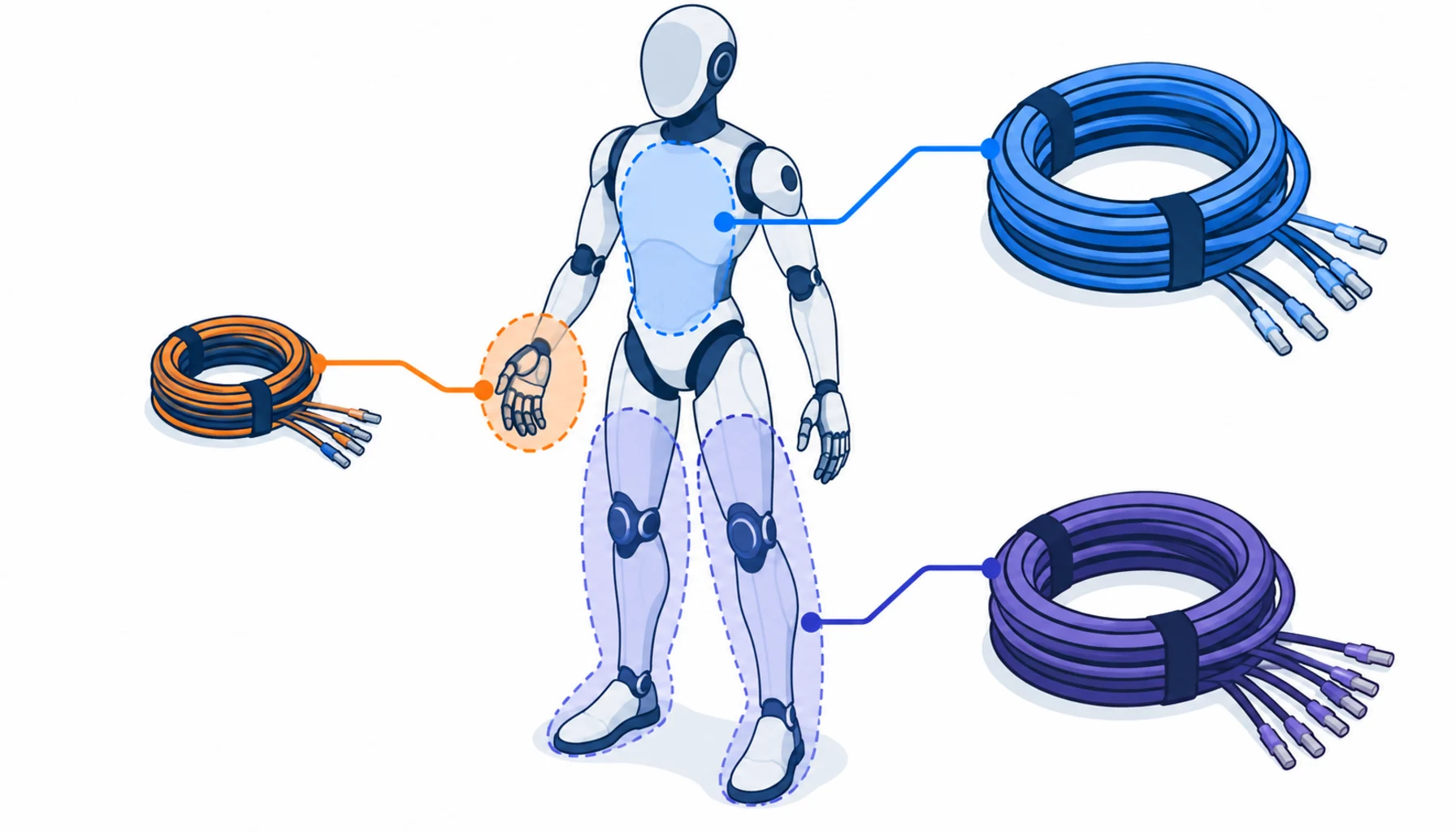
Map a humanoid’s wiring and three zones appear. The limbs carry the highest-flex duty: actuator power, joint encoders and communication lines packed into a forearm or shin that must flex at the wrist, the elbow and the fingers, some of them through ranges industrial robots never attempt. The torso carries the trunk runs: battery power, the compute bus, and the harnesses bridging arms to hips, flexing with every step rather than every cycle. And the extremities, the hands especially, carry the densest packing problem in the industry: tactile wiring and finger actuation in a volume the size of a human palm, where jacket thickness is measured against millimetres of available space.
Each zone stresses a different cable property, which is why humanoid wiring resists the one-construction-fits-all approach. Limbs need extreme flex life at tiny radii. Trunk runs need durability under continuous low-amplitude flexing plus shielding against the machine’s own drive electronics. Hands need miniaturisation without giving up signal integrity, which pushes conductor classes and insulation systems toward their practical limits. The failure modes these stresses produce, from broken conductors to intermittent shields, follow the industry’s standard catalogue, explained in the analysis of why cables fail on machines.
| Zone | What runs through it | Duty profile | Deciding cable property |
|---|---|---|---|
| Limbs and joints | Actuator power, encoder feedback, communication per joint | Extreme flex at tight radii, wide joint arcs, millions of cycles | Flex life at very small bend radii |
| Torso and trunk | Battery power, compute bus, limb bridging harnesses | Continuous low-amplitude flexing with each step, drive noise nearby | Durability and shield integrity |
| Hands and extremities | Finger actuation, tactile and sensor wiring | Dense packing in millimetre-scale volumes, fine motion | Miniaturisation with signal integrity |
What the 80 Per Cent Share Means for Cable Sourcing
The zones explain a supply chain pattern worth naming: humanoid makers do not buy cable, they buy wiring systems. Harness design, connector choice and jacket chemistry are co-engineered with the limb design, because a cable that gains two millimetres of diameter can force a redesign of the forearm. That co-engineering favours suppliers who sit close to the design process, whether the maker is in Hangzhou or California, and the build-model choices involved are compared in the guide to OEM versus ODM supply.
When the Humanoid Story Is Not the Answer
For humanoid makers outside China, the supply chain concentration presents a sourcing decision rather than a problem to be solved. Western governments and makers are investing in domestic actuator and component capacity, but cable-specific capability, the stranding lines, the test rigs, the compound experience, concentrates faster than capital can replicate it, because it compounds through production volume. The realistic near-term pattern is hybrid: Chinese cable inside Western humanoids, qualified through the makers’ own verification, with control cabinets and internal assemblies built to the maker’s standard in the guide to custom control cabinet construction.
For cable suppliers, the humanoid opportunity arrives in two tranches. The first is design-in: being specified when a limb architecture is drawn, which rewards proximity to the makers and their iteration speed. The second is scale-up: the moment any maker’s shipments multiply, its flex cable demand multiplies with it, and the suppliers who held the design-in win the volume. Neither tranche rewards size alone; both reward the ultra-fine stranding and evidence culture the industrial robot market already demanded. Signal-level requirements inside these machines mirror the compact, high-integrity demands described in the guide to control and instrumentation cabling.
| Decision | Why it matters for humanoids | Practical handling |
|---|---|---|
| Design-in versus catalogue sale | Limb architecture and wiring are co-designed | Engage at the joint design stage with engineer-to-engineer support |
| Ultra-fine capability proof | Hands and wrists exceed industrial flex requirements | Show stranding class, lay data and flex results at tiny radii |
| Iterate at maker speed | Hardware revisions arrive in months | Support short prototype runs and fast construction changes |
| Weight and diameter budget | Every gram and millimetre competes in the limb | Optimise construction for the mass budget, not just the duty |
| Scale-up readiness | Shipping rates can multiply within a year | Plan capacity and construction stability for the ramp |
RFQ Checklist: Cable for a Humanoid Programme
Three cautions keep the hype honest. First, volumes remain small: even after record growth, humanoid shipments are a rounding error beside the roughly 600,000 industrial robots installed worldwide in 2025, so cable suppliers should size the near-term opportunity accordingly. Second, the shipping figures are company disclosures, unaudited and promotional by nature, and the 80 per cent share should inform strategy, not spreadsheets. Third, the technology’s wiring problems are industrial problems: extreme flex, miniaturisation, signal integrity, the same disciplines this catalogue covers, which means the humanoid opportunity rewards suppliers who mastered industrial robots first and treats the rest as marketing.
Conclusion
Send these so the quote reaches the design team with substance:
- Zone application: limb joint, trunk run or hand, since constructions differ sharply
- Joint duty: arc range, flex frequency, and the design-life cycle target
- Bend radius at the joint, measured on the limb geometry, not free air
- Conductor and diameter budget, including the mass limit per limb
- Signal set: actuator power, encoder, communication and any sensor lines in the same bundle
- Prototype-versus-production phase, and the construction change process between them
- Test evidence expected: flex life at radius, conductor fatigue, shield continuity in motion
- Scale-up timeline, so capacity planning can track the shipping ramp