Live Swap Power in the Data Center: Buying Maintenance Access Without a Shutdown
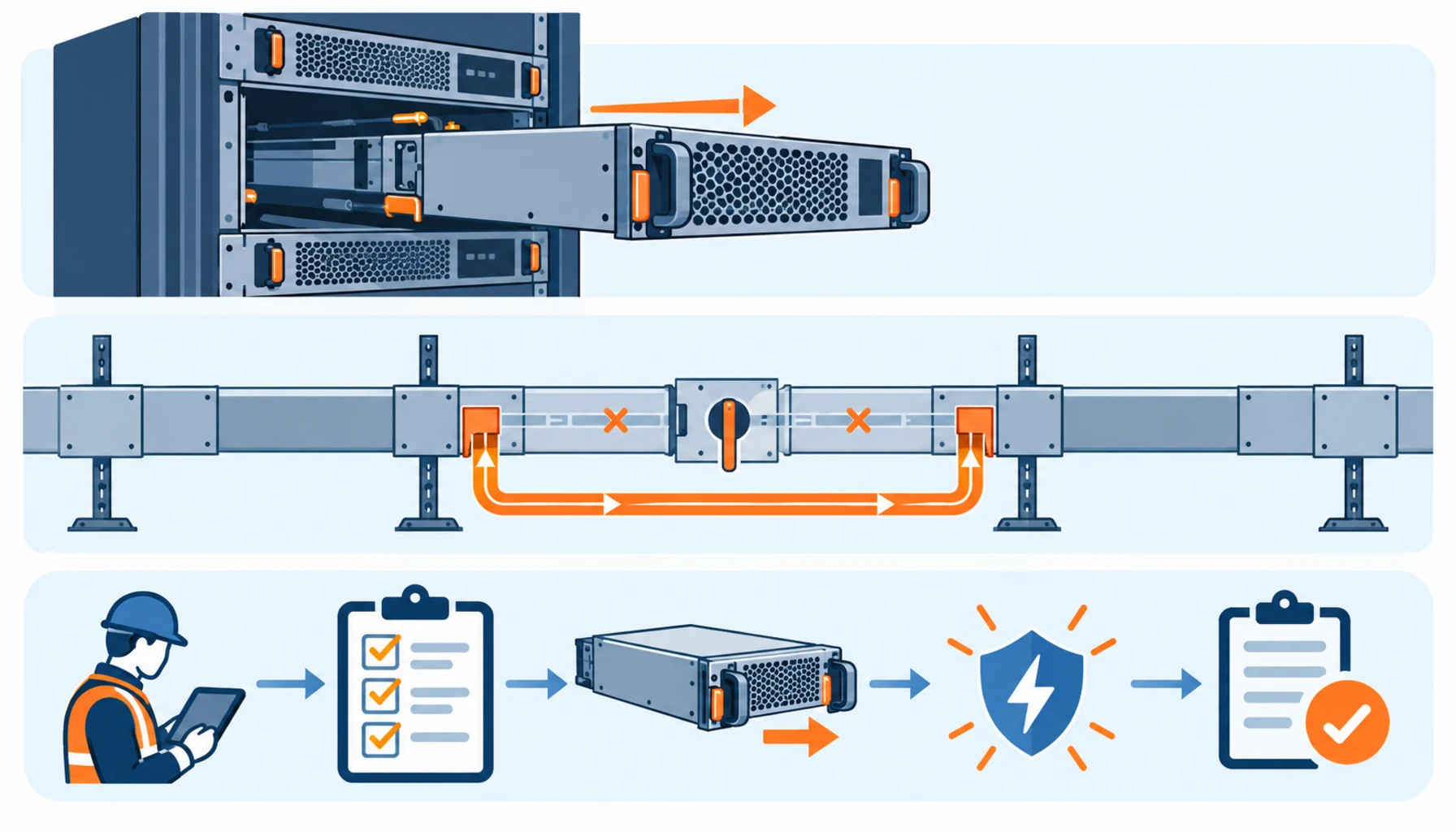
Quick Answer: Live swap is a buying requirement, not a feature you discover after installation. It has to be purchased at three levels — the removable module, the isolation point that lets it be removed safely, and the bypass path that carries the load while it is out — and it is only worth paying for where a shutdown would cost more than the mechanism.
Every data center operator says they want maintenance without downtime. Very few write it into a specification in a way a supplier can quote against. The result is equipment that can be maintained in theory and requires an outage in practice, and the gap between the two is usually discovered during the first failure rather than at the design review.
Introduction
Live swap has moved from a nice-to-have to a procurement line item as rack density has risen. In an AC hall with a conventional UPS topology, replacing a power module or a section of distribution meant either a planned outage on that feed or a bypass arrangement that existed mostly on paper. In an 800V DC hall the power path runs through a smaller number of higher-rated components, so the consequence of taking one out is larger, and the industry has responded by designing for removal under load as a first-class requirement.
Vendors now market live swap capabilities on power shelves and distribution equipment — the ability to pull a module or a busway section out of a running system and replace it with the hall still at load. As a buyer you are not choosing whether that is a good idea. You are deciding whether you are paying for it, and whether the components in your specification actually deliver it. The roadmap stage that introduces these rack-side power shelves is described in our note on the 800VDC roadmap in three steps.
Three Levels of Live Swap, and What Each One Costs
Live swap is not a single property. It exists at three levels, and the common procurement error is paying for one level while assuming the others came with it.
| Level | What It Means in Practice | What Must Be Specified | Cost Position | Risk If It Is Assumed Rather Than Bought |
|---|---|---|---|---|
| Module level | A power module can be pulled and replaced with the system at load | Removable enclosure, keyed connector, hot-plug rated contacts, load sharing | Modest premium, mostly in connector and control engineering | A module that has to be isolated first, which is the outage you were avoiding |
| Distribution level | A busway section or tap-off can be worked on without dropping the row | Sectionalised busway, isolation points, bypass path and rating of the bypass | Larger premium, and it drives the layout early in design | A run that is electrically continuous everywhere, so any work drops the row |
| Procedure level | People are permitted and equipped to work on a live system | Written switching procedure, arc-rated PPE, insulated tooling, training records | Low capital cost, real operating cost | A live-capable system nobody is authorised to touch — capability bought and never usable |
The Module Level Is Where the Money Is Spent First
Module-level live swap is the version most buyers actually need, because the components that fail most often are the ones with the shortest design life — power conversion modules, fans and control boards. Making those removable under load is a connector problem before it is a power problem: the contacts have to be rated for make and break at load, the mechanism has to sequence correctly so that sensing and communication pins engage before power pins, and the load sharing has to survive the moment one module drops out.
Three specification lines turn a claim into a purchase. The connector’s hot-plug rating at the actual load current, not a generic rating. The load-sharing behaviour during a swap, expressed as a maximum transient on the remaining modules. And the sequencing arrangement of the connector, so that an operator cannot close power before the control contacts are made.
There is also a redundancy question that sits underneath. Live swap only works if the system has somewhere for the load to go. A rack power shelf running at N with no spare module cannot have a module removed under load regardless of how good the connector is, which is the same arithmetic that governs UPS topologies. Our note on N+1 versus 2N UPS redundancy covers the redundancy side, and it applies unchanged to a DC rack shelf.
Distribution-Level Live Swap Drives the Layout
Being able to work on a busway run without dropping the row is a more expensive capability, and it has to be designed in from the start. It requires the run to be sectionalised with isolation points, each isolation point to be rated for the fault duty it will see when it is opened under load, and a bypass path to exist that can carry the full row current while a section is out.
That bypass is the part that gets left out of a specification. If the enquiry asks for “sectionalised busway with isolation”, the supplier will quote sectionalised busway with isolation, and the bypass may end up being a manual arrangement that requires its own outage to set up. Ask instead for the switching sequence in writing: what the operator does, in what order, and what carries the load at each step.
Two further items belong in the same conversation. The isolation device has to be rated for the fault level at the point it is opened, which is a DC protection question governed by the time constant and by the device’s DC rating. And the tap-off hardware in the section being worked on has to be removable without disturbing the sections on either side — a mechanical property that is easy to lose in a value-engineered revision. Our busbar tap-off box range is the conventional reference for the hardware; the live swap question is about the isolation and bypass around it.
The Procedure Level Is Free of Capital Cost and Rarely Free in Practice
The cheapest determinant of whether live swap works is whether anyone on site is allowed to do it. A system can be fully live-swap capable in hardware and still require an outage, because the facility has no written switching procedure, no arc-rated protective equipment, no insulated tooling, and no training records for the people who would perform the work. That is a specification item in the same way a breaker rating is.
The procurement action is to make it a deliverable rather than an assumption. Ask the supplier for the recommended switching procedure, the arc flash assessment for the equipment as installed, and the tooling list. Ask your own operations team who is qualified. If the answer is nobody, the live swap premium has been spent on a capability that will not be used, and the honest options are either to fund the training or to drop the requirement and plan the outages properly.
One more consideration is genuinely a safety one rather than a commercial one. Working on energized DC equipment carries a hazard that does not clear the way an AC arc does, which is why the isolation device and the PPE have to be selected together. Maintenance planning across the equipment life cycle, including when replacement rather than repair is the right answer, is covered in our note on data center cable lifecycle.
What to Freeze in the Live Swap Specification
Each item below is something a supplier will default on unless it is written into the enquiry, and each default turns a live swap capability into a planned outage.
| Specification Item | What to State | Evidence to Demand | Cost of Leaving It Open |
|---|---|---|---|
| Hot-plug connector rating | Make and break capability at the actual load current | Connector type test for hot-plug duty at that current | A module that must be de-energized before removal |
| Redundancy position | The N, N+1 or 2N configuration the swap is performed under | Load calculation showing the remaining capacity during a swap | A live swap procedure with nowhere for the load to go |
| Isolation points | Where the system can be broken, and the DC rating of the device that breaks it | Device DC rating at the fault level at that point | An isolation device not rated for the fault it will interrupt |
| Bypass path | What carries the load during work, and its current rating | Switching sequence in writing, step by step | A bypass that itself needs an outage to set up |
| Connector sequencing | The order in which control, sensing and power contacts engage | Connector arrangement drawing and mating sequence | A mechanism that can close power before control is established |
| Switching procedure | Who performs the swap, using what, in what order | Written procedure, PPE list, tooling list, training records | A live-capable system nobody is authorised to work on |
| Spares holding | The modules and hardware held on site for swap, with delivery dates | Spares list and standing lead times | Live swap capability with nothing to swap in |
When Live Swap Is Not Worth Paying For
The capability is worth its premium where an outage is expensive and the equipment is genuinely modular. It is a poor purchase in three common situations.
Low-density halls with short maintenance windows already arranged. Where the hall is small, the density is moderate and a planned outage is cheap and easily scheduled, the live swap premium buys a capability nobody needs. A conventional arrangement with a properly documented bypass is cheaper and just as serviceable. The AC reference for a facility like that is our note on 415V data center distribution.
Systems with no redundancy to swap into. Live swap without spare capacity is a procedure that cannot be executed. Buying the mechanism without buying the redundancy is the most common way this requirement turns into dead capital.
Facilities with no live work authorisation and no route to it. If the organisation’s safety policy does not permit energized work, or the site cannot fund the training and equipment, the hardware capability will never be used. In that case the money is better spent on redundancy and on shortening the planned outage. The cabling patterns that support a redundant arrangement are covered in our note on redundant power feeds and cable.
The general rule is that live swap is a purchase you make three times: the module, the isolation and bypass, and the procedure. Buying only the first is the most common and the most expensive mistake, because it produces equipment that looks maintainable on a datasheet and demands an outage in practice.
RFQ Checklist for Live Swap Capability
Send the maintenance requirement, not just the electrical rating. Each enquiry should carry:
- The maintenance scenarios you need to perform without an outage, described as tasks rather than features
- The redundancy configuration during a swap, and the maximum transient allowed on the remaining capacity
- The hot-plug rating required at the actual load current, with the connector type named
- Where the system may be broken, and the DC rating and fault level at each isolation point
- The bypass path, its current rating, and the switching sequence as a written procedure
- Connector mating sequence, including the order of control, sensing and power contacts
- Enclosure and mechanism design for removal, with clearances and tooling requirements
- Arc flash assessment for the equipment as installed, and the PPE it implies
- Training requirements and the records you will accept as evidence
- The spares holding for modules and hardware, with standing lead times rather than intentions
- Warranty treatment of parts removed and replaced under a live swap procedure
Conclusion
Live swap is decided at the specification stage, not discovered at the first failure. It has three levels — the removable module with a genuinely hot-plug rated connector, the sectionalised distribution with isolation and a bypass that can actually carry the load, and the authorised procedure with the people and equipment to execute it. A supplier can quote the first convincingly and leave the other two to be discovered later, and that is exactly what happens when the requirement is expressed as a wish rather than as a line item.
Buy it where an outage genuinely costs more than the mechanism. Kexingyu Cable Group (KXYE) supplies the power, control and mineral insulated cable ranges, distribution cabinets and switchgear that these maintenance arrangements are built around — WDZ-YJY, WDZN-YJY, BTTZ, BBTRZ, NG-A (BTLY), KVV and YJV, along with busbar tap-off boxes, the dual power ATS cabinet range and medium voltage switchgear — from a single factory group, with copper price linkage available on project-scale orders. Send your maintenance scenarios, redundancy position and fault level and we will return a distribution package with the switching sequence itemised; the fastest start is a request for quotation.