Mexico: Nearshoring Factories and the Motion Cable Opportunity
Quick Answer: Nearshoring keeps moving production into Mexican plants, and every relocated production line brings moving axes whose motion cable demand is growing faster than local supply.
Nearshoring stories usually get told at the container level: factories moving, tariffs dodged, lead times shortened. There is a cable story inside the same trend that gets less attention. When a production line moves from Asia or the United States into a plant in Monterrey, Tijuana or Querétaro, it arrives with machine tools, conveyors, robots and gantries, all of them full of flex-rated cable that has just spent weeks at sea and will now run three shifts. And when new lines are commissioned instead of moved, the machines ordered come with the same requirement. Mexico’s manufacturing floor is filling up with moving machinery, and motion cable is one of the quiet beneficiaries.
Introduction
Mexico’s position in the automation map is unusual: it is a large manufacturing economy whose robot statistics understate its cable consumption. IFR’s World Robotics 2026 places global installations at roughly 600,000 units for 2025, with the United States setting a record at 38,500, and Mexico’s own installation counts remain modest by comparison. But Mexican plants do not need national installation records to consume flex cable. They inherit it inside imported machines, and they expand it every time a tenant line in an industrial park adds a cell, a conveyor spur or an automated packing station. The demand is embedded in equipment rather than declared in national statistics, which is precisely why it gets overlooked.
This article reads the market from the factory floor: where the machinery is, what duty it runs, and what the resulting cable buying looks like. The electrical infrastructure side of Mexican industrial parks, the substations and distribution that feed the machines, is covered in the batch-two analysis of industrial park power demand and is not repeated here in detail.
Where the Moving Machinery Lives
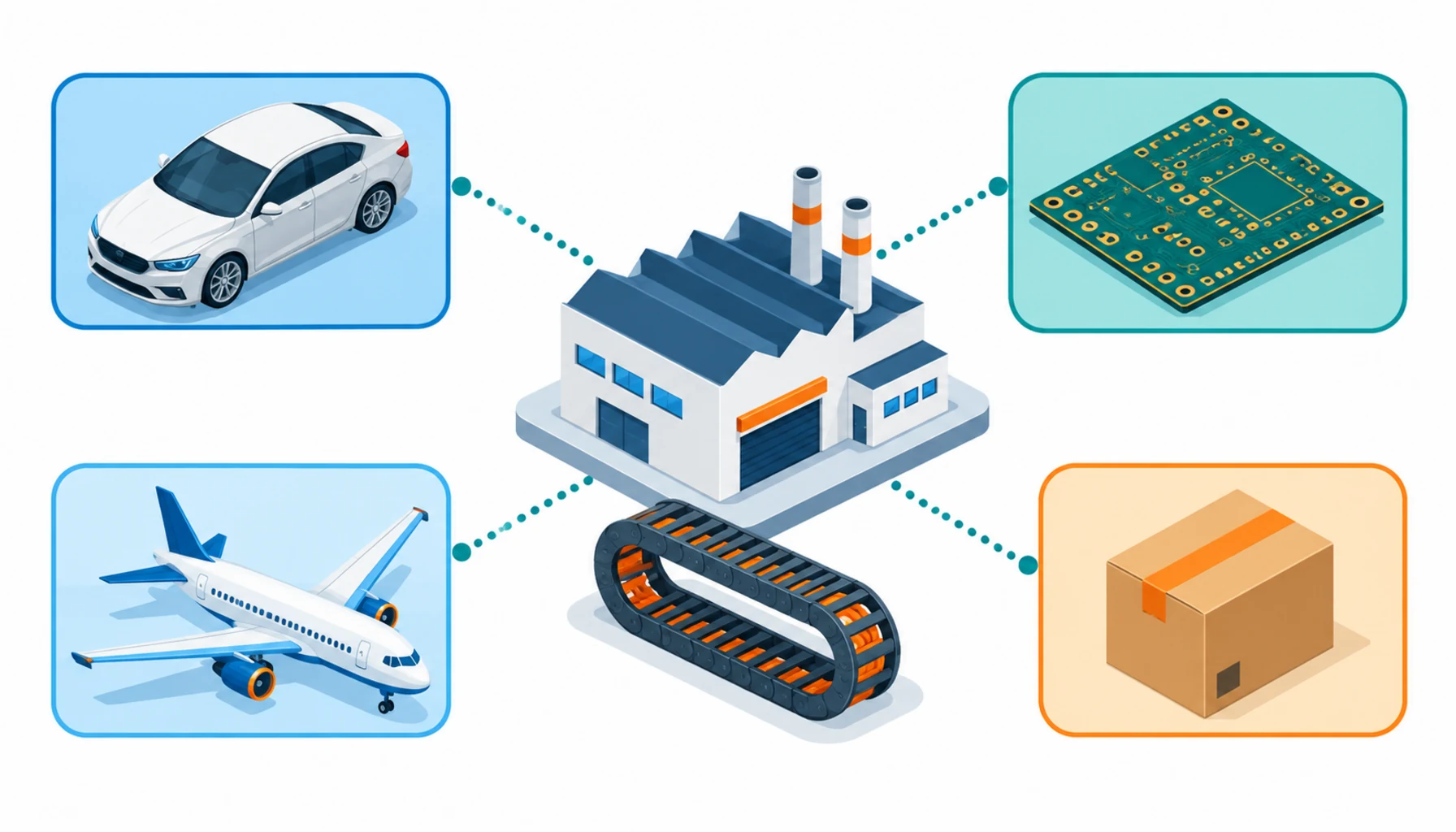
Four clusters carry most of Mexico’s automation. Automotive and its deep supplier base remain the anchor: body shops, powertrain plants and the fast-growing EV component sector run the heaviest robot fleets in the country. Home appliances and electronics, concentrated along the northern border, run high-speed assembly and test lines with compact cells and dense carriers. Aerospace, clustered in Querétaro and Baja California, automates precision machining and composite handling at the strictest quality level in the country. And the newest arrivals, furniture, medical devices and data-centre-adjacent fabrication, bring mid-sized fleets with the same three-shift expectations as their northern parents.
The common thread across clusters is lineage. Mexican plants overwhelmingly produce for export, mostly into the United States market, and their equipment and quality standards arrive from American, Asian and European parent companies. Cable inside those machines is specified by the parent’s build standard, then maintained by the local plant. That makes Mexico a replacement-heavy market with imported specification DNA, a combination with its own sourcing logic.
What the Cable Demand Actually Looks Like
Embedded demand has three practical consequences for cable buyers and suppliers. First, the replacement cycle dominates. Machines arrive, run for years, and their flex cable fails on schedule regardless of where the machine was built; the local maintenance team then sources cable that matches the original construction, often with little engineering support from the machine builder. Second, specification knowledge is uneven. A plant may run German-built machining centres beside Asian-built conveyors, each wanting a different cable philosophy, and the maintenance buyer needs help translating. Third, urgency outranks elegance: a failed drag chain cable stops a line that serves a US customer, so availability and lead time decide many orders that a catalogue would have decided on price.
Market research supports the scale beneath the anecdotes. QYResearch’s 2026 analysis of the robot drag chain cable market projects global demand growing from roughly USD 850 million in 2026 to about USD 1.24 billion by 2032, with the Americas’ share rising as manufacturing capacity returns to the region. PW Consulting’s 2026 review of warehouse automation, the segment most likely to appear inside Mexican fulfilment and nearshore logistics operations, projects the AMR market growing from about USD 7.6 billion to USD 23.4 billion over the same window. Neither figure is Mexico alone, but both describe currents flowing through it.
| Cluster | Where | Cable duty profile | What buyers actually need |
|---|---|---|---|
| Automotive and EV components | Bajío corridor, northern border, central states | Heavy payloads, weld heat and spatter, long dress packs, torsion at wrists | Duty-matched constructions and spares on short notice |
| Electronics and appliances | Tijuana, Ciudad Juárez, Mexicali, Guadalajara | Compact cells, tight carriers, high cycle counts, clean signals | Flex evidence at tight radii; fast replacement supply |
| Aerospace | Querétaro, Baja California, Sonora | Precision machining tending, composite handling, audit-heavy documentation | Traceability and parent-company spec compliance |
| Nearshore logistics and fulfilment | Border industrial parks and central hubs | Continuous motion, charging interfaces, round-the-clock abrasion | Cycle-proven cable and availability over catalogue price |
The Sourcing Patterns That Decide Orders
The table’s last column is the honest summary of the Mexican buying environment: engineering questions arrive wrapped in urgency. A maintenance lead sourcing a replacement cable cares about flex-life evidence, but cares about the shipping date more, because the line behind the failed cable feeds a delivery that will not move. Suppliers who solve availability, through regional stock, realistic lead times or split production runs, win orders that pure price quotes never see. Sizing cable correctly under time pressure is easier with the method in the guide to cable size selection, and the infrastructure that feeds these lines is planned with the industrial power distribution checklist.
When Nearshoring Headlines Are Not the Answer
Mexican cable purchasing sorts into three patterns, each with its own failure mode. In the imported-machine pattern, the plant inherits a foreign specification and must find an equivalent locally; failure comes from substitutions that look similar and fail earlier, a trap the analysis of why cables fail explains in mechanical terms. In the expansion pattern, a plant adds cells and needs new cable alongside the machines; failure comes from ordering late, because specialty flex cable is made to order with real lead times. In the OEM-support pattern, a supplier feeds a nearby plant building machines for export; failure comes from documentation gaps that surface when the finished machine reaches the border or the customer’s audit.
Each pattern rewards the same supplier behaviour: keep common flex constructions available quickly, state flex-life evidence openly, and put compliance papers in the box rather than in a promise. Cross-border equipment and cable buying carries wider risks that are catalogued in the guide to international sourcing mistakes, and most of them, from unclear specifications to certificate surprises, are avoidable with paperwork discipline at the order stage.
| Decision | Why it matters in this market | Practical handling |
|---|---|---|
| Match the inherited spec | Imported machines arrive with foreign build standards | Identify the original construction and verify equivalents by test, not appearance |
| Order timing | Specialty flex cable carries real production lead time | Order with the machine, not after the failure |
| Availability for breakdowns | Export lines cannot wait for a sea crossing | Agree spares stocking or split-run supply for critical axes |
| Documentation completeness | Export-bound machines face audits at the border and at the customer | Ship certificates and test records with the cable, every time |
| Heat and humidity margins | Plant halls without full climate control swing widely | Confirm jacket and insulation ratings against the real ambient |
RFQ Checklist: Motion Cable for a Mexican Plant
Three cautions. First, nearshoring is a direction, not a guarantee; individual projects move on individual economics, and a cable supplier betting on headlines rather than qualified customers will feel the difference. Second, Mexico’s robot statistics understate embedded demand but they are not wrong; a supplier expecting national installation figures to translate directly into cable orders will be confused by the replacement-driven reality. Third, duty still rules: a Mexican plant needs cable matched to its machine and its hall, and the certification overview in the cable certification checklist matters exactly as much here as anywhere the machines were born.
Conclusion
Include these so quotes match the reality of nearshored production:
- Machine origin and the build standard it carries, if known
- Duty per axis: travel, cycles per shift, and the shift pattern at the plant
- Actual bend radius and carrier type, measured if the original cable is being replaced
- Environmental exposure: coolant, oil, dust, and the real hall temperature range
- Whether the order is replacement, expansion or OEM support, since terms differ
- Required certificates for any machine bound for export
- Delivery expectation, including whether breakdown spares need regional availability
- Copper price adjustment terms for volume orders