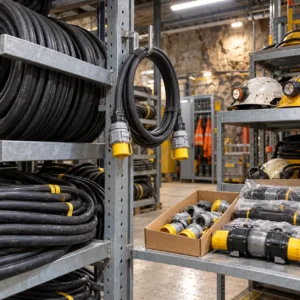
Buying Rubber-Sheathed Mining Cable (MYP, UGF and Equivalents)
Quick Answer: A rubber-sheathed mining cable is defined by its sheath compound, not by the letters stamped on the drum. MYP, UGF and the Chinese GB codes describe constructions that map only loosely onto IEC and BS equivalents, so the same three letters can mean two different cables from two suppliers. This guide covers what the codes do and do not tell you, how the compounds differ, what to demand as test evidence, and what to freeze before the order goes out.
Introduction
Rubber dominates mining mobile cable for a reason that has little to do with the catalogue. A rubber sheath stays flexible when the cable is dragged and coiled, tolerates being bent tighter than a thermoplastic sheath allows, and does not shatter at low temperature. Where cable is going to move, rubber is the default starting point rather than an upgrade.
The buying problem is that rubber is a family, not a product. Type codes such as MYP and UGF were written for national markets, and a supplier who quotes the nearest equivalent code is telling you the cable is roughly the right shape, not that it is the same construction. The three things worth pinning down before a quotation means anything are the compound, the duty, and the standard the destination site accepts.
What the Rubber Cable Codes Actually Tell You
Take the two letters apart and most codes stop being mysterious. In the Chinese GB scheme, M indicates a mining cable, Y indicates a rubber insulation or sheath, and the following letters describe the core of the construction: a P for a braided screen, a shield, a control core, or a flat profile.
UGF and the equivalent IEC family names follow the same logic in a different alphabet. What no code tells you is the sheath compound, the conductor class, the wall thickness, or the test regime, and those are the numbers that decide whether the cable survives a bench. Two suppliers can both quote “MYP-equivalent” and ship constructions that differ in every one of them.
So use the code to shortlist, then buy on specification. Ask the supplier to publish the construction code with its compound and conductor class beside it, and compare that line rather than the headline letters.
Sheath Compounds and What They Survive
Rubber sheaths are not one material. The common families behave differently enough that the compound choice matters more than the type code.
Polychloroprene-based sheath. The workhorse for mining trailing cable: good abrasion resistance, reasonable oil and weather resistance, and it keeps working across a wide temperature band. It is the compound most buyers picture when they picture mining cable.
CSM and EPR-based sheaths. Better ozone and weather resistance and a longer low-temperature range, at a higher unit cost. Worth the premium where cable is stored outdoors or the site runs cold.
Thermoplastic and TPE sheaths. Cheaper and perfectly serviceable on fixed runs, but the wrong starting point for a cable that flexes daily. Our note on cable sheath materials compared works through where each compound earns its price.
Two details matter as much as the polymer. Wall thickness sets how long the sheath lasts against abrasion, and the reinforcement, whether a textile braid or an embedded layer, decides whether the cable resists a haul truck tyre or only survives it once.
Matching the Cable to the Machine's Duty
Rubber cable is bought by duty, and the four duties pull the specification in different directions. A cable that satisfies a fixed feeder is a poor trailing cable, and the reverse is true as well.
Trailing duty. Dragged over gravel, coiled by hand at the end of a shift, and bent repeatedly at the machine entry. This is where flexible conductor classes and reinforced sheaths pay for themselves.
Reel and guide duty. Wound and unwound under tension. The wind-on geometry decides whether the cable rounds or flattens, and a spiral drum adds torsion to the load.
Fixed and semi-mobile duty. Laid along a roadway or carried on a gantry, moved rarely. A standard stranding and a lighter sheath are usually enough, provided the environment is handled.
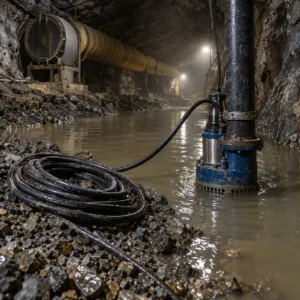
Immersed duty. Sump and dewatering service, where water-blocked construction and the earthing arrangement matter more than flexibility. The families available for each duty are listed in our rubber cable range.
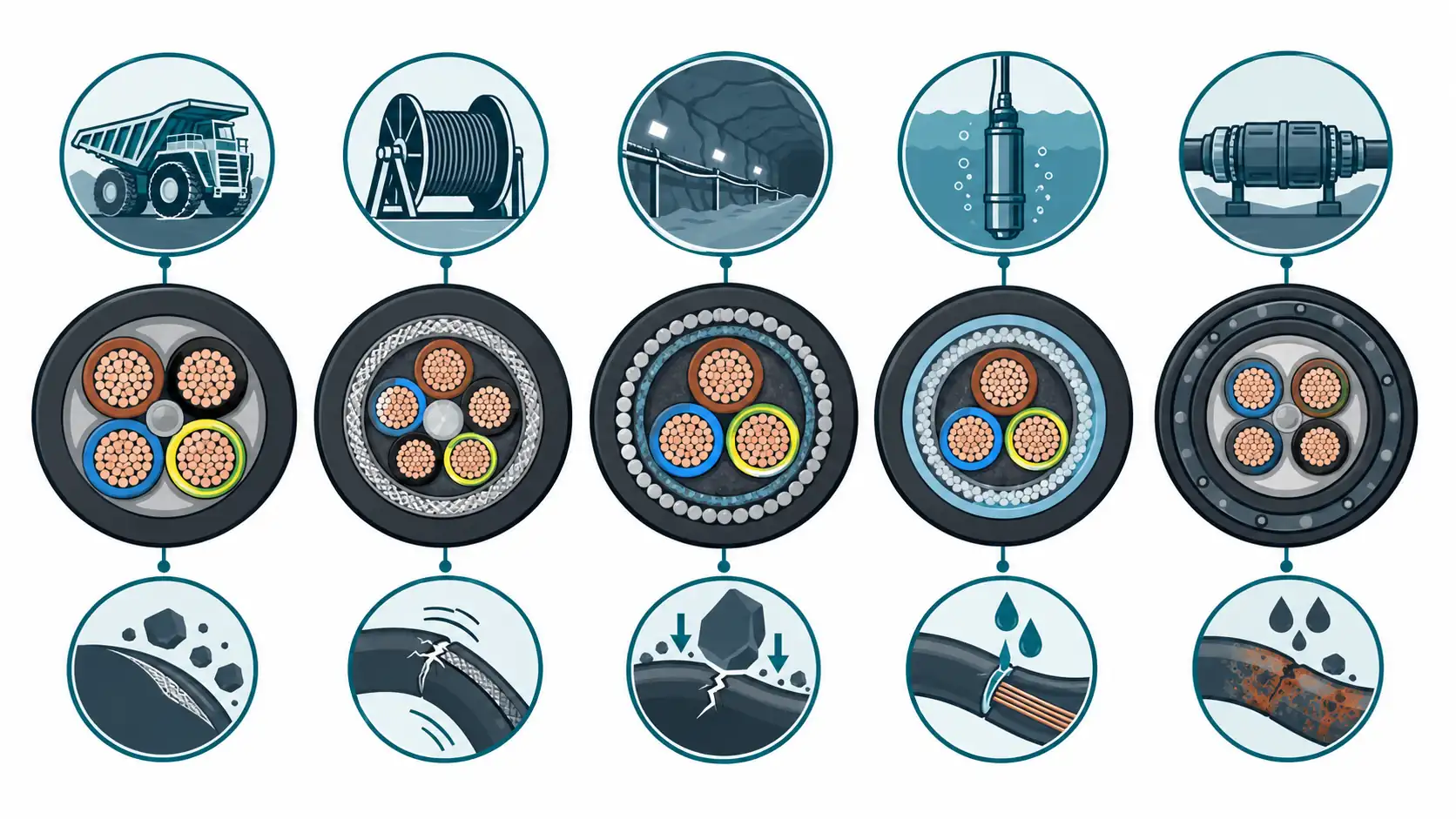
The table below sets the families side by side: what each is for, what to specify, what evidence to demand, and how it fails when the order is written loosely.
| Family | Duty on Site | What to Specify | Evidence to Demand | Cost and Lead-Time Driver | How It Fails |
|---|---|---|---|---|---|
| Mobile machine cable, MYP type and equivalents | Dragged and coiled daily behind loaders and drills | Class 5 or 6 conductor, EPR insulation, heavy polychloroprene sheath, screen arrangement, bend radius | Flex and drag data at the declared radius, sheath tear results, screen continuity on the finished length | Sheath compound and wall thickness set the price band; flexible stranding adds cost | Sheath cut through to the screen, then water ingress and an earth fault |
| Reeling cable | Wound and unwound under tension along a bench | Reel duty and torsion rating for the winding geometry, drum and guide dimensions, length per drum | Reeling cycle test at the declared tension, torsion test for spiral drums | Torsion-rated construction costs more and is usually made to order | Corkscrewing after torsion beyond rating, core breakage at the drum entry |
| Underground flexible feeder | Fixed or semi-mobile in a damp, congested roadway | Flame retardant and antistatic performance, armour or screen arrangement, bend radius, pulling sections | Flammability and antistatic report to the named standard, mark covering the construction | The certified compound and the approval paperwork both sit in the lead time | Damage at tight bends, water tracking into a joint, corroded armour |
| Service and pump cable | Continuous immersion for dewatering pumps | Water-blocked or submersible construction, flat or round profile, earthing core arrangement | Immersion test evidence, insulation resistance figures, gland details | Submersible construction carries a premium over general rubber cable | Water treeing in insulation, earth core corrosion, failure at the gland |
| Couplers, joints and repair sleeves | Assembled in the field, wet and under time pressure | Rated voltage and current, ingress protection, compatibility with the rubber construction, tooling | Type test evidence, sealing verification for the assembled state, assembly instructions | Cheap against the labour of a joint; incompatible kits are the expensive version | Joints that pass a megger and fail under load, moisture into the screen |
Construction Details That Decide Life
Conductor class. Flexible rubber cable uses finely stranded copper, and the finer the stranding the longer it survives being dragged. Class 5 and class 6 conductors cost more than standard stranding, and on a trailing application they are not optional.
Insulation. Ethylene propylene rubber is the usual partner for a rubber sheath. It keeps its properties at low temperature and tolerates the repeated working that a mobile cable sees, where a cross-linked polyethylene insulation would stiffen and crack.
Screen or pilot core. Mobile machine cable carries one or the other for earth continuity monitoring, and its continuity is a safety function rather than a signal function. Whether the screen is metallic or composite, and how it behaves when the sheath is cut, matters more than the coverage figure.
Reinforcement. A textile braid or embedded reinforcement layer is what separates a haul-road cable from a general-purpose rubber cable. Ask for it in writing, because a cheaper compound sheath without reinforcement will pass a visual inspection and fail in the first season.
Standards and Test Evidence
Rubber mining cable is specified against a national standard, and the equivalent code from another market is a starting point rather than a substitution. Chinese MYP-family constructions sit under the GB/T 12972 series, and the IEC equivalent sits in the 60245 family; the two overlap in intent and not in every dimension.
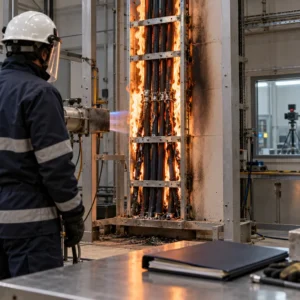
What to demand with the quotation is more specific than a standard number. Ask for the construction drawing with conductor class, insulation compound, sheath compound, wall thickness and screen arrangement; the test report for the exact construction quoted; and, where the destination is underground and regulated, the mark issued against that construction. Our note on MV cable standards across IEC, GB and BS explains how the same cable is described differently in each system.
A certificate names a construction, not a brand. Substituting a sheath compound or moving production to a second line breaks it on paper even when the cable looks identical, which is why compound changes need to be agreed in writing rather than discovered on delivery.
What to Freeze Before the Order Goes Out
These five items are cheap at specification stage and expensive once drums are on a truck.
| Decision | What to State | Evidence to Attach | Cost of Leaving It Open |
|---|---|---|---|
| Sheath compound | The polymer family and the compound grade, not the type code alone | Material declaration and the compound on the construction drawing | A cheaper sheath that passes visual inspection and fails in a season |
| Duty per run | Trailing, reeling, fixed or immersed, run by run | A cable schedule mapping every run to its machine | One construction bought for two duties |
| Conductor class | Class 5 or 6 for trailing duty, class 2 for fixed feeders | Conductor class declared on the construction drawing | Premature core breakage at the machine entry |
| Standard and mark | The standard the destination site accepts, plus the mark covering the construction | Test report for the exact construction quoted | A delivery that cannot be inspected in |
| Ends, lengths and spares | Factory-fitted ends, working lengths, drum sizes, and a stated spare allowance | Packing list checked against the cable schedule | Joints where a continuous length was expected |
Price, Lead Time and the Copper Element
Rubber cable is priced from the copper outward. The conductor, at a flexible class, is the largest single component and the only one that moves between quotation and order. On a tender that precedes the purchase order by months, the copper basis and its validity window belong in the comparison rather than in a footnote.
The sheath compound is the second lever. A reinforcement layer, a certified compound and a submersible construction each add cost that a general-purpose cable avoids, and a quotation that is unexpectedly cheap is usually a quotation for less cable than was asked for.
Lead time runs on the compound, the reinforcement and the drum lengths. Stock constructions ship in days; made-to-order rubber cable runs on the sheath line; certified underground construction is the longest, because the approved compound and the standard’s test regime sit on the critical path. Plan back from the shutdown, not forward from the specification date.
Incoming Inspection: What to Witness
Against the drum, before anything is cut. Count drums against the packing list, verify the marked lengths and photograph the markings, including the construction code and the drum number.
Electrical and dimensional checks. Conductor resistance and continuity, insulation resistance, and screen continuity end to end; then overall diameter, sheath thickness and actual conductor cross-section on a cut sample. Measuring the copper area settles arguments about what the conductor is, and it is best done with both parties present.
Documents. Match the test reports to the drum references, and confirm that couplers, joints and consumables arrived with the cable rather than behind it.
When a Rubber Sheath Is Not the Answer
When the run never moves. A fixed roadway feeder does not need a flexible conductor or a premium sheath, and paying for both is money spent on properties the installation cannot use. The correct saving is in the conductor class and the sheath grade, not in the standard the site requires.
When the failure is routing rather than the cable. Repeated damage at one point on a face conveyor is usually a guide, a clamp or a bend radius problem. Our note on cable damage wear patterns is written to separate a routing fault from a cable fault before a heavier drum is bought.
When the site’s approved list already settles it. If the mine’s engineering standard names a construction and a supplier, the competition moves to delivery, service and spares, and the specification work is about writing the duty accurately enough to enforce it.
When the tightest bend is the real specification. A rubber cable bought without stating the radius at the machine entry will be judged against a figure the supplier chose. Where a run bends tighter than the standard allowance, the answer is often a different construction or a routing change rather than a thicker sheath; our note on cable minimum bend radius covers where suppliers quote that number optimistically.
RFQ Checklist
- Duty stated per run: trailing, reeling, fixed, semi-mobile or immersed
- Working length including trailing loop and vertical drops
- Sheath compound family and grade, declared on the construction drawing
- Conductor class per duty, with flexible class named for trailing runs
- Insulation compound, and screen or pilot core arrangement with coverage
- Reinforcement or armour required, stated as a construction clause
- Minimum bend radius at the machine entry and at the reel or guide
- System voltage, insulation level and prospective fault current per feeder
- Continuous and starting current, plus starting frequency per shift
- Standard and mark the destination site accepts, for the exact construction
- Factory-fitted ends versus field joints, with coupler type and supplier
- Working lengths, drum sizes, mass limits and drum marking
- Tests to be witnessed, records per drum, and the copper basis with its validity window
Conclusion
Rubber-sheathed mining cable is bought on compound, duty and standard, with the type code used only to shortlist. Get those three into the RFQ in numbers a manufacturer can build against, and the comparison between quotations becomes a comparison of cable rather than of letters.
Kexingyu Cable Group (KXYE) has supplied electrical cable from Quanzhou since 1996, including the rubber-sheathed, screened and control constructions that mobile and underground mining duty calls for, along with the joints, couplers and accessories that go with them. Send us the cable schedule with the duty, the run lengths, the standard and the site conditions, and we will come back with the constructions, the test evidence that applies to each, and a delivery plan against your shutdown window. The fastest route is a request for quotation.