Off-Grid and Hybrid Inverters for Unstable Grid Regions
How to evaluate backup architecture, transfer behavior, generator compatibility, battery requirements, and supplier support where utility power is unreliable.
Why Grid Instability Changes Inverter Selection
In a stable utility network, a solar inverter is often selected mainly for PV compatibility, conversion efficiency, grid-code compliance, and cost. In a region affected by brownouts, load shedding, frequency drift, or extended outages, the decision becomes broader: the inverter is part of the site’s power-resilience system.
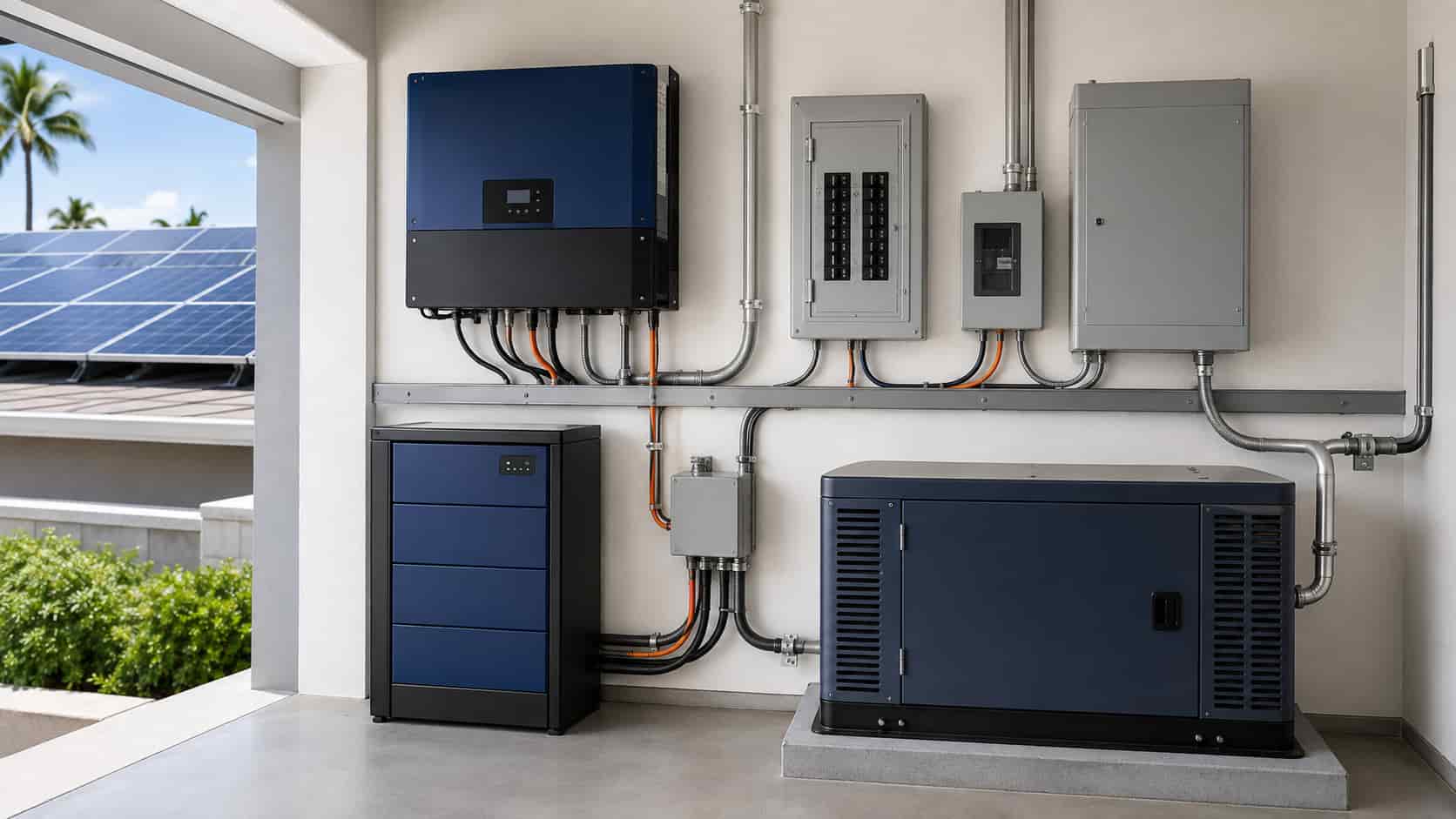
A standard grid-tied inverter normally disconnects when utility power fails. This anti-islanding behavior protects utility workers and equipment, but it also means that solar panels alone will not keep ordinary site loads running during an outage. Backup operation requires an inverter architecture with a designated backup output, appropriate control logic, and an energy source that can support the loads.
That energy source is usually a battery, although some systems also coordinate a generator. The practical question is therefore not simply whether a product is described as “hybrid” or “off-grid.” Buyers must confirm how the complete system behaves during low voltage, unstable frequency, a total blackout, generator operation, battery depletion, and grid restoration. Our guide to on-grid, off-grid, and hybrid inverter systems explains the basic architectural differences.
What an “Unstable Grid” Can Mean
Grid instability is not one uniform condition. A site may experience voltage that remains above or below nominal for hours, short voltage sags, frequent complete outages, scheduled load shedding, frequency excursions, phase imbalance, poor power quality, or rapid cycles of failure and restoration. Each condition places different demands on the inverter and connected equipment.
Before requesting quotations, record the nominal voltage and frequency, measured minimum and maximum values, typical outage duration, daily outage frequency, available fault information, generator details, and the loads that must continue operating. A short site power-quality study is more useful than telling a supplier only that the grid is “weak.”
Off-Grid or Hybrid: Choose the Operating Model First
An off-grid inverter is intended to form and regulate a local AC supply without depending on the utility grid. A hybrid inverter can coordinate PV, a battery, and the grid, and some models can also accept a generator. However, the word “hybrid” does not guarantee the same backup capabilities across products.
Confirm whether the inverter can operate in grid-forming mode during an outage, whether all loads or only a separate essential-load panel are supported, and whether three-phase backup remains balanced under unequal phase loading. Also check whether the system can black-start from the battery and PV after a complete shutdown.
For many commercial facilities, separating critical and noncritical loads produces a more economical and reliable design. Medical equipment, telecom systems, controls, security, lighting, refrigeration, and selected production loads can remain on the backup bus, while large discretionary loads are shed.
Input Voltage and Frequency Tolerance
A wider configurable grid-acceptance window may reduce unnecessary transfers to battery when the utility voltage or frequency drifts. But a wider window is not automatically safer. Connected loads must tolerate the same supply conditions, and the settings must comply with the applicable grid code and protection requirements.
Ask for the permitted voltage and frequency ranges, reconnection delay, ride-through behavior, and whether thresholds can be configured by authorized personnel. Determine whether the inverter passes the grid through to the loads, regulates it, or transfers to another source when values leave the accepted window. These are different behaviors with different consequences for battery cycling and load protection.
Transfer Time and Load Compatibility
Manufacturers may describe backup transfer as seamless, fast, or UPS-level, but the actual transfer time and test conditions must be stated. Some computers and electronic power supplies tolerate a short interruption; process controls, servers, medical devices, contactors, and communications equipment may have stricter limits.
Review the transfer time for grid failure and grid restoration, not only one direction. Verify behavior at different loads and power factors. If a load cannot tolerate the documented interruption, a dedicated online UPS may still be required even when a hybrid inverter supplies longer-duration backup.
The inverter’s continuous power rating is also not enough. Motors, pumps, compressors, transformers, and refrigeration equipment can demand high starting current. Check overload duration, peak or surge capability, voltage dip during starting, and the starting sequence of multiple loads.
Generator Compatibility Requires More Than an AC Port
A generator input label does not prove that the inverter and generator will operate reliably together. The inverter must accept the generator’s voltage and frequency variation, and the generator must remain stable when inverter charging power or site load changes quickly.
Confirm the permitted generator power range, input current limit, frequency and voltage window, maximum battery-charging power, warm-up and cool-down control, dry-contact or communications interface, and whether the inverter can prevent reverse power into the generator. Where supported, generator charging should be limited so the combined load and charging demand do not overload the set.
Generator neutral and earthing arrangements also require engineering review. Neutral switching, neutral-to-earth bonding, residual-current protection, and transfer equipment must match the local system and applicable rules. These points should never be inferred from a generic wiring diagram.
Battery Design Determines Real Backup Performance
Backup duration depends on usable battery energy, load profile, inverter losses, battery temperature, allowable depth of discharge, ageing reserve, and discharge-rate limits. A battery that appears adequate from nominal kilowatt-hours may be unable to supply the inverter’s required power or surge current.
Confirm battery chemistry, nominal and operating voltage range, continuous charge and discharge current, peak current, usable state-of-charge window, cycle-life test conditions, thermal management, and battery-management-system communications. The inverter and BMS must agree on current limits and protective actions.
For frequent outages, battery cycling can become much heavier than in a conventional self-consumption system. The operating strategy should reserve enough state of charge for backup while avoiding excessive generator runtime and unnecessary grid charging. Inverter size, battery power, and energy capacity must be checked together; our inverter sizing guide covers the main inverter-side constraints.
Environmental and Installation Conditions
High ambient temperature can reduce inverter output and shorten component life. Dust, humidity, salt mist, insects, poor ventilation, and direct solar exposure can also affect reliability. Check the enclosure rating, corrosion protection, permissible temperature and humidity range, altitude derating, cooling method, clearances, and installation location.
An IP rating alone does not cover every environmental risk. Ask whether the rating applies to the installed cable glands and connectors, and whether filters, fans, or other serviceable parts require scheduled maintenance. For remote sites, accessible replacement fans, control boards, surge-protection devices, and communication modules can materially reduce downtime.
Monitoring, Protection, and Remote Recovery
A resilient system should make faults diagnosable. Confirm local event logs, remote monitoring, alarm contacts, time-stamped grid and battery data, firmware-management policy, and communication options such as Ethernet, RS-485, CAN, or cellular gateways.
Protection coordination must include DC isolation, overcurrent protection, surge protection, earthing, residual-current requirements, battery protection, generator protection, and the downstream distribution system. Remote restart can be useful, but it should not bypass safety interlocks or replace investigation of repeated trips.
Supplier Evaluation Checklist
Ask suppliers to respond against a project-specific schedule rather than a generic catalog. The response should identify the exact inverter, battery, meter, transfer equipment, communication accessories, and firmware version proposed. It should also show which functions are standard, optional, or dependent on local configuration.
Request representative single-line diagrams, operating-mode descriptions, protection settings, battery compatibility information, generator integration logic, commissioning procedures, warranty terms, spare-parts recommendations, and escalation contacts. When possible, ask for references from installations with comparable grid and environmental conditions.
Factory acceptance testing can verify configuration, communications, alarms, protection responses, and selected operating transitions before shipment. Site acceptance testing should then confirm the actual grid, generator, battery, and load interactions.
| Evaluation item | Information to request | Why it matters | Evidence to verify |
|---|---|---|---|
| Grid tolerance | Voltage/frequency windows, ride-through and reconnection settings | Avoids unnecessary battery transfers without exposing loads to unacceptable supply | Exact model manual, setting list and applicable grid-code certificate |
| Backup transfer | Transfer time in both directions and test conditions | Determines whether sensitive loads reset or require a separate UPS | Test report and load-specific acceptance test |
| Generator integration | Accepted generator range, charge limit, start/stop control and reverse-power protection | Prevents unstable operation and generator overload | Approved wiring diagram and operating-sequence document |
| Battery system | Usable energy, power limits, BMS protocol and cycle conditions | Determines actual backup time, surge capability and battery life | Compatibility list, battery data sheet and sizing calculation |
| Environment and service | Temperature/altitude derating, IP rating, spares and support response | Reduces failure and downtime at hot, dusty or remote sites | Derating curves, installation manual, warranty and spare-parts plan |
Standard Product or Configured Solution?
Many projects can use a standard inverter with carefully selected settings and accessories. Others require approved configuration changes, external transfer equipment, a specific enclosure, regional communications, different battery integration, or generator controls. Configuration should be documented and validated; changing protection windows merely to keep an inverter online can create compliance or equipment risks.
OEM or ODM capability can be valuable when a project has repeatable volume and clear technical requirements, but customization adds validation, certification, documentation, spare-parts, and firmware-support obligations. Buyers should distinguish genuine engineering configuration from a cosmetic label change.
How to Build a Reliable Procurement Specification
Provide the supplier with measured grid data, critical-load schedule, motor-starting information, required backup duration, battery preference, generator data, ambient conditions, communications requirements, applicable standards, and the intended operating sequence. If the system uses multiple PV orientations, verify MPPT allocation and limits using our explanation of what MPPT means in solar systems.
Then require a written compliance matrix showing offered values, exceptions, and document references. The goal is a system whose behavior is predictable—not simply an inverter with an impressive list of features.
For KEXINGYU E-POWER GROUP projects, the engineering review should be based on the exact site and proposed model. Final voltage windows, transfer behavior, generator integration, battery compatibility, enclosure selection, and regional compliance should all be confirmed in project documentation before an order is released.