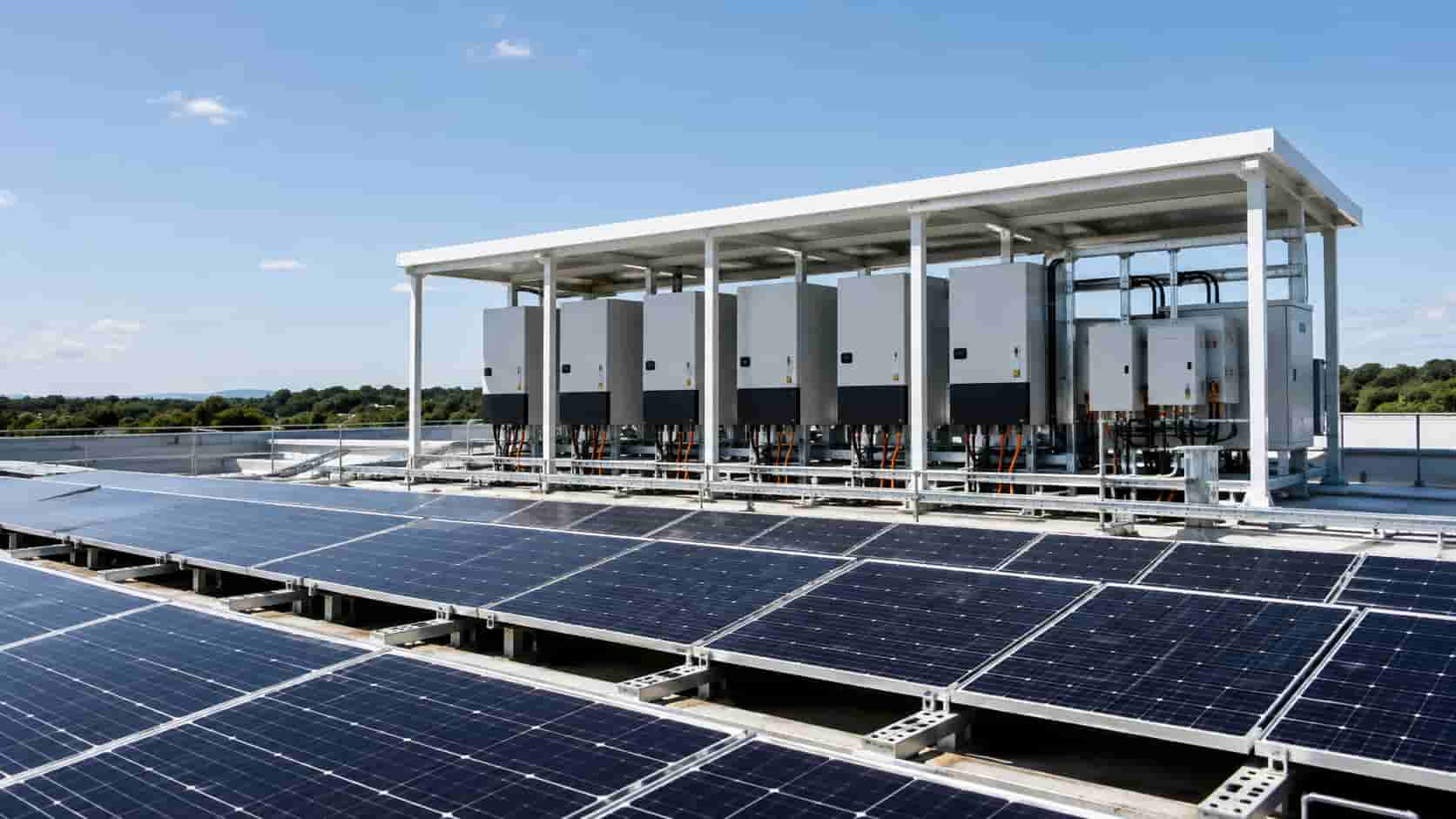
Modern commercial solar inverter used for PV array capacity and DC-to-AC ratio planning
A practical sizing guide for matching PV array capacity, DC/AC ratio, string voltage, MPPT current and backup-load requirements without overpaying or limiting system performance.
Why Inverter Sizing Deserves Its Own Step
Inverter sizing is not simply a matter of matching the inverter nameplate to the total wattage printed on the solar modules. The correct capacity depends on the type of system, expected PV production, local climate, array orientation, electrical string design and the loads the inverter may need to support.
For a grid-connected project, engineers normally begin with the PV array’s DC capacity and the target DC-to-AC ratio. For an off-grid or hybrid project, the inverter must also be checked against continuous load, short-duration surge demand and the size of the designated backup circuit. If you are still deciding which architecture applies, review On-Grid vs Off-Grid vs Hybrid Inverter before completing the sizing calculation.
This guide builds on What Is a Solar Inverter and How Does It Work? and focuses on the checks project developers, EPC contractors and procurement teams should complete before requesting a final model selection.
Step 1: Identify the Inverter's Operating Role
The calculation method changes depending on what the inverter is expected to do. Defining the operating role first prevents a common mistake: selecting a grid-tied inverter by PV capacity and then assuming it can also carry the site’s critical loads during an outage.
Grid-connected PV inverter
The primary objective is to convert available PV power and operate in parallel with the utility grid. The key capacity decision is normally the relationship between installed DC module capacity and the inverter’s rated AC output.
Off-grid or hybrid inverter
The inverter may need to form an independent AC supply when the grid is absent. In addition to PV capacity, the design must cover simultaneous loads, starting currents, battery discharge limits, backup duration and the permitted output of the inverter while islanded.
The physical architecture also matters. A project using many smaller units distributes capacity differently from one using a central machine. See String Inverter vs Central Inverter: A Buyer’s Comparison for the maintenance, MPPT and availability implications.
Step 2: Calculate the PV Array's DC Capacity
Calculate total installed DC capacity using the module rating at Standard Test Conditions (STC):
Total PV array capacity (kWp) = number of modules × module rated power (W) ÷ 1,000
For example, 240 modules rated at 550 W produce a nominal array capacity of 132 kWp. This is a nameplate value under standardized laboratory conditions. It is not a promise that the array will deliver 132 kW continuously in the field.
Module temperature, irradiance, orientation, soiling, mismatch, cable loss and degradation all influence actual DC output. This is why grid-connected systems commonly use an inverter with an AC rating below the array’s STC capacity.
Step 3: Select a Target DC-to-AC Ratio
The DC-to-AC ratio, also called the inverter loading ratio, compares installed PV capacity with inverter rated AC output:
DC/AC ratio = PV array capacity (kWp DC) ÷ inverter rated output (kW AC)
A 132 kWp array paired with a 110 kW inverter has a DC/AC ratio of 1.20. Conversely, the preliminary inverter rating can be calculated by dividing the array capacity by the target ratio:
Preliminary inverter capacity (kW AC) = PV array capacity (kWp DC) ÷ target DC/AC ratio
There is no universal best ratio. Values around 1.1 to 1.3 are common starting points for many commercial projects, but some designs use lower or higher ratios after energy-yield and financial modelling. Climate, orientation, export limits, module degradation, inverter efficiency, energy price and acceptable clipping must all be considered.
What clipping actually means
Preliminary DC-to-AC Ratio Calculation
The following examples use the same 132 kWp solar array to show how different target DC-to-AC ratios affect the preliminary inverter capacity calculation.
| PV Array | Target DC/AC Ratio | Calculated AC Capacity | Planning Observation |
|---|---|---|---|
| 132 kWp | 1.10 | 120 kW AC | Lower inverter loading and less potential clipping, but higher installed inverter capacity. |
| 132 kWp | 1.20 | 110 kW AC | A common preliminary starting point for commercial project evaluation, subject to yield modelling. |
| 132 kWp | 1.30 | 101.5 kW AC | Higher inverter loading with greater potential for clipping during peak irradiance. |
Formula: inverter capacity = PV array capacity ÷ target DC-to-AC ratio. These figures are preliminary examples only. Final selection must also satisfy manufacturer PV-input limits, string voltage, MPPT current, environmental derating, grid requirements and project-specific energy-yield modelling.
Clipping occurs when available DC power exceeds the inverter’s maximum AC conversion capability. The output curve is temporarily limited at the inverter rating. A small amount of clipping during infrequent peak conditions can be economically acceptable if the additional annual energy captured during lower-irradiance hours outweighs the lost peak production.
A ratio should not be selected only from a generic rule of thumb. Confirm the inverter manufacturer’s permitted maximum PV input, model the expected annual energy yield and review any utility export limitation.
Solar Inverter Sizing
Common questions from EPC contractors, project developers and buyers calculating solar inverter capacity and checking array compatibility.
01 What formula is used to calculate solar inverter capacity?
For preliminary grid-connected PV sizing, divide total PV array capacity in kWp by the target DC-to-AC ratio. For example, a 132 kWp array divided by a target ratio of 1.20 produces a preliminary inverter capacity of 110 kW AC. The final model must also satisfy voltage, current, environmental and grid-connection requirements.
02 Should solar panel capacity match inverter capacity 1:1?
Not necessarily. Grid-connected PV arrays commonly have a DC rating higher than the inverter's AC rating because modules rarely operate at their full STC capacity in field conditions. The correct ratio should be selected through energy-yield and financial modelling rather than automatically using a 1:1 match.
03 What is a suitable DC-to-AC ratio for a commercial solar project?
Ratios around 1.1 to 1.3 are common preliminary starting points for many commercial projects, but they are not universal limits. Climate, array orientation, module degradation, energy price, export restrictions, inverter efficiency and acceptable clipping can justify a lower or higher project-specific ratio.
04 Can the inverter be smaller than the solar panel array?
Yes, provided the proposed array remains within the manufacturer's maximum permitted PV power, voltage and current limits. Some peak production may be clipped, but moderate clipping can be economically acceptable if oversizing the array improves energy capture during lower-irradiance periods.
05 How is an off-grid or hybrid inverter sized?
Off-grid and hybrid inverters must be sized for the maximum simultaneous backed-up load as well as short-duration starting currents from motors, pumps, compressors and transformers. Battery discharge power, BMS current limits, phase imbalance, transfer mode and the inverter's overload-duration curve must also support the required loads.
06 Why must string voltage be checked at different temperatures?
Module open-circuit voltage increases in cold conditions and may exceed the inverter's maximum DC input voltage. Operating voltage falls as module temperature rises and may drop below the MPPT operating window. Both cold-condition Voc and hot-condition Vmp therefore need to be checked.
07 Can future solar expansion be covered by installing a larger inverter now?
Sometimes, but an oversized inverter does not automatically guarantee expansion capacity. Maximum DC voltage, MPPT current, total permitted PV power, spare inputs, utility approval, transformer capacity, switchgear and cable routes must all support the final planned system.