Pre-Terminated Fiber and Copper Trunks: Cutting On-Site Installation Time
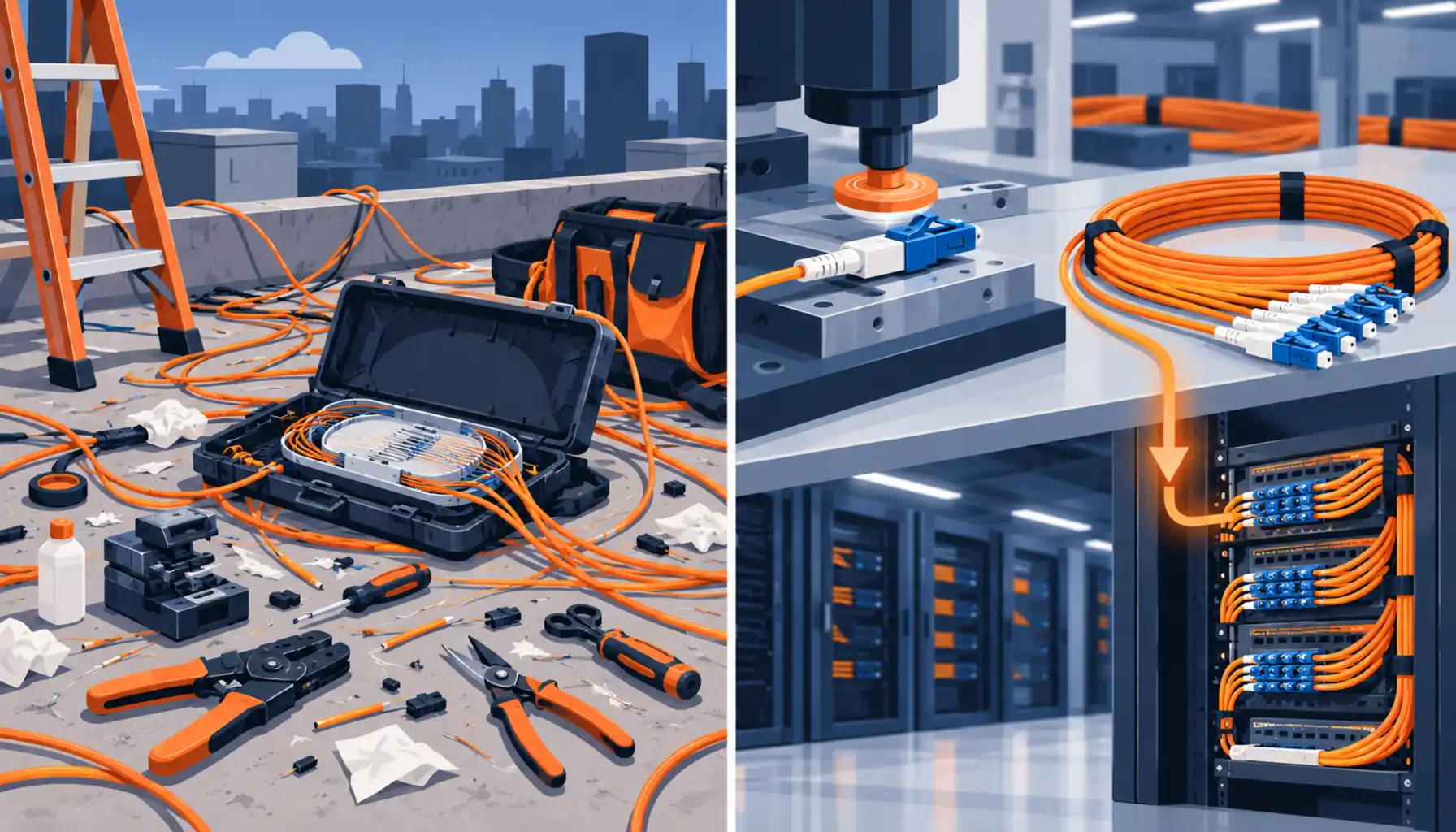
Quick Answer: Pre-terminated trunks move termination from the site’s worst conditions to the factory’s best ones — install time drops by half or more, every link ships tested, and the site’s job becomes pulling and plugging.
Pre-terminated cabling is really a location decision more than a product choice: where does a link’s termination happen — on a bench in a controlled factory, or on a ladder in a live hall? Field termination is the traditional answer and it carries the field’s conditions: dust and temperature, installers of varying skill, test equipment shared across crews, and a schedule that pushes quality decisions into overtime hours. Factory termination replaces all of it with machine-verified consistency: polished connectors on calibrated equipment, each trunk tested end to end before it ships, lengths cut to the pulling plan, and a site job reduced to pulling, seating and labeling. The savings compound in exactly the places data center projects hurt — schedule compression, skilled-labor scarcity, and the defect rate that field terminations carry at multi-hundred-link scale. This guide covers what pre-terminated means for fiber and copper, where it wins, and where field termination still holds its ground.
Introduction
The economics rest on a simple observation: termination quality is a function of conditions, and the factory’s conditions beat the site’s on every variable that matters. A pre-terminated fiber trunk arrives with its MPO or LC connectors factory-polished and factory-tested — insertion loss and return loss measured per link, documented per trunk — while its field-terminated equivalent carries the variance of whoever polished it at the end of a shift. The same logic governs copper trunks: factory-terminated 25-pair and Category bundles arrive with tested pinouts and verified performance, versus field punch-downs that inherit every technique error. The schedule mathematics is the decision driver: at hundreds of links, field termination time is a project-phase cost measured in weeks, and pre-terminated trunks replace it with pull-and-connect labor measured in days. The manufacturing logic is the one buyers already trust in power equipment, where factory acceptance testing per the FAT and SAT comparison moves verification to the bench; pre-terminated cabling applies the same principle strand by strand. The two families:
Pre-Terminated Fiber: MPO Trunks and the Pull-and-Plug Hall
The fiber version is the MPO trunk: a multi-fiber cable — 12, 24, 48 strands and up — factory-terminated at both ends with MPO connectors, or broken out at one end to LC duplexes, cut to the route’s measured length and tested as a complete assembly. The deployment model changes the hall’s rhythm: trunks pull through trays like cable, plug into MPO cassettes and panels at each end, and the link is live at seating — the site crew pulls and plugs, and the termination skill stays in the factory. The quality evidence ships with each trunk: factory test results per assembly, connector end-face inspected, polarity schemes (A, B, C methods) confirmed at order so the link’s transmit and receive land correctly. The design consequences deserve respect: trunk lengths must be measured before order because field-trimming a factory termination is impossible — slack planning becomes part of the route design, and the panel architecture (cassette-based breakout to LC, direct MPO to MPO) is chosen per tier. Pre-terminated architecture suits the tiers where links repeat — leaf-spine fabrics, row-to-row trunks, storage fabrics — and the repeat-density context that makes them repeat is the same rack arithmetic documented in the rack power distribution comparison.
Pre-Terminated Copper Trunks and Hybrid Rollouts
The copper version applies the same logic where copper tiers persist: factory-terminated Category bundles and multi-pair trunks, tested to their class limits before shipping, delivered on reels or in coiled packaging cut to route. The savings profile differs from fiber — copper’s field termination was already tool-driven — but the consistency gain and the schedule gain hold, particularly in high-repetition builds: workarea bundles, zone-to-rack trunks, and the standardized rows where every rack receives the same loom. For rollouts that repeat across sites — a chain of edge halls, a multi-building campus — the deeper advantage is repeatability: the same factory loom, the same tested assembly, deployed site after site, with the first site’s verification transferring to the rest; the multi-site operations pattern at the multi-site UPS supplier analysis shows the same lever in the power room. Sourcing-wise, pre-terminated assemblies reward suppliers who control both the cable and the termination line — the factory discipline behind that control is the same one audited per the manufacturer checklist, and bundling cable plus assemblies into one order mirrors the package logic of one-stop equipment sourcing.
| Aspect | Field Termination | Pre-Terminated Trunk |
|---|---|---|
| Termination site | Ladder, dust, overtime | Calibrated factory bench |
| Quality variance | Installer-dependent | Machine-controlled, documented |
| Testing | After install, by shared testers | Per assembly before shipping |
| Install time | Weeks at link scale | Days — pull, seat, label |
| Length changes | Cut and re-terminate freely | Fixed at order — measure first |
| Skill demand on site | High and scarce | Low — pulling and plugging |
The Design Discipline: Measure First, Order Once
Pre-terminated cabling shifts the project’s difficulty upstream to design, and the discipline is worth naming. Measure before order: trunk lengths come from the surveyed route — not the floor plan’s straight line — with slack and service loops budgeted per route, because a factory termination cannot be trimmed and a too-short trunk is a re-order. Polarity and pinout at order: fiber polarity method and copper pinout are factory-fixed; both are specified on the order so the shipped assemblies match the panel architecture. Panel architecture chosen first: cassette breakout versus direct MPO, LC density, and the loom layout per rack are design decisions the trunks then serve — reversing the order produces perfectly made assemblies for the wrong architecture. Staging: trunks arrive labeled per route; a staging plan that sequences pulling by tray section keeps the installation’s schedule advantage intact. Done in this order, the method delivers its promise — the hall’s links go live in days, with each assembly’s factory test report standing in for the field certification sweep that field-terminated projects run at the end.
When Pre-Terminated Is Not the Answer
The method has honest limits. Unmeasured routes — retrofits whose pathways are assumed rather than surveyed — generate re-orders, because a factory termination tolerates no trimming; on routes that cannot be surveyed, field termination’s flexibility is the feature. One-off links with unusual constructions or panel interfaces are sometimes cheaper field-terminated than special-ordered. And the schedule advantage evaporates on long-lead orders: factory trunks take their production and test time, so a compressed project that discovers its cabling need late may find field termination — for all its inefficiency — faster to start. The mature plan hybridizes deliberately: pre-terminated trunks for the repeating, surveyed, high-count tiers; field termination for the odd, unmeasured remainder; and the transition designed at panels so both constructions meet on purpose. The full cable-layer plan those panels organize — power alongside fiber and copper — is mapped in the data center power hub.
| Line | What to Specify | What It Prevents |
|---|---|---|
| Measured lengths | Route-surveyed lengths with slack budget | Re-orders on fixed terminations |
| Polarity / pinout | Method stated on the order | Transmit-receive faults at commissioning |
| Panel architecture | Cassettes, breakout, density chosen first | Assemblies built for the wrong panels |
| Factory test data | Per-assembly results with the shipment | Undetected bad links before pull |
| Labeling plan | Route labels applied at factory | Site-side sorting of lookalike trunks |
| Staging sequence | Pull order per tray section | Schedule advantage lost in chaos |
RFQ Checklist: Trunk Lines for the RFQ
Put the assemblies in writing:
- Routes surveyed; trunk lengths measured with slack
- Fiber counts, polarity method and breakout stated per trunk
- Copper pinout and class per trunk, tested to class limits
- Factory test reports required per assembly
- Labeling and packaging plan per route
- Panel architecture and cassette specs attached
- Delivery staged to the pulling sequence
Conclusion
Pre-terminated fiber and copper trunks move termination to where it is done best and pay for the move in schedule, consistency and shipped test data. The method’s price is design discipline — measured lengths, polarity at order, panel architecture first — and its honest boundary is the unmeasured and the one-off. Where links repeat, it is the fastest way a hall gets wired.
Kexingyu Cable Group (KXYE) produces pre-terminated fiber trunks and copper assemblies on its own termination lines: factory-tested per assembly, polarity and pinout fixed at order, labeled to route, and staged to the pulling plan — cabling that arrives ready to install rather than waiting to become one.