Schools and Public Buildings: Cable Selection and Compliance
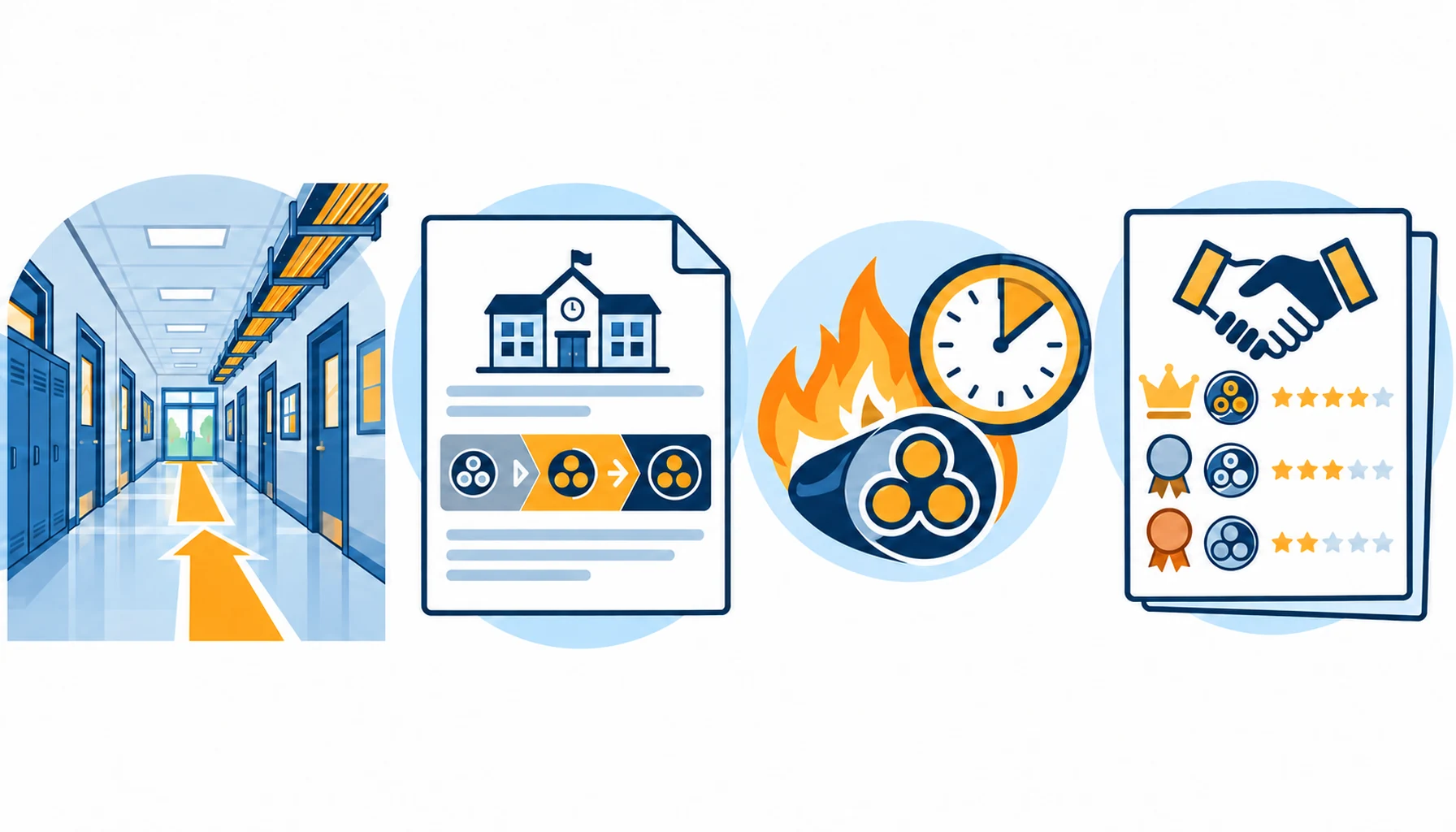
Quick Answer: A public building cable package has to satisfy two authorities at once. One is the regulatory regime, which names a material class and an egress requirement that must be met and documented. The other is a procurement process that has to justify the choice in public, which means the specification, the evaluation and the award all have to be defensible on paper. Get the compliance class right, design for users who will not treat the installation carefully, and keep the documentation to the standard the audit will expect.
Introduction
Schools, clinics, libraries, sports centres and civic offices share a set of conditions that make their cable requirements different from a commercial building of the same size. They are occupied by people who are not trained to avoid hazards, they are managed by organisations that answer to auditors and inspectors, and they are usually altered in a hurry during a holiday shutdown.
Their cable procurement therefore has three threads rather than one: the compliance class and the egress requirement, the durability the installation needs against the people using it, and the paperwork a public body has to be able to produce years later. This guide covers all three and lists what to freeze before the order.
What Sets the Requirement in a Public Building
Occupancy and egress. Large numbers of people, many of them unfamiliar with the building, have to get out unaided. The smoke behaviour of the materials along their escape route therefore matters more than it does in an office, where occupants know the layout and the routes are shorter.
Low supervision. Nobody in a school corridor is watching for a damaged cable. Surface wiring, sockets at reachable height and containment that can be climbed on or hung from are all normal, and the installation has to survive that rather than assume it will not happen.
Public accountability. The specification, the evaluation criteria, the reasons for the award and the evidence behind the delivered product all become records. A supplier who cannot produce documentation years later creates a problem for the client, not just for the project.
Seasonal working windows. Much of the work happens during holiday closures with a fixed return date. Lead time matters more than in a project with a movable handover, and a delivery that slips costs access to the building rather than a programme float.
The Compliance Side: Classes, Smoke and Egress
The regulatory requirement in most jurisdictions comes down to two questions that have to be answered with documents rather than with adjectives.
What class is the cable? Building cable is declared against a national or regional material classification that expresses flame spread, heat release, smoke and, in some frameworks, burning droplets and acidity. The class attaches to the construction, not to the brand, so the declaration has to name the conductor, insulation and sheath combination being supplied. Our notes on the GB 31247 B1 building cable class and on LSZH versus fire retardant cable set out how those declarations are read.
Which circuits must survive? The egress strategy names circuits that have to keep working: alarm, emergency lighting, smoke control, evacuation lifts where provided and firefighting supplies. Those are bought on survival test evidence at a stated grade and duration, which is a different document from the class declaration and is frequently confused with it. Our note on fire survival grades covers how the test conditions differ between schemes.
The egress path itself. Corridors, stairwells and lobbies are where the class requirement bites hardest, and where the fixings, penetration details and containment materials all have to be suitable for the same duty. A cable that meets the class running through a combustible duct liner does not deliver the intent. Our note on firestop cable penetrations covers what the detail has to include.
Circuit Groups and What Each One Needs
| Circuit group | Duty | What to Specify | Evidence to Demand | Cost and Lead-Time Driver | How It Fails |
|---|---|---|---|---|---|
| Small power and lighting final circuits | Large metreage, exposed to users, cleaned and occasionally knocked | Material class for the route, sheath toughness and colour, socket circuit arrangement, containment suitable for the wall construction | Class declaration for the exact construction, dimensional records, test results per circuit | Metreage and the class of the sheath; the biggest single line in the package | Surface cable damaged by trolleys and furniture, or a class bought for the corridor applied to a plant room unnecessarily |
| Distribution and sub-mains | Long runs, plant rooms, ducts shared with other services | Class by location, conductor size from the load and the voltage drop, containment and penetration details | Class declaration, derating calculation, penetration system approval | Copper; the class premium here is smaller than on the final circuits | Undersized sub-mains after a plant upgrade, or a penetration detail that fails inspection |
| Fire alarm and emergency lighting | Must work during an incident, in a building full of people who do not know the layout | Integrity grade and duration, screening and earthing convention, circuit arrangement for the alarm standard | Integrity test evidence, system approval for terminations and fixings, commissioning records | The grade rather than the copper; the approved accessories narrow the supplier list | A circuit that tests correctly and does not survive, or an alarm path that fails at the first fire-damaged section |
| IT, network and communication | Dense data distribution, often added to after the building opens | Category and screening per the system, integrity grade where it shares an egress route, spare capacity per area | Category test results, screen continuity records, spare capacity stated on the schedule | Small conductors; the category and the screening drive cost | Adding a classroom or a desk position that needs a new riser because no spare capacity was left |
| External and site circuits | Outdoor runs, lighting columns, gates, sports facilities, direct burial where used | Sheath for ultraviolet and water, armour or duct where the route is exposed, ingress protection at terminations | Construction declaration, dimensional records, armouring or duct detail, test records | Armoured or ducted construction costs more than indoor cable; burial adds mechanical protection | Sheath degradation in a few years, water ingress at a column base, damage during grounds maintenance |
Durability Against the People Using the Building
A public building installation is used by people who are not thinking about it, which changes several specification details.
Reachability. Sockets at a height a child can pull on, cable clipped where a trolley passes, containment used as a handrail. Where the building cannot be designed to prevent it, the cable and the fixing have to tolerate it: a tougher sheath on the surface runs and mechanical protection where the route is exposed cost less than repeated repairs.
Cleaning and disinfection. Public buildings are cleaned hard and often, sometimes with aggressive products. The sheath compound has to tolerate that without cracking, and the colour has to tolerate it visually, because a fitting that looks degraded will be reported whether or not it is a problem.
Alteration. Schools and civic buildings are altered constantly, usually cheaply and often without a full design. The cable package can make that easier by leaving spare capacity in boards and routes, and by recording where the spares are. Our note on cable minimum bend radius is the kind of detail that gets ignored in a hurried alteration and becomes a fault a year later.
Tamper and vandal resistance at ground level. External fittings, external lighting circuits and ground-floor services need mechanical protection, and the armoured option is often the cheapest way to get it. Our note on armoured versus unarmoured construction sets out where the trade is worth making.
What to Freeze Before the Order
| Decision | What to State | Evidence to Attach | Cost of Leaving It Open |
|---|---|---|---|
| Class by location | The required material class for each route, escape paths treated separately | A schedule mapping locations to classes | Premium class bought everywhere, or the wrong class in an escape route |
| Survival circuits | Grade and duration for alarm, emergency lighting, smoke control and evacuation lifts | Survival test report plus the system approval | A compliance package that cannot be signed off |
| Durability detail | Sheath type, colour and protection level where routes are exposed to users | Specification clauses with the protection detail shown on the drawings | Repairs funded from a maintenance budget for the life of the building |
| Spare capacity | Spare ways, spare pairs and spare route space per area | The schedule with the allowance stated | Every alteration becoming a new riser or a new containment run |
| Compliance evidence pack | The declarations and test reports that travel with the delivery | A documentation schedule agreed at order stage | An audit question years later that nobody can answer |
| Delivery against closures | Dates tied to the building's holiday or shutdown windows | A delivery plan matched to the access calendar | Work that cannot be done until the next closure |
Procurement Under Public Rules
Public bodies buy cable through processes that have to be seen to be fair, which changes what a specification has to contain.
Specify performance, not brands. The document should name the class, the standard, the test evidence and the durability requirement, and let suppliers demonstrate compliance. Brand-specific clauses are hard to defend and they narrow competition away from better value.
State the evaluation basis. Price alone is rarely defensible for a building material that will be maintained for decades. Installed cost, whole-life durability, documentation quality and delivery against the closure window are all legitimate criteria when they are stated in advance and applied consistently.
Ask for the evidence with the bid. A tender that requires the class declaration, the test reports and a construction description to be submitted with the offer sorts capable suppliers from optimistic ones before award rather than after delivery. Our note on the sample approval process covers how to test that evidence in practice.
Keep the record. The specification, the clarifications, the evaluation notes and the delivered documentation all belong in one file the client can retrieve. On publicly funded work that file is the difference between a defensible decision and an awkward question.
Order against the access calendar, not the programme. Most public building cable work happens in closures: school holidays, half terms, or a weekend shutdown for a leisure centre. The order has to be phased so material is on site before the closure rather than during it, which means measuring lead time back from a date the building sets and cannot move. Where a package mixes stock and made-to-order items, split the order so the standard cable lands early and the specialist items are booked against the window; our note on cable MOQ and lead time covers that phasing logic.
When a Compliance Specification Is Not the Answer
When the class is being bought as a substitute for a route. A cable through an unprotected space is a routing problem. A better class does not fix it, and the money is better spent on the route.
When the failure is durability, not performance. Repeated damage to a surface run is a specification problem about protection, not about the fire class, and upgrading the class changes nothing.
When the tender was written around one supplier. A specification that only one product can satisfy is difficult to defend and usually costs more. Write the requirement in terms of performance and evidence.
When the delivery date assumes a building that is not closed. Public buildings are used during term time and the works have to fit around them. A cable order scheduled without reference to the access calendar will sit in a corridor.
RFQ Checklist
- Location schedule mapping each route to the required material class
- Escape route circuits identified separately, with the class that applies
- Survival grade and duration for alarm, emergency lighting, smoke control and evacuation lifts
- Sheath type, colour and protection level for exposed and surface routes
- External circuit construction, with armour or duct where the route is exposed
- Spare ways, spare pairs and spare route space stated per area
- Documentation pack agreed at order stage and cross-referenced at goods-in
- Evaluation criteria stated in the tender, including whole-life and delivery factors
- Tests to be witnessed and the records that ship with each drum
- Delivery plan matched to the building’s shutdown and holiday windows
Conclusion
Public building cable is bought under a compliance regime and a procurement process at the same time. Get the class right for each route and the survival grades right for the circuits that must keep working, specify durability where users will inevitably test the installation, leave spare capacity for the alterations that always come, and keep the documentation to a standard that will survive an audit. Do that and the cable package is the least interesting part of a public building project, which is exactly what it should be.
Kexingyu Cable Group (KXYE) has manufactured cable in Quanzhou since 1996, supplying the building wire, fire-rated, control and external constructions that schools and civic buildings need, with the declarations and test records that public procurement expects. Send us the location schedule with the classes, the survival grades and the closure dates, and we will come back with the constructions, the evidence pack that applies to each and a delivery plan against your access windows. The fastest route is a request for quotation.