What Robot Cable Really Costs: Ultra-Fine Copper, PUR and Why per-Meter Pricing Misleads
Quick Answer: Robot cable prices cluster around a QYResearch average of roughly USD 4.15 per metre, but the number is an outcome, not an input. Ultra-fine copper, PUR jacketing and stranding time set the floor, and the cheapest metre usually hides a construction change.
Procurement meetings about robot cable tend to stall on a single number. Three suppliers, three prices per metre, and a gap between the highest and lowest that looks like negotiating room. It rarely is. The spread reflects differences in what is inside the cable, and since those differences are invisible at the point of purchase and decisive at the point of failure, the price conversation deserves a cost breakdown rather than a benchmark.
Introduction
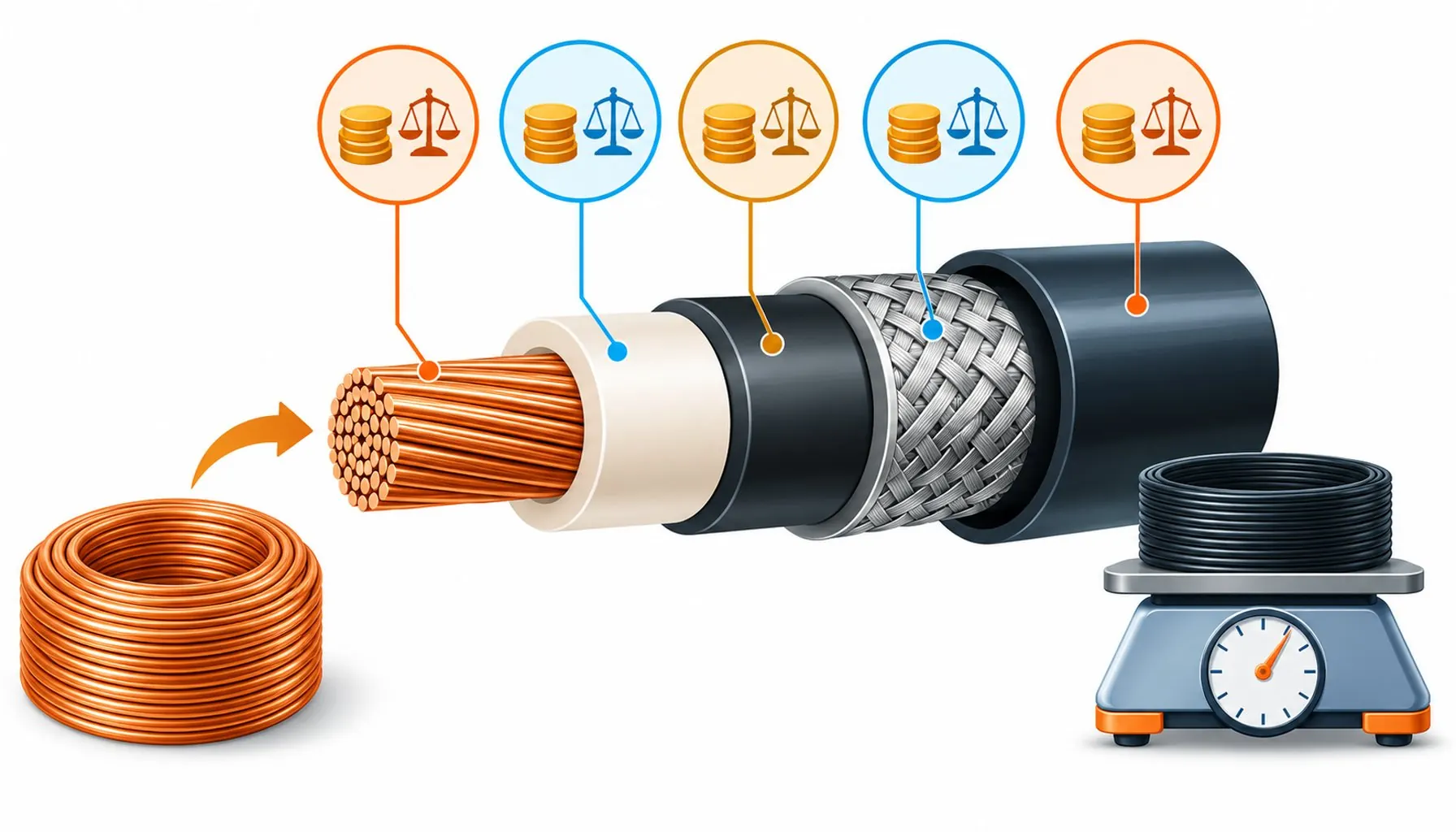
Robot cable is a small product with a concentrated cost structure. Copper dominates, and not ordinary copper: a high-flex conductor is built from many fine wires, drawn thin, bunched to a controlled lay, and the drawing and stranding of that wire consumes time and creates scrap in a way that building wire never does. Around the conductor sits a stack of materials chosen for motion: insulation that resists cracking, a shield sized for the electrical environment, and a jacket compound selected for oil, coolant and abrasion. Each layer is a cost line, and each cost line is a place where a supplier can quietly save money.
Understanding the stack changes the way buyers negotiate. Instead of pushing on the total, they can push on the one or two elements where their application genuinely allows a saving, and hold the elements where it does not. That is a more productive conversation than a price benchmark, and it protects the flex life that the purchase was meant to buy.
The Cost Stack, Layer by Layer
Published market research puts the average robot drag chain cable price at roughly USD 4.15 per metre, with gross margins across the segment in the 22 to 38 percent band depending on construction complexity and volume. Those figures are useful as orientation, not as a target. The more useful exercise is breaking the metre into its parts and asking which parts your application actually needs.
| Cost element | Rough share of price | What drives it | Buyer's lever |
|---|---|---|---|
| Ultra-fine copper conductor | 45-65% | Copper market level, wire fineness, stranding scrap | Fix a copper basis and let it float rather than fighting the total |
| Insulation | 5-12% | Compound grade and wall thickness | Do not specify a temperature class the application never sees |
| Shielding | 3-10% | Coverage, braid or foil, drain construction | Specify the screening the drive and EMC environment actually needs |
| Jacket compound | 8-18% | PUR versus TPE versus PVC, oil and abrasion resistance | Match compound to the real environment, not the harshest imaginable |
| Stranding and processing time | 10-20% | Lay length, line speed, batch size | Consolidate orders so setup is amortised across more metres |
| Testing and qualification | 2-6% | Bend or torsion cycles, electrical routine tests, records | Fund the tests you will rely on in a dispute |
| Tooling and setup | 1-5% amortised | Whether the construction or size is new | Standardise on a few sizes instead of many near-identical ones |
| Reels, packing and freight | 3-8% | Reel type, volume, destination and Incoterm | Specify reels that fit your racks and drum capacity |
| Supplier margin and risk | 22-38% | Volume, service level, payment terms, technical support | Buy service deliberately, and price the risk of not having it |
Why the Cheapest Metre Is Usually the Wrong Comparison
Two rows carry most of the explanatory power. Copper explains why the same cable changes price between quotations months apart, and why suppliers in China commonly work on a copper-linked price basis keyed to a public spot index such as the Yangtze copper quotation: the conductor is most of the product, so the conductor market is the price. Processing time explains why two cables with identical materials can still price differently, because a torsion-rated conductor with a short lay is slower to strand than a standard flexible build and the line time is real money. Suppliers who quote a construction rather than a cable type are the ones worth shortlisting, and the questions that establish whether they own the process are gathered in the checklist for evaluating a Chinese cable manufacturer.
It also explains why small orders cost more per metre in a way that has nothing to do with being overcharged. Setup, testing and reel handling are fixed costs spread across the order, and a two-hundred-metre run carries them differently than a five-kilometre run. Buyers who understand this stop treating a higher small-order price as an insult and start planning volumes around it. The principles of matching cable construction to the duty, covered in the guide to cable size selection, apply to cost as well as to performance: over-specifying is as expensive as under-specifying, just less dangerous.
When Price Negotiation Is Not the Answer
When one quote comes in well below the others, something in the stack has changed. It may be a shield with lower coverage, a jacket compound swapped from PUR to a cheaper blend, a conductor with fewer and coarser wires, a wall thickness reduced within tolerance, or a nominal length that is slightly short. None of these differences shows up in a goods-in inspection that checks labels and drum count, and all of them show up in the field.
The right response is not to reject the quote but to deconstruct it. Ask for the construction sheet for the exact item, compare it line by line with the reference construction, and ask the supplier to confirm which element differs and why. A supplier who can explain the difference in engineering terms may have proposed a legitimate cost optimisation for your duty. A supplier who cannot explain it has told you that the saving came from somewhere they would rather not name. The documentation habits that make this comparison possible are the same ones described in the guide to reading an electrical equipment datasheet, where the specification is only useful if the numbers are attributable.
| Quote pattern | Most likely explanation | How to test it |
|---|---|---|
| 20 to 30 percent below the field | Thinner shield, cheaper compound or reduced copper section | Request the construction sheet and compare element by element |
| Similar price, noticeably lighter reel | Short length delivered or reduced wall thickness | Weigh the reel and check the metre marking against the delivery note |
| Low price only at high volume | Setup amortised across a large run | Get the price basis in writing and confirm the MOQ it depends on |
| Price with no copper clause | Margin loaded against a fixed copper assumption | Ask which copper basis and validity period the offer uses |
| Same price for a torsion build | Construction not differentiated from a standard flex item | Demand a torsion test report for that exact construction |
RFQ Checklist: Getting a Price You Can Compare
Three limits are worth holding. First, price comparison only works between comparable constructions, so a quote without a construction sheet cannot be benchmarked at all, however detailed the number. Second, the cheapest cable is sometimes genuinely correct, particularly on static runs and low-cycle applications, where the flex premium buys nothing; refusing to buy cheap cable where duty allows is its own kind of waste. Third, negotiating margin down does not improve the product. Push a supplier below the cost of the construction you specified and you will eventually receive the construction that fits the price instead, which is the failure pattern described across common cable failure causes and a recurring theme in the review of international sourcing mistakes.
Conclusion
Send these so the numbers mean something:
- The construction you want priced, with conductor, insulation, shield and jacket defined
- Cores and cross-section, and whether the build is for bend, torsion or both
- Quantity for the first order and expected annual volume
- Whether the offer includes test reports and what those tests cover
- The copper basis used in the price and how long the offer is valid
- Reel or drum specification, packing and the Incoterm
- MOQ and lead time attached to the price
- The destination market and any certification the construction must carry
- Acceptance criteria for length, marking and incoming inspection