The Custom Robot Cable RFQ: Information That Gets Accurate Quotes
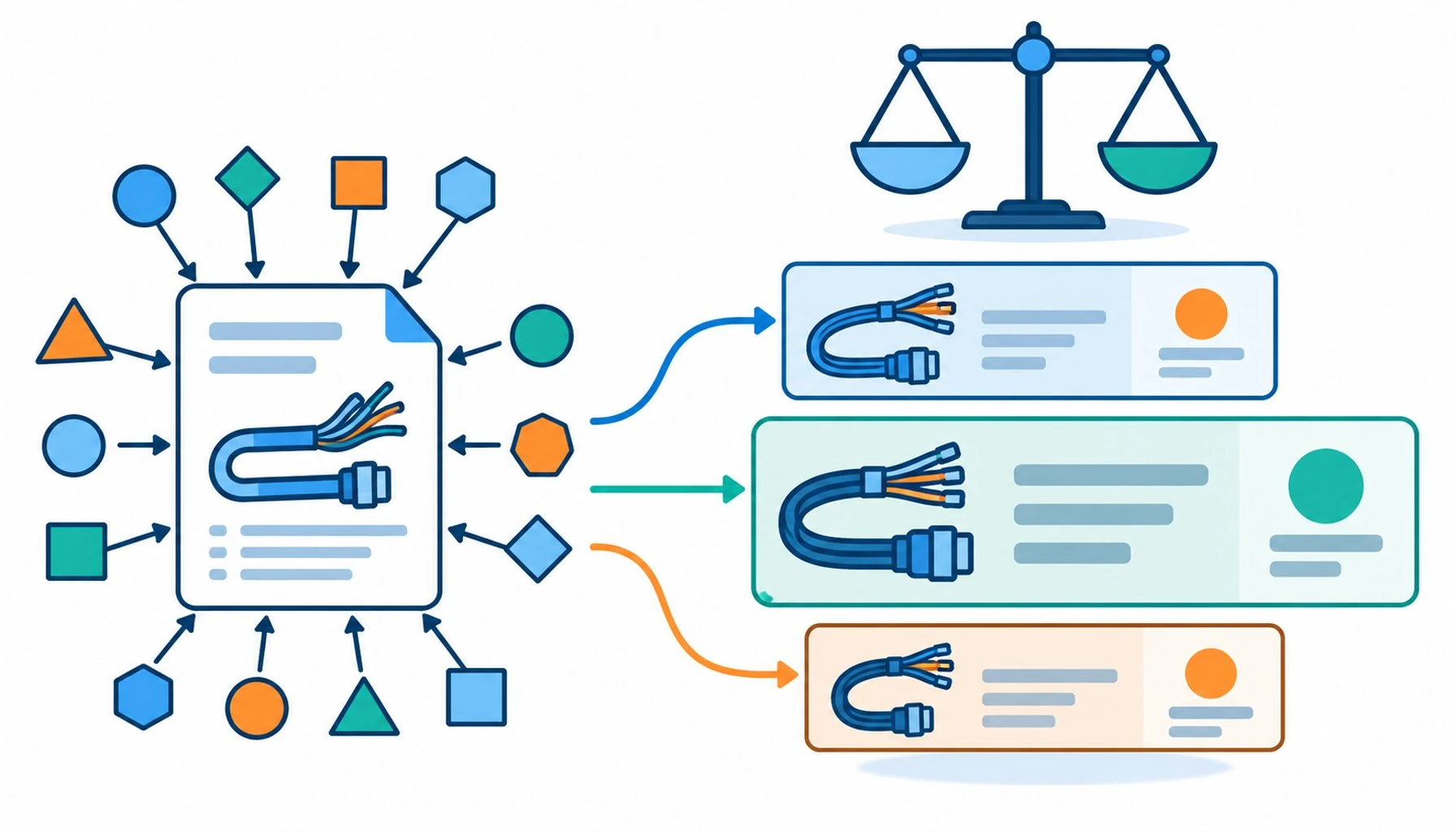
Quick Answer: A robot cable RFQ returns accurate quotes when it carries twelve inputs, from motion type and bend radius to cycle counts, environment, shielding and the evidence you expect, because each one changes the construction a supplier must price.
The typical custom cable enquiry is one line long. Something like a request for a shielded four-core flexible cable in a given size, with a quantity and a delivery date, sent to five suppliers at once. Five replies come back, the prices differ by a factor of two, and nobody can explain why. The explanation is not in the prices. It is in the enquiry.
Introduction
Robot cable is specified by duty, not by type name. Two cables that both answer to a catalogue description can differ in conductor stranding, shield coverage, jacket compound and wall thickness, and those are the variables that decide whether the cable survives a million cycles or a hundred thousand. When the RFQ omits them, every supplier fills the gap with its own assumption. One quotes a standard flexible build, another quotes a torsion-rated construction, a third quotes a jacketed cable with a light shield for cost. The prices are not comparable because the products are not the same.
This article sets out the twelve inputs that make quotes comparable, the shape of an accurate reply, and the failure modes that keep procurement teams exchanging emails for a month. It is written to be used directly as an RFQ template.
Why Most RFQs Produce Incomparable Quotes
Three gaps cause most of the damage. The motion gap is the largest: “flexible” covers a reverse bend in a carrier, a rolling bend over a sheave, and a torsion twist in a robot wrist, and those three duties produce three different constructions. The environment gap is the second: oil mist, coolant, washdown, UV exposure and ambient temperature each rule out certain compounds, and a supplier left to guess will guess cheap. The evidence gap is the third and the most expensive to close late: unless the RFQ states what proof is expected with the offer, the cheapest reply will contain no test data, and comparing it against a reply that includes a bend report is comparing a claim against a measurement.
The commercial gaps matter too. Quantity, delivery format, Incoterm and destination market all move the price, and a supplier who does not know the destination cannot tell you whether the construction you asked for can carry the certification you will need. Closing these gaps before the enquiry goes out costs an hour. Closing them after the order costs a project.
The Twelve Inputs That Change the Answer
Each input below changes either the construction, the cost or the evidence, which is the test for whether it belongs in the enquiry. Items that change none of the three can be left for the second email.
| RFQ input | Why the supplier needs it | What goes wrong without it |
|---|---|---|
| Application and motion type | Decides reverse bend, rolling bend or torsion construction | Quotes for three different products arrive together |
| Bend radius and travel | Sets the stranding and the strain relief design | The cable is specified beyond its radius and fails early |
| Cycle count and duty hours | Defines the flex life target and the test regime | No test can be judged pass or fail against your duty |
| Environmental exposure | Selects jacket compound and temperature class | Cheap compound chosen by default, then attacked by oil |
| Voltage class and cores | Sizes insulation and overall diameter | Oversized or undersized cable in a tight carrier |
| Conductor cross-section | Drives copper content, weight and price | Price comparison across unlike copper quantities |
| Shielding and EMC need | Sizes coverage, braid and drain construction | Shield chosen for price, then EMC problems at commissioning |
| Jacket and fire performance | Rules in or out compounds and standards | Compliance failure at the destination market |
| Length and delivery format | Sets reel size, continuous length and packing | Joints or short lengths where a continuous run was needed |
| Quantity and annual volume | Determines setup amortisation, MOQ and pricing tier | A price that collapses when the real volume appears |
| Destination market and certification | Establishes which standards the build must satisfy | A construction that cannot legally be installed |
| Evidence expected with the offer | Sets the test reports and records to be attached | Cheapest reply wins on the thinnest evidence |
What an Accurate Reply Contains
Twelve inputs sound like a long enquiry. In practice they fit on one page, and the same page is reusable for every future project with the application details swapped. Suppliers notice the difference immediately, because a duty-based RFQ tells them the buyer has done the work and the answer will be judged on engineering. The dimensional side of the input list is covered in more detail in the guide to cable size selection, which is worth reading before the cross-section is fixed, and the wording conventions that make a specification unambiguous follow the guidance on reading an electrical equipment datasheet in reverse.
Three Ways an RFQ Fails
A quote worth comparing contains more than a number. It should restate the construction it is pricing, naming conductor stranding, insulation material, shield type and jacket compound, because that restatement is the supplier’s understanding of the duty and the only way to catch a misread before the order. It should state the price basis, including the copper reference and validity period, and whether the figure depends on the quantity offered. It should give MOQ, lead time and the delivery format, and it should say which test reports come with the delivery.
Where certification is part of the requirement, the reply should name the standard and the scope, not just the certificate number. And it should name a technical contact who can discuss the construction directly, because the questions that matter at quotation stage are engineering questions and a sales-only channel adds a translation step. The same test regime that makes acceptance meaningful at delivery, set out in the guide to factory acceptance testing, is what makes the quotation stage meaningful here: both depend on a written criterion agreed before anyone measures anything.
When a Detailed RFQ Is Not the Answer
The first failure is the shopping list, where an RFQ copies a competitor’s part number and asks for a price. It produces a price for something approximately similar, and the difference surfaces at installation. The second is the over-specified enquiry, where the buyer specifies exotic materials and a temperature class the application never sees; this is not safer, it is more expensive, and it often forces the supplier to improvise a construction it does not normally run. The third is the fragmented enquiry, where the duty profile goes to one supplier and the commercial terms to another, and neither reply is complete enough to compare.
The control layer of the specification deserves separate attention, because it is where enquiries most often go quiet. A motion cable that carries an encoder or a bus signal is a different product from one that carries motor power, and the pairing rules are set out in the comparison of control and instrumentation cable. Buyers who state the signal requirement in the first enquiry get a shielded construction sized for it, rather than discovering the mismatch during commissioning.
| RFQ tier | What it contains | What you can compare | Typical outcome |
|---|---|---|---|
| One line | A cable type, a size and a quantity | Nothing but price | Selected on the lowest number, corrected in the field |
| Basic specification | Type, cores, length, quantity, destination | Price and delivery on a loose construction | Comparable quotes with hidden construction differences |
| Duty-based | All twelve inputs plus the necessary evidence | Performance, price, lead time and evidence | A defensible selection with test data behind it |
| Duty plus acceptance | Duty, evidence, test protocol and acceptance criteria | The whole commercial and technical package | Repeat orders on a frozen construction, no surprises |
RFQ Checklist: The Page to Send
Three cases keep the enquiry short. For a replacement spool of standard cable on a known machine, the original specification is the RFQ, and copying it is faster and safer than re-deriving it. For a low-cycle, static or indoor application, the flex-related inputs collapse and the enquiry is genuinely simple; adding a torsion requirement where none exists costs money for nothing. And for the first exploratory conversation with a new supplier, a summary rather than a full RFQ is appropriate, provided the summary is honest about what has not yet been fixed. The questions that establish whether the supplier can answer properly in the first place are gathered in the checklist for evaluating a Chinese cable manufacturer.
Conclusion
Copy this list into the enquiry and delete what genuinely does not apply:
- Machine, axis or carrier where the cable is installed, and the motion type
- Bend radius, travel length, cycle count and duty hours per shift
- Temperature range, oil or coolant exposure, washdown, UV and abrasion risk
- Voltage class, cores, cross-section and whether the run carries power, control or signal
- Shielding and EMC requirements, including any encoder or bus pairing
- Jacket expectations and any fire performance standard
- Continuous length required, reel preference and delivery format
- Quantity for the first order and expected annual volume
- Destination market and the certification the construction must carry
- Evidence you want with the offer: test reports, batch records, retained samples
- Requested lead time and the Incoterm you intend to work on
- Acceptance criteria you will apply on arrival