RoHS, REACH and Material Compliance for Cable Sold Inside Machines
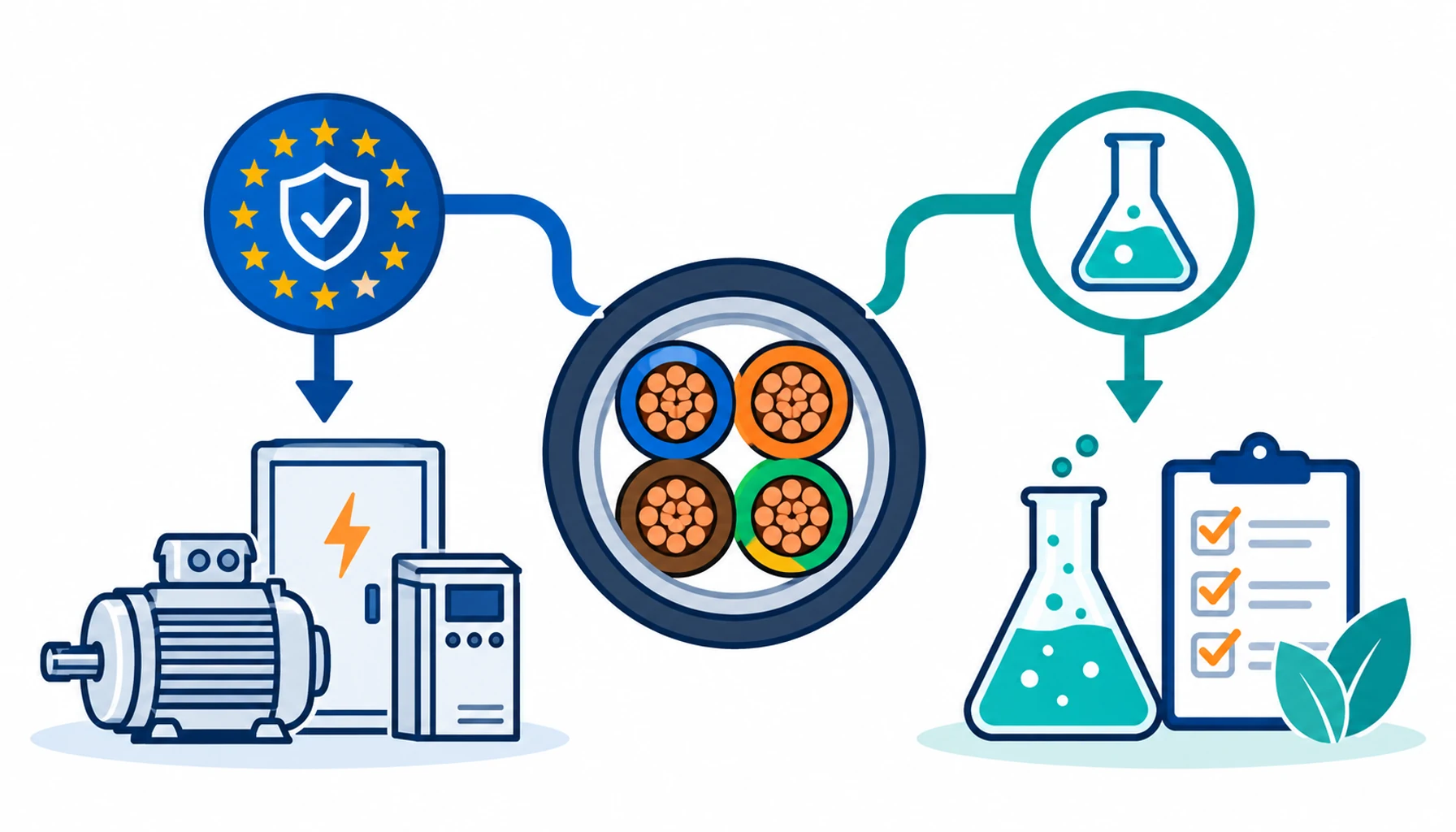
Quick Answer: RoHS reaches cable only through the equipment it is fitted to, while REACH reaches the cable directly as an article. Both ask for material-level data, not a signature.
A machine can pass every electrical check and still be held up by a substance question, because the two European regimes that govern what is inside a product do not treat a cable the same way. One of them applies to the finished machine and pulls the cable in as one of its materials. The other applies to the cable as an article in its own right, whether or not it is ever fitted to anything. Which one you are answering decides what you have to collect, from whom, and how often it has to be refreshed.
Introduction
RoHS and REACH appear together in procurement emails so often that they read as a single requirement. They are not. The legal basis is different, the scope is different, the way the threshold is measured is different, and the obligation that falls on a supplier is different. Treating them as one means asking the wrong part of the supply chain for the wrong document, and that costs calendar time in a way no test report can recover.
There is a second complication inside the cable itself. A cable is not one material. It is a set of homogeneous materials — conductor, insulation, filler, tape, braid, jacket — and each is assessed on its own. PVC insulation and a PVC jacket, the most common combination in machine cable, are also the two places where the substances both regimes care about tend to appear. The material comparison behind that choice is set out in the guide to XLPE versus PVC cable, and it is worth reading alongside this one because the compound decision and the compliance decision are the same decision.
A Cable Is Not EEE Until a Machine Makes It One
RoHS applies to electrical and electronic equipment placed on the market. A drum of cable is not equipment. It is a component, and components are not separately in scope. The moment that cable goes into a robot, a control panel, or a packaging line that will carry a CE mark, the finished equipment is in scope and the cable becomes one of the materials that has to be accounted for in the technical file.
This is why the same cable can be sold with a RoHS declaration in one transaction and without one in another. It also explains the answer some suppliers give, which is technically correct and practically useless: “RoHS does not apply to cable.” True of the cable by itself. Irrelevant to the customer who is going to fit it into equipment and needs the data anyway. A supplier who understands the difference provides the declaration as standard and states the basis on which it is given — that sentence is what separates a document a buyer can file from one they can only admire.
What RoHS Restricts, and Where Cable Touches It
Ten substances, each with a maximum concentration measured in homogeneous material: lead, mercury, cadmium, hexavalent chromium, polybrominated biphenyls, polybrominated diphenyl ethers, and — since the 2015 amendment — four phthalates: DEHP, BBP, DBP and DIBP. Nine of the ten are limited to 0.1% by weight. Cadmium is tighter, at 0.01%.
Three of them matter to a machine cable. The phthalates were added specifically because flexible PVC depends on plasticisers, and a general-purpose compound can contain DEHP or DIBP by design rather than by mistake. Lead has a long history as a PVC stabiliser and survives in recycled or older compound stock. Hexavalent chromium shows up in plated or passivated hardware rather than in the cable body, which is worth pressing on when the cable is supplied with terminations, glands or brackets.
Exemptions exist, they are time-limited, and they are category-specific. A declaration that says “RoHS compliant” without naming the exemption being relied on, if there is one, leaves the buyer unable to tell whether that exemption will still be alive when the machine ships. The wider certification picture for these products, including the market-specific marks that sit alongside substance compliance, is surveyed in the guide to cable certification checklists.
| Question | RoHS (2011/65/EU) | REACH ((EC) 1907/2006) |
|---|---|---|
| What it applies to | Electrical and electronic equipment placed on the market, across the listed categories | Substances, mixtures and articles, with no product category gate |
| Where a cable sits | As a component of the finished equipment, in scope through the machine rather than on its own | As an article in its own right, whether or not it is ever fitted to anything |
| How the threshold works | Defined concentration limits per substance, assessed at homogeneous material level | Information duty where a candidate list substance exceeds 0.1% by weight of the article |
| What cable is exposed to | Phthalate plasticisers in flexible PVC, lead stabilisers, hexavalent chromium in plated hardware | Whatever is added to the candidate list, plus restriction entries such as the lead limit for PVC articles |
| What the supplier owes | A reasoned assessment, documented, with any exemption named | Information to the recipient, and to consumers on request within 45 days |
| Documentation route | Technical file assembled to EN IEC 63000, with substance data underneath it | Substance-level declaration such as IPC-1752A or IEC 62474, refreshed as the list changes |
Where REACH Takes Over
REACH governs substances, mixtures and articles, and a cable is an article — which changes the shape of the obligation completely. There is no approved list and no pass or fail certificate. There is a candidate list of substances of very high concern, updated twice a year, which has now passed 250 entries, and an information duty attached to it.
Where an article contains a candidate list substance above 0.1% by weight, the supplier has to give the recipient enough information to use it safely, at minimum the name of the substance. Consumers can ask for the same information and must receive it free of charge within 45 days. That threshold is assessed per article rather than per finished product. Following the 2020 court ruling usually summarised as “once an article, always an article”, a small part containing the substance does not get diluted by everything around it.
Then there is the SCIP database, in force since January 2021 under the waste framework legislation, which requires a notification where an article contains a candidate list substance above the threshold. Recyclers and market surveillance authorities use it. If a buyer asks whether your cable appears in SCIP, the accurate answer involves whoever placed the machine on the market, because the duty sits with the producer or importer of the article. The data still has to travel upstream from the compound supplier, and that is where a cable maker’s own disclosure file earns its place. The documentation side of this, alongside the national marks that go with it, is covered in the guide to Chinese electrical equipment certification.
Lead in PVC: The Restriction That Reached Cable
In 2023 the Commission amended the restriction entry for lead, and the change landed on cable. Since 29 November 2024, PVC articles with a lead concentration of 0.1% or more by weight cannot be placed on the market, with a derogation for articles containing recovered flexible PVC that ran only to 28 May 2025. Lead stabilisers are the target. Less toxic stabiliser systems have been standard in European production for years, but the restriction now closes the door on imported and recycled material as well, and it applies to compound stock rather than to finished goods alone.
The boundary is worth knowing because it decides which instrument you are answering. Articles within the scope of RoHS are excluded from that restriction entry, since RoHS covers them. So a PVC cable inside CE-marked equipment is judged under RoHS, while the same cable sold as a standalone product is judged under the REACH restriction. Different instruments, same practical conclusion: specify a lead-free stabiliser system, and be able to show it rather than assert it.
What a Useful Declaration Actually Contains
The document that holds up under questioning is not a one-page certificate. Under RoHS, the technical documentation is assembled to EN IEC 63000, which superseded the earlier standard and describes how a supplier evidences that a product has been assessed. That is a reasoned technical file covering materials and, where relevant, the exemption relied upon — not a single test report standing alone.
For substance data, the industry exchange formats are IPC-1752A and IEC 62474. A declaration saying “compliant” without a substance-level breakdown cannot be passed downstream, because the next party in the chain owes their own customer the same disclosure and has nothing to build it from. Screening is normally done by X-ray fluorescence, with wet chemistry or mass spectrometry where a phthalate or chromium result needs confirming rather than screening.
Dates and revisions matter more than most buyers expect. The candidate list changes twice a year. A sweeping statement issued in 2022 says nothing about substances added since. A declaration is useful when it names the list revision it was checked against and the date it was checked.
| Document | What good looks like | Refresh trigger |
|---|---|---|
| RoHS declaration | Names the directive and the amending act, states that the assessment is at homogeneous material level, and names any exemption relied on | New construction, new compound source or exemption expiry |
| Substance of very high concern statement | States the candidate list version checked against, with a date, and either lists the substances above the threshold or states none are present | Each candidate list update, twice a year |
| Material declaration | Substance-level data in IPC-1752A or IEC 62474 format, broken down per homogeneous material rather than per product | Any change of compound or of compound supplier |
| Test reports | Accredited laboratory, screening plus a confirmatory method where the result is close to the limit, tied to the construction tested | New construction or new compound |
| Technical file | Assembled to EN IEC 63000, retained, and available for inspection rather than prepared on request after the fact | Annual review, or on any material change |
| SCIP reference | Where the threshold is exceeded, a dossier reference identifying the substance and where it sits in the article | A new substance above the threshold, or a new candidate list entry |
When Material Compliance Is Not the Answer
Three limits are worth stating plainly. A material declaration proves what is in the cable and nothing more. It says nothing about whether the cable will survive ten million flex cycles, tolerate oil, or hold up at low temperature, all of which need test evidence of a different kind — the failure modes that matter in a moving application are collected in the analysis of common causes of cable failure.
Second, these regimes are chemical. Halogen content, smoke density and flame propagation are separate requirements with their own standards, set out in the comparison of low smoke zero halogen and fire retardant cable. A RoHS declaration is not a low-smoke declaration, and buyers sometimes accept one in place of the other, which is a substitution that only shows up in a fire test.
Third, the paperwork is only as good as the tier it comes from. A cable maker can declare only what the compound supplier declares. Where that data sits two tiers upstream and has never been verified, the finished declaration inherits the uncertainty. It is also worth tracking the direction of travel: disclosure expectations are moving toward fuller material data, and the ongoing discussion around PFAS could reach fluoroelastomer jackets and high-temperature constructions in time. Constructions chosen today for a machine with a fifteen-year life will be judged against rules that do not exist yet.
RFQ Checklist: Material Compliance for Machine Cable
Send these with the inquiry so the compound choice and the paperwork are settled together:
- Where the cable will be placed on the market, and as part of which finished equipment
- Whether a RoHS declaration is needed for the cable as a supplied component, or only for the machine as a whole
- Jacket and insulation compounds, with lead-free stabiliser systems specified where PVC is used
- Whether PVC is acceptable at all, or a halogen-free construction is preferred from the start
- Substance-level declarations in IPC-1752A or IEC 62474 format rather than summary statements
- Any exemption being relied upon, named explicitly, with its expiry date
- The candidate list revision the substance statement was checked against, and the date of that check
- Whether terminations, glands or hardware come with the cable, since plated parts bring their own substances into the assessment
- Whether the buyer needs the material data to support their own SCIP filing, and in what format
Conclusion
The two regimes ask different questions. RoHS asks whether the materials in a piece of equipment are within defined limits, and expects a reasoned technical file to show it. REACH asks whether anything on a list that keeps growing is present above a threshold, and expects information to flow along the chain. Cable sits inside both, approached from different directions, and the only clean way to answer either is to hold substance-level data on the compounds and to issue declarations that say what they were checked against and when. A buyer who receives that does not have to trust the answer; they can file it.
Kexingyu Cable Group (KXYE) supplies control, power and motion cable with compound-level documentation, and where a construction needs a particular material profile — lead-free stabiliser PVC, a halogen-free jacket, a phthalate-free plasticiser system — we build to that specification and state plainly what the data covers and what it does not. Send the market, the compounds you will accept and the declaration format your customer expects through the RFQ page, and if the compliance file has to be read by someone technical, the parameters worth checking are set out in the guide to reading an equipment datasheet.