Saudi Arabia's Data Center Expansion: Sourcing Cable for Gigawatt Projects
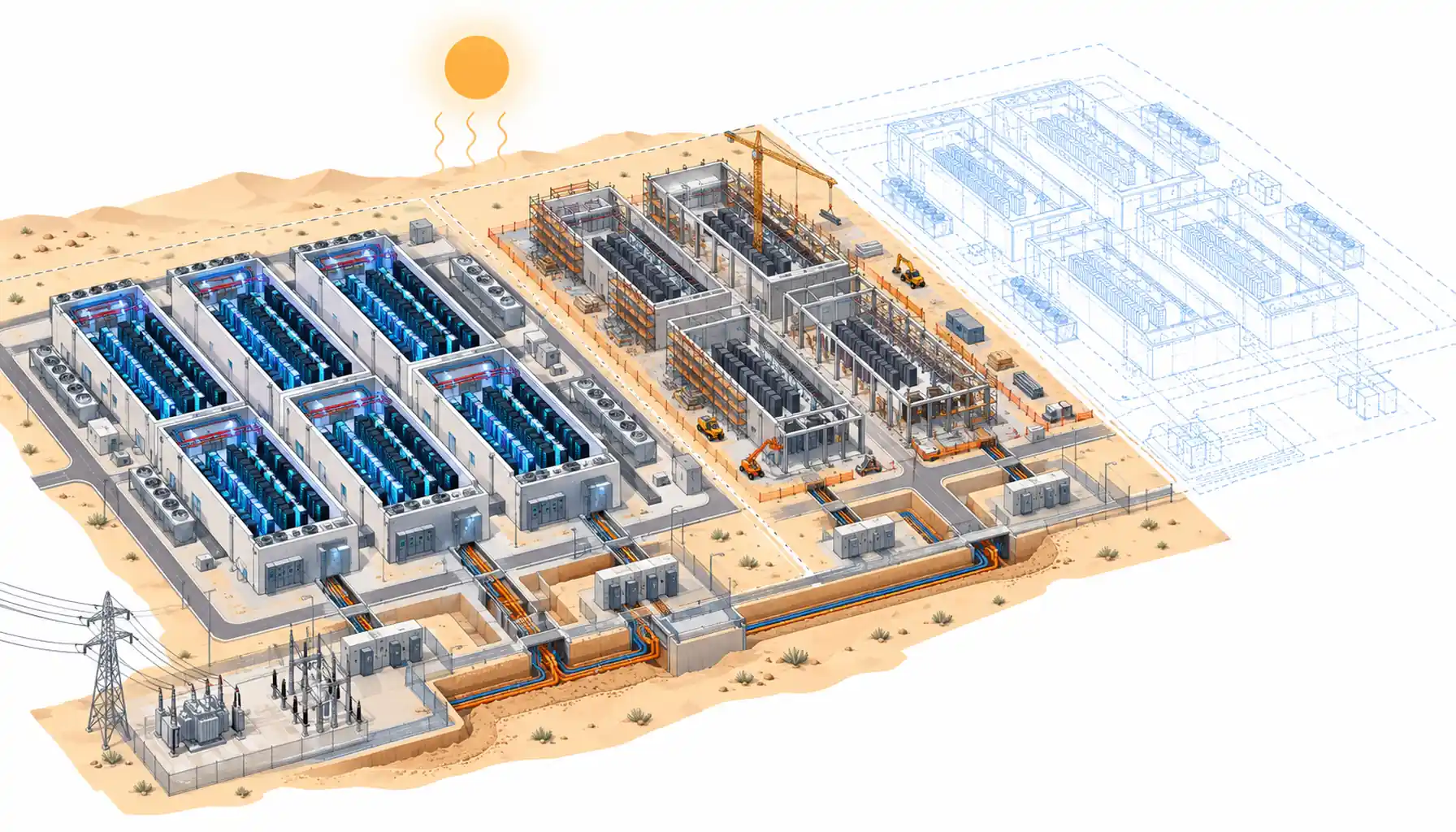
Quick Answer: Saudi Arabia is scaling data centers toward gigawatt footprints under Vision 2030 — and entry runs through heat-rated engineering, national conformity paperwork and schedules that start before the RFP.
Few markets anywhere are adding computing capacity at the scale Saudi Arabia has committed to. Vision 2030 turned digital infrastructure into national strategy: giga-project cities that need their own power and their own data halls, hyperscale campuses announced in the hundreds of megawatts, AI infrastructure programs that treat compute as a state resource. For cable suppliers, the arithmetic is tempting and the gatekeeping is real. The kingdom buys at national scale, against national conformity rules, in an environment where summer ambient temperatures would derate a European specification into failure. This guide maps what the projects actually demand and how the qualification path works.
Introduction
The regional frame is a Gulf power market adding generation, grid and computing at once, with the sourcing landscape mapped in Middle East power equipment sourcing — and Saudi Arabia is its center of gravity. The global demand analysis in data center power demand growth ranks the kingdom among the fastest-scaling pipelines in the world; what the ranking undersells is the character of the demand. Saudi projects are not incremental expansions bolted onto existing halls. They’re greenfield campuses engineered from scratch — intake, substations, distribution, cooling, halls — which means the cable bill is specified once, at scale, by consultants working to international frameworks with national overlays.
What Gigawatt Projects Demand From Cable
The electrical bill follows the hyperscale pattern — MV feeders to on-site substations, LV distribution to UPS strings and PDUs, hall cabling, monitoring — but three Saudi conditions reshape every layer. Heat first: summer ambients push deep into derating territory, so conductor sizing, sheath compounds and installation methods must be selected for the real environment, running the derating arithmetic of cable size selection against local temperatures rather than laboratory ones. Standards second: the specification culture is IEC-based with national conformity requirements layered on top, and the documentation file — type tests, certificates, batch traceability — gets reviewed with the same rigor the four-check discipline of the power cable certifications checklist describes. Scale third: a gigawatt campus is a cable program, not a cable order. The quantities reward factories with genuine capacity, and the schedules punish anyone who quoted lead times they couldn’t keep.
| Layer | Cable Family | Saudi Condition That Shapes It |
|---|---|---|
| Intake and substations | MV XLPE feeder cable, engineered constructions | Greenfield campuses specify from zero; heat derating on every run |
| Distribution and UPS | LV power cable, parallel feeders | Hyperscale redundancy; backup depth against grid ambitions |
| Halls and galleries | LSZH power and structured cabling | International consultant frameworks with national overlays |
| Campus and program | Repeat constructions across phased builds | Gigawatt scale rewards factory capacity and batch consistency |
| Documentation | Type tests, certificates, batch traceability | National conformity paperwork gates the tender file |
Who Buys, and How the Calendar Runs
Understanding the buyer map prevents the most common strategic error: approaching the kingdom as if it had one customer. In practice the bill is split. State-backed digital and giga-project programs buy through master developers and their consultants, with submittal discipline inherited from international frameworks. The national telecom and carrier operators buy cable for their own facility programs on procurement calendars that repeat annually. Enterprise and colocation operators buy through local integrators who expect foreign suppliers to arrive with documentation already localized. And the utility layer touches every project at the connection point, regardless of who signs the order. The calendar follows the same layered logic: national programs announce years ahead, tender in waves, and energize on dates tied to state milestones. That means the suppliers who engaged during the announcement phase are writing the specifications the tender later references, while the suppliers who arrive at tender time are answering someone else’s specification. The lesson compounds across every gigawatt program: in Saudi Arabia, early presence isn’t a sales tactic. It’s the specification strategy.
The Qualification Path Before the Tender
Saudi procurement moves on national rhythms, and the suppliers who win are qualified before the tender closes, not after. The path runs: conformity paperwork first — the national conformity regime assembled per family, evidence filed and current, because a tender scored on documentation doesn’t wait for a factory to gather certificates mid-bid; then standards alignment — constructions mapped to the IEC-based frameworks the consultants specify, with type-test evidence from accredited laboratories; then capacity proof — production schedules and batch records that demonstrate the factory can feed a phased gigawatt program without substitution. The coordination logic matters at this scale: pairing cable delivery with the switchgear and transformer calendar, the integrated approach of one-stop power equipment sourcing, because a campus that cannot energize on schedule blames the family that slipped. And the recurring failure catalog of international power equipment sourcing mistakes applies at kingdom scale. The most expensive mistake is quoting a lead time the factory cannot keep, to a buyer who never forgets.
| Stage | Action | Classic Trap |
|---|---|---|
| Pre-qualification | Conformity paperwork and standards file assembled per family | Starting certification when the tender is published |
| Specification | Constructions mapped to IEC-based frameworks with heat derating | Sizing cable to laboratory ambients instead of site ambients |
| Tender | Capacity proof and phased delivery schedule submitted honestly | Quoting lead times the factory cannot keep at scale |
| Delivery | Batch identity and reports reconciled per consignment and phase | Batch substitution between approved file and shipped goods |
| Program | Framework terms across the campus build phases | Treating one phase as the whole gigawatt opportunity |
When National Scale Is Not an Open Door
Two cautions frame the opportunity. National strategy is not a guarantee of easy entry: the same state commitment that creates gigawatt demand also enforces conformity discipline, local-content preferences and long institutional memories. Suppliers enter through paperwork and patience, not through price alone. And scale is not the whole market: between the headline gigawatt campuses sits a broad base of enterprise, telecom and government data halls with smaller bills and faster cycles. The suppliers who serve the giants and the base alike build the record that the next tender reads.
RFQ Checklist: Saudi Lines for the RFQ
Put the market’s questions in writing:
- National conformity evidence assembled and current per cable family
- Constructions mapped to the IEC-based frameworks with site-ambient derating stated
- Type-test reports from accredited laboratories, traceable to offered constructions
- Batch identity and marking commitments across phased deliveries
- Capacity proof: production schedule demonstrating phased gigawatt supply
- Coordinated calendar with switchgear and transformer delivery families
- Framework terms for repeat phases across the campus program
Conclusion
Saudi Arabia is the Gulf’s gigawatt-scale cable opportunity: greenfield campuses specified from zero, a national conformity gate that filters the unprepared, and an environment that turns heat from a footnote into a design parameter. The demand is national in size and unforgiving in character. The suppliers who qualify early, document deeply and schedule honestly take a share of a market that rewards preparation at every stage.
Kexingyu Cable Group (KXYE) approaches the kingdom’s projects the way they are won: conformity evidence assembled before the tender, heat-derated engineering stated in the offer, and phased delivery schedules the factory can actually keep. That’s cable supply built for gigawatt programs, not improvised for them.