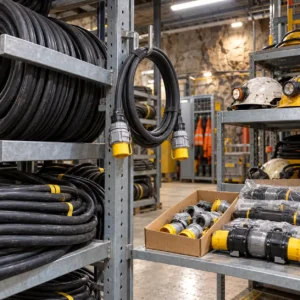
Solar Cable Suppliers for Uzbekistan: What EPC Buyers Should Check

Quick Answer: Solar DC cable looks like a commodity and behaves like a twenty-five-year decision, which is why EPC buyers screening suppliers for Uzbekistan projects check six things before they check price: whether the supplier separates DC from AC duty, whether voltage ratings and sizing follow the array’s actual operating conditions, whether environmental test evidence covers heat, UV and the design life, whether marking and drum lengths are agreed as deliverables, whether samples anchor the batch, and what the certification claim actually covers. A quote that answers all six can be compared; one that answers none is a price on a reel.
Introduction
In a utility scale photovoltaic plant, DC cable is everywhere and visible nowhere: thousands of runs under and between array tables, chosen once, buried or clipped, and expected to carry full current through summer heat and winter frost for the plant’s whole life. Its price is a rounding error in the EPC budget; its replacement cost, should it fail early, is not. That asymmetry is why supplier screening for solar DC cable is a documents exercise before it is a negotiation.
This guide is for EPC procurement teams, design engineers and developers buying solar DC cable for projects in Uzbekistan. It walks the screening checklist in the order the risks sit: the DC and AC distinction that starts the specification, voltage ratings and conductor sizing against real array conditions, the environmental and test evidence that separates a design-life product from a generic one, marking and drum length agreements, sample-to-batch discipline, and the scope check that keeps certification claims honest. The specification fundamentals are set out in our solar cable specification guide, and our solar cable range shows the product families this checklist applies to. Country-level supplier screening for Uzbekistan is covered by the procurement checklist in this series.
Start by Separating DC from AC Duty
DC and AC cables fail differently, so they are specified differently. DC strings and array runs carry continuous unidirectional current, sit at elevated temperatures against hot module backs and sun-heated ground, and see no alternating stress in the conductor. AC interconnection cable has its own duty. A supplier who quotes a generic “solar cable” covering both is either selling one product into two duties or has not engaged with the specification, and both are screening findings.
The DC cable’s environment is the specification’s centre. Direct burial under array rows, exposure on table edges, routing through combiner runs: each placement stresses the sheath differently, and the UV, heat and mechanical requirements follow the placement, not the product name. The enquiry should carry the routing plan’s extremes, hottest exposure, deepest burial, most-handled section, so the supplier answers for the plant’s real conditions rather than a catalogue average.
Keep the screening scoped to DC. This guide deliberately stays with DC strings, array and combiner cabling; AC collection and grid interconnection cabling belongs to the power cable process, covered by the power cable RFQ guides in this series. Mixing the two in one screening round blurs the evidence each duty needs.
Check Voltage Ratings and Sizing Against Array Reality
The voltage rating answers the system, not the label. String and array voltages set the insulation requirement, and the enquiry states the system’s maximum DC voltage so the supplier rates the offered construction against it explicitly. The evaluation confirms the rating appears on the datasheet with a test basis, because a figure without a test behind it is a brochure sentence.
Sizing follows current, temperature and routing, together. Conductor cross-section is derived from design current, derating for the temperatures the routing actually sees, bundling where runs share a tray or trench, and voltage drop budgets over string lengths. A supplier who sizes from the enquiry’s conditions shows engineering; a supplier who sizes from a table shows a catalogue. Both can be right, but only one can defend the answer when the plant’s losses are audited.
Conductor construction is part of the sizing check. Flexible class conductors ease installation handling on array tables, and copper quality carries the current; the purity and compaction questions that govern performance are set out in our note on conductor copper purity. The insulation family matters equally: cross-linked insulation is the standard answer for the thermal duty, and the reasoning is set out in our note on XLPE versus PVC insulation.
Demand Environmental Test Evidence, Not Weather Adjectives
UV, heat and design life are tested properties. Solar DC cable earns its category through ageing tests: UV exposure on the sheath, thermal ageing on the insulation, and the combination over durations that stand for the design life. The screening question is what tests the offered construction has passed, at what conditions and durations, evidenced by reports naming the tested specimen. “UV resistant” without a test is a description of intent.
Ask for the reports, then read their scope. A report supports a purchase only when its construction, specimen and conditions match the line being bought. The reading method, checking what a report names against what the order describes, is set out in our note on the type test report review, and it is the single highest-value skill in this screening round.
Ozone, cold and mechanical evidence complete the set. Depending on the site, cold installation and operation, ozone exposure and abrasion from routing practice each add a test to the evidence list. The screening collects the evidence per requirement rather than accepting one strong report as covering all of them, because test coverage is specific: a UV report says nothing about cold bend, and vice versa.
Agree Marking and Drum Lengths as Deliverables
Marking is how the plant’s records stay true. Printed meter markings on the sheath, drum numbers and batch references let the as-built documentation trace every run to its test evidence, and the screening confirms the marking content and durability as deliverables in the quote, not as factory defaults.
Drum lengths follow the installation plan. String runs, table spacing and pull plans decide useful lengths, and shorts and remnant lengths cost the installer jointing and waste. The enquiry states the preferred drum lengths and the remnant policy, and the quote answers per line; the tolerance mechanics around ordered lengths are set out in our note on ordered length and drum tolerance. The traceability side of marking practice is covered in our note on cable marking and traceability.
Packaging travels with the length decision. Reels that survive the route to a desert site with intact ends and readable drums are part of the deliverable, and the packaging confirmation belongs in the quote alongside the lengths it protects.
Anchor the Batch with Samples
The sample proves the construction; the batch proves the factory. For each DC construction in the tender, the screening includes a sample round: samples from the production route, sealed as references, with the batch production compared against them through routine tests. The process from sample submission to sealed reference is set out in our note on the sample approval process.
Routine tests carry the batch evidence. Conductor resistance, withstand and insulation results per production batch, tied to drum numbers, are the delivery’s own proof that the manufactured cable matches the sample and the specification. The screening asks each supplier to commit to that reporting in the quote, because a commitment given at screening is enforceable at delivery and one asked for at delivery is a favour.
Where independent verification is wanted, arrange it early. Pre-shipment inspection against the tender’s requirements is cheap to specify at screening and expensive to improvise later. The arrangements are set out in our note on third-party cable inspection.
Check What the Certification Claim Actually Covers
A certificate has a scope, and the scope is the claim. The screening reads each certification claim for three things: which construction it names, which test program it represents, and which market or scheme it belongs to. A report against one standard does not transfer to another scheme’s requirements, whatever the logo on the cover, and a report against a national standard does not silently become a different market’s certification.
IEC or GB reports evidence the tested properties, and only those. Test reports written against IEC or GB programs are legitimate evidence of the properties they tested, on the constructions they name. The screening error to avoid is the upgrade: treating such reports as if they satisfied a different certification regime. Where the project’s employer or lender requires a specific certification, the question to the supplier is whether that certification exists for the offered construction, and the honest answers are yes, no, or in progress with a date.
Certification scope questions are normal screening, not accusation. Competent suppliers answer scope questions precisely and quickly, because they live with scope limits daily. The screening format that asks “which scheme, which construction, which report” per claim is set out in our note on export cable certification, and it produces a comparison table the EPC can put in front of an engineer or a lender.
The Supplier Verification Table
The table is the working sheet for the screening round: each check, what the buyer is confirming, and what a passing answer looks like.
| Check | What the Buyer Confirms | A Passing Answer Looks Like |
|---|---|---|
| DC versus AC duty | The supplier separates DC string and array constructions from AC interconnection in the offer | Quote structured by duty, with DC constructions specified for array environment |
| Voltage rating | Insulation rating stated against the system's maximum DC voltage, with test basis | Rating on the datasheet with the test it rests on named |
| Sizing | Cross-section derived from current, temperature derating, bundling and voltage drop | A sizing note showing the derivation from the enquiry's conditions |
| Environmental evidence | UV, thermal ageing, ozone and cold tests named with conditions and durations | Reports naming the tested specimen and conditions, scoped to the offered construction |
| Marking and lengths | Marking content, drum lengths and remnant policy agreed as deliverables | Quote answers lengths and marking per line, with tolerance stated |
| Samples and batch | Sample round from the production route; routine batch reports tied to drum numbers | Sample plan and reporting commitment written into the quote |
| Certification scope | Each claim read for scheme, construction and report coverage | Scope stated per claim; gaps admitted with status rather than glossed |
Cost and Lead Time in Solar DC Cable Supply
Copper moves the price, and the contract decides who carries it. Solar DC cable is copper-heavy, and quotes valid for different periods or on different price bases are not comparable until the basis is aligned. The mechanism and the buyer’s options are set out in our note on copper price and cable procurement.
Lead time is honest only when the scope is complete. Sample round, production, marking, packaging and documents each carry calendar weight, and quotes that omit stages quote dates that fail. The screening compares lead times on the same scope, as with every other dimension, and holds the agreed scope in the order documents.
What the DC scope should look like in the enquiry is set out in our guide to requesting a cable quotation for Central Asian projects.
Volume phasing is the EPC’s schedule lever. Array construction phases consume DC cable in sequence, and staged deliveries against the installation programme free working capital and site storage alike. Suppliers who can phase production against the programme are worth weighting in the evaluation, provided the phase boundaries carry their own marking and reporting discipline.
Price differences between screened suppliers are information. After the six checks, a residual price gap usually means a construction difference, an evidence gap or a scope difference, and the screening table names which. The EPC that prices the gap consciously buys better than the one that prices it accidentally.
| Claim on the Quote | What It Evidences | What It Does Not Evidence | Question That Resolves It |
|---|---|---|---|
| "Tested to IEC requirements" | The named properties, per the report's program, on the named specimen | Any other scheme's certification; properties outside the report's program | Which report, naming which construction and conditions? |
| "GB standard compliant" | Compliance with the cited GB program for the cited construction | Transfer to another market's certification regime | Does a certification for the required scheme exist for this construction? |
| "Certified solar cable" | Whatever the certificate's scope actually names | Other constructions in the range; other properties outside the scope | Certificate copy with scope, read against the quoted line |
| "UV resistant, long life" | Nothing, until a test stands behind it | The design-life claim the plant's financing assumes | Which ageing tests, at what conditions and durations? |
When a Solar Cable Quote Is Not the Answer
When DC and AC are quoted as one product. The duties differ, the specifications differ, and a supplier who will not separate them has answered a different enquiry than the one the plant issued.
When the evidence is a logo instead of a scope. Certification claims that survive the scope question get compared; claims that dodge it are removed from consideration, whatever the price.
When the sizing cannot show its derivation. Cross-sections that appear without temperature derating or voltage drop reasoning transfer the design risk to the EPC, and the design engineer should reject them at screening rather than inherit them at commissioning.
When the schedule cannot absorb the evidence round. A tender timeline that leaves no room for samples and report review will pressure every later check, and the honest options are a longer timeline or a stock-supported construction whose evidence already exists. A screening round skipped is a commissioning argument scheduled.
RFQ Checklist
- Duty split stated: DC string, array and combiner cabling scoped separately from AC interconnection
- System maximum DC voltage stated, insulation rating answered against it with test basis
- Sizing derivation required: current, temperature derating, bundling, voltage drop
- Environmental evidence per requirement: UV, thermal ageing, ozone, cold, each with conditions and durations
- Type and test reports scope-read against the quoted constructions before weighting the offer
- Marking content, drum lengths and remnant policy agreed as deliverables per line
- Sample round from the production route, sealed references, batch reporting tied to drum numbers
- Certification claims read for scheme, construction and report scope, gaps admitted in writing
- Price basis and validity aligned across quotes before comparison
- Delivery phasing against the installation programme, with per-phase marking and reporting
Conclusion
Screening solar DC cable suppliers for Uzbekistan is six checks applied patiently: duty separated, ratings evidenced, sizing derived, environmental tests read for scope, samples anchored to batches, and certification claims read for what they actually cover. None of the six is difficult, and together they turn a reel of black cable into a documented component of a plant that has to run for decades. The price conversation is short and honest once the six are done, because by then the quotes describe the same product.
Kexingyu Cable Group (KXYE) manufactures solar DC constructions in Quanzhou and answers EPC screening enquiries at scope level: duty-separated constructions, test reports with named conditions, per-line marking and drum length agreements, and batch reporting tied to drum numbers. Send us your system parameters, quantities and destination, or upload your BOQ and cable schedule, and we will answer the checklist line by line. A request for quotation is the fastest route to start.