SWA Cable and Steel Tape Armour: Choosing Protection for the Route
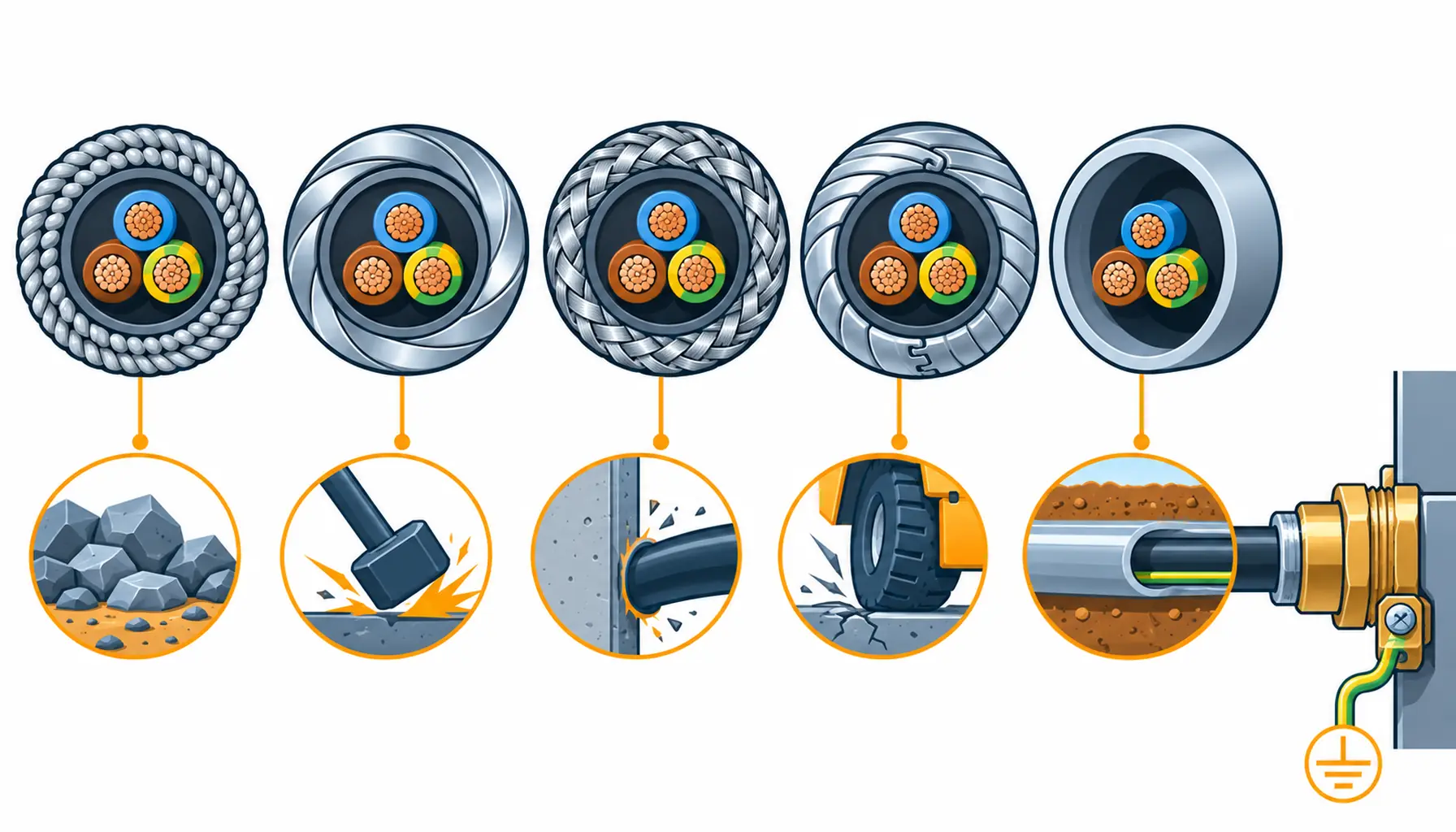
Quick Answer: SWA cable is bought against the threat on the route, not against the habit of the last project. Steel wire armour protects against crushing and impact where the cable may be struck or walked over; steel tape armour gives mechanical protection at a lower weight where the threat is lighter; braid suits where flexibility has to be kept. Armour also carries earth fault current, so the gland and the earthing arrangement are part of the purchase, not an installation detail.
Introduction
Armour is the layer that turns a cable into something a site can treat roughly. Where a route is walked over, run over, backfilled with rubble, or routed where a machine can strike it, mechanical protection is cheaper than containment and far cheaper than a failure.
This guide is written for the person raising the requisition. It covers what each armour type is for, how the choice interacts with earthing and glands, the evidence worth demanding, and the decisions to freeze before the order goes out. The underlying comparison of protected and unprotected constructions is in our note on armoured versus unarmoured cable.
What Armour Is Asked to Do
Resist mechanical damage. Armour spreads a point load over a wider area, so a wheel, a dropped tool or a spade is less likely to reach the insulation. Steel wire is the strongest general answer to impact and crushing; tape is lighter and cheaper but resists less.
Be the earth fault path. On most armoured constructions the armour is a metallic layer over the whole length and it is used as the circuit protective conductor, either alone or with a separate core. That makes its cross-section, its conductivity and the continuity of every joint an electrical requirement rather than a mechanical one.
Hold the cable together. Armour keeps cores in place under bend and tension, which matters on a vertical drop where the cores would otherwise carry their own weight.
Bring its own problems. Armour adds weight, reduces flexibility, needs glands rated for the armour type, and corrodes in some soils and chemicals. Where the route is wet or aggressive, the armour material and the corrosion protection on it belong in the specification. Our note on grounding and bonding verification covers the continuity checks that prove the path works.
The Armour Types a Site Buyer Chooses Between
Steel wire armour is the standard answer where the cable may be crushed or struck. Galvanised steel wires laid over the bedding give the highest mechanical protection of the common types, and the long lay direction of the wires suits the magnetic field on alternating current systems.
Steel tape armour is lighter and cheaper for the same size, and gives good protection against impact from above on a buried or tray route. Tape is poorer at resisting crushing and gives less flexibility, so it suits fixed routes rather than anything that moves.
Braided armour uses fine wires woven over the core, which keeps flexibility and gives good protection against abrasion and moderate impact. It is the usual answer on cables that must stay flexible, and it can be supplied in tinned copper where the braid is also used as a screen.
Where a project needs an armoured construction matched to one duty, it is simpler to buy it as a construction than to assemble it from clauses. Our cold-resistant armoured instrument cable covers exposed routes in low ambient, and the medium voltage XLPE armoured cable covers distribution runs where the armour carries fault current, in both cases with the armour arrangement, bedding and outer sheath already fixed for the duty.
The table below compares the options on route threat, with what to specify, the evidence worth demanding and how each choice fails when it is made on price alone.
| Armour type | Best route duty | What to Specify | Evidence to Demand | Cost and Lead-Time Driver | How It Fails |
|---|---|---|---|---|---|
| Galvanised steel wire armour | Buried routes with rubble, areas where machines cross, exposed vertical drops | Wire diameter and count, armour cross-section for earthing, bedding thickness, outer sheath over the armour | Armour cross-section and conductivity data, dimensional records, galvanising or corrosion test results | Armour mass and the extra sheathing pass drive cost; weight drives transport limits | Armour corrosion in aggressive soil, a gland that does not terminate the wires properly |
| Steel tape armour | Direct buried routes and tray runs with impact from above but no heavy crushing | Tape thickness and overlap, bedding and outer sheath, earthing arrangement for the tape | Tape dimensions, corrosion protection data, continuity test on the finished length | Cheaper than wire armour at the same size and lower in weight | Crushing damage where a wheel crossed, tape unwound at a badly made gland |
| Braided armour | Cables that must stay flexible but still need protection and screening | Braid material and coverage, whether the braid is also the screen, flex and torsion duty | Coverage figure, conductivity data, flex results at the declared radius | Braid material and coverage drive cost; tinned copper braid costs more than steel | Braid damaged by repeated flexing at a support, coverage lost at a joint |
| Aluminium or interlocked tape | Light mechanical protection and a moisture barrier on lighter cable | Tape material and thickness, moisture barrier requirement, earthing arrangement | Material declaration, water-blocking or barrier test data, continuity results | Lower material cost; compatibility with the surrounding compounds matters | Dissimilar metal corrosion at a gland, barrier defeated by a poor joint |
| Non-armoured with containment | Routes where a duct, conduit or tray carries the mechanical duty | Containment type and fill, pulling tension limit, protection at crossings and terminations | Containment specification, pull records, installation instructions | Cheapest cable, but the containment has to be bought and installed | Damage during the pull, a duct that is not continuous where it was assumed to be |
Armour, Earthing and Glands
The armour is usually part of the earth fault path, which turns three installation details into procurement questions.
Armour cross-section. Where the armour is the circuit protective conductor, its cross-section has to satisfy the same rule as a copper conductor for the fault current and the disconnection time. On some sizes the steel armour is adequate on its own; on larger or longer circuits a separate protective core is needed inside the cable. That decision changes the core count and therefore the whole order.
Gland type. A wire armour gland has to clamp the armour wires and make the electrical connection; a tape armour gland does the same for the tape. A gland for the wrong armour type will assemble and will not connect, and the fault is invisible until someone measures continuity. Where the gland is also the seal, its ingress rating belongs in the specification.
Continuity through joints. Every joint in an armoured run has to carry the armour continuity through, and joints are where it is most often lost. Where a run will be jointed, specify the jointing system as a set with the cable.
Bonding at both ends or one. Whether the armour is bonded at both ends or one depends on the earthing arrangement, and it changes the cable accessories. This is a design decision that has to be made before the glands are ordered, not after.
What to Freeze Before the Order Goes Out
These six items are cheap at specification stage and expensive once drums are on a truck.
| Decision | What to State | Evidence to Attach | Cost of Leaving It Open |
|---|---|---|---|
| Threat per route | What could actually damage the cable: crushing, impact, rodents, excavation | A route drawing with the threats marked and the depth of cover | Armour bought for a route that did not need it, or missing where it did |
| Armour as earth path | Whether the armour carries fault current, and the cross-section required | An earthing calculation with the fault level and disconnection time | A protective conductor that does not disconnect the circuit |
| Corrosion environment | Soil type, moisture, chemicals and whether the route is in contact with other metals | Corrosion protection data for the armour material supplied | Armour corroded through in a wet or aggressive backfill |
| Gland and termination type | The gland model for the armour type, its ingress rating and whether the armour is bonded at one end or both | Gland compatibility statement and installation instructions with torque values | A gland that assembles but does not connect the armour |
| Bending and handling | The minimum bend radius in the route and the weight limits of the drums | Radius data for the armoured construction and a drum mass schedule | Damage during installation on a route that was never going to bend that far |
| Test and marking | Continuity tests required and the sheath marking for the armoured construction | A test plan and a marking schedule agreed with the order | An armoured delivery that cannot be traced to its records |
Cost and Lead Time
Stock armoured cable is usually available in the common sizes with wire armour, because that is what sells in volume. Made-to-order constructions cover tape and braid armour, unusual core counts and larger sizes, and they run on the armour arrangement, the sheathing passes and the drum lengths. Corrosion-protected and specialist armours for aggressive ground are the longest line, and the evidence for the protection is part of the product.
Armour affects price in two ways that are easy to miss. First, the wire or tape and the extra sheathing pass add cost beyond the copper. Second, and often larger on a heavy feeder, the mass of the finished drum changes transport and handling, which changes how a site has to install it. Ask for a drum mass schedule with the quotation rather than discovering the handling requirement on delivery day.
Incoming Inspection
Against the drum. Count drums against the packing list, verify marked lengths and photograph the drum markings before anything is cut, so the delivery links back to the construction certificate.
Dimensional and armour checks. Measure the outer sheath thickness over the armour, the armour wire or tape dimensions, and the overall diameter on a sample. On a wire armoured cable, confirm the wire count and lay, because a reduced wire count is one of the easiest economies to make in a factory.
Continuity evidence. Where the armour is the earth path, ask for the continuity test on the finished length and repeat it on site at goods-in. Match the test report to the drum references, and check the glands and jointing kits arrived with the cable.
When Armour Is Not the Answer
When the damage is happening at one point. Repeated sheath damage in the same place is a guide, a clamp or a radius problem rather than a missing armour layer. Our note on cable damage wear patterns sorts one from the other before money is spent.
When a duct would do the job better. Where a route is already in containment, buying armoured cable and a duct is paying twice. Where the containment is continuous and correctly sized, the cable does not need armour for mechanical protection.
When the cable has to move. Armour adds weight and stiffness, and a moving application is better served by a flexible construction inside a cable carrier. Where the duty is drag or reel, armouring is usually the wrong direction. Our note on cable minimum bend radius covers how the heavier construction changes the radius the route must provide.
When the earthing arrangement has not been designed. Buying an armoured cable before deciding whether the armour carries fault current and where it is bonded puts the accessory order in the wrong sequence, and accessories are what cause the rework.
RFQ Checklist
- Route threat stated per run: crushing, impact, excavation, rodents or none
- Armour type required, with wire, tape or braid and the material named
- Whether the armour is used as the circuit protective conductor, with the cross-section required
- Fault level and disconnection time where the armour carries fault current
- Corrosion environment: soil type, moisture, chemicals and contact with other metals
- Gland model and ingress rating, with the bonding arrangement at each end
- Jointing system, supplied as a set compatible with the armoured construction
- Minimum bend radius in the route and the drum mass limits for handling
- Continuity test requirements, with records per drum
- Sheath marking for the armoured construction, and the copper basis with its validity window
Conclusion
Armour follows the threat, and the threat is a route question rather than a cable question. Name what could damage the cable, decide whether the armour carries fault current, and buy the gland and the jointing kit that suit the armour you chose. Armour bought by habit is weight and cost with no benefit; armour missing where it was needed is a repair under a finished surface.
Kexingyu Cable Group (KXYE) has manufactured cable in Quanzhou since 1996, supplying wire, tape and braid armoured constructions with dimensional records, continuity results and armour cross-section data that travel with the drums. Send us the route schedule with the threats, the earthing arrangement and the soil conditions, and we will come back with the constructions, the glands and joints that suit them, and a delivery plan against your programme. A request for quotation is the fastest route.