Torsion Cable for Rotating Applications: How Twisted Designs Survive
Quick Answer: Torsion cable is built to rotate around its own axis — typically ±90° to ±270° and beyond — using layer geometry and stranding that let the whole construction wind and unwind without fatiguing.
Bending is the motion most cables are judged on. Twisting is the one most cables are never tested for — and it is the more violent of the two. When a rotary table turns, a robot wrist articulates, or a rotating tool head swings through its arc, the cable in the path does not just bend around a radius; it winds around its own axis, hundreds of degrees at a time, millions of times over. An ordinary flexible cable answers that duty by failing: cores unwind out of their lay, lengths migrate, the shield unravels, and the cable kinks into a corkscrew that jams the machine. Torsion cable exists because that failure is predictable — and therefore preventable. This guide covers where torsion duty appears, what it does to cable internals, how torsion constructions differ, and how to specify rotation so the cable you buy matches the degrees you actually need.
Introduction
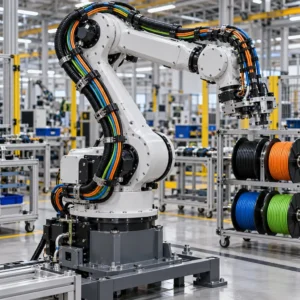
Torsion duty hides in plain sight across industry. Robot axis 4, 5 and 6 — the wrist joints — rotate continuously through production cycles. Rotary indexing tables, turntables and rotating prefeeds on assembly machines twist their wiring by design. Rotating tool heads, radar and camera mounts, packaging machinery with oscillating sections, even the internal wiring of humanoid robot joints — all of it is torsion, not bending. The cable does not travel along a guided path; it stays roughly in place while its ends rotate relative to each other.
That distinction matters because the two duties stress different parts of the construction. Bending stresses the outermost layers most and distributes strain around the bend; torsion stresses the whole cross-section uniformly, in shear, and it tries to undo the cable’s own lay — the deliberate twist geometry that holds conductors, shields and jacket together. A cable can be superb at one and hopeless at the other. Machine builders who treat “flexible” as a single property meet this distinction the expensive way, usually in the failure mode described in the common causes of cable failure: a cable that looked perfect and then corkscrewed itself out of service in weeks.
What Twisting Actually Does to a Cable
To see why torsion needs its own construction, it helps to follow one wire through a rotation. In a conventional cable, each conductor follows a helical path around the cable center. Twist the cable 180 degrees and that helix tightens on one side and loosens on the other; do it repeatedly and the conductors migrate — the lay length changes, some cores shorten and others lengthen, and the geometric harmony the factory built collapses. Cores poke through insulation, shields bag and unravel, and the jacket develops the spiral wrinkle that every maintenance technician recognizes as the beginning of the end.
Torsion-rated construction answers this by making the cable comfortable with its own winding, and the methods are specific:
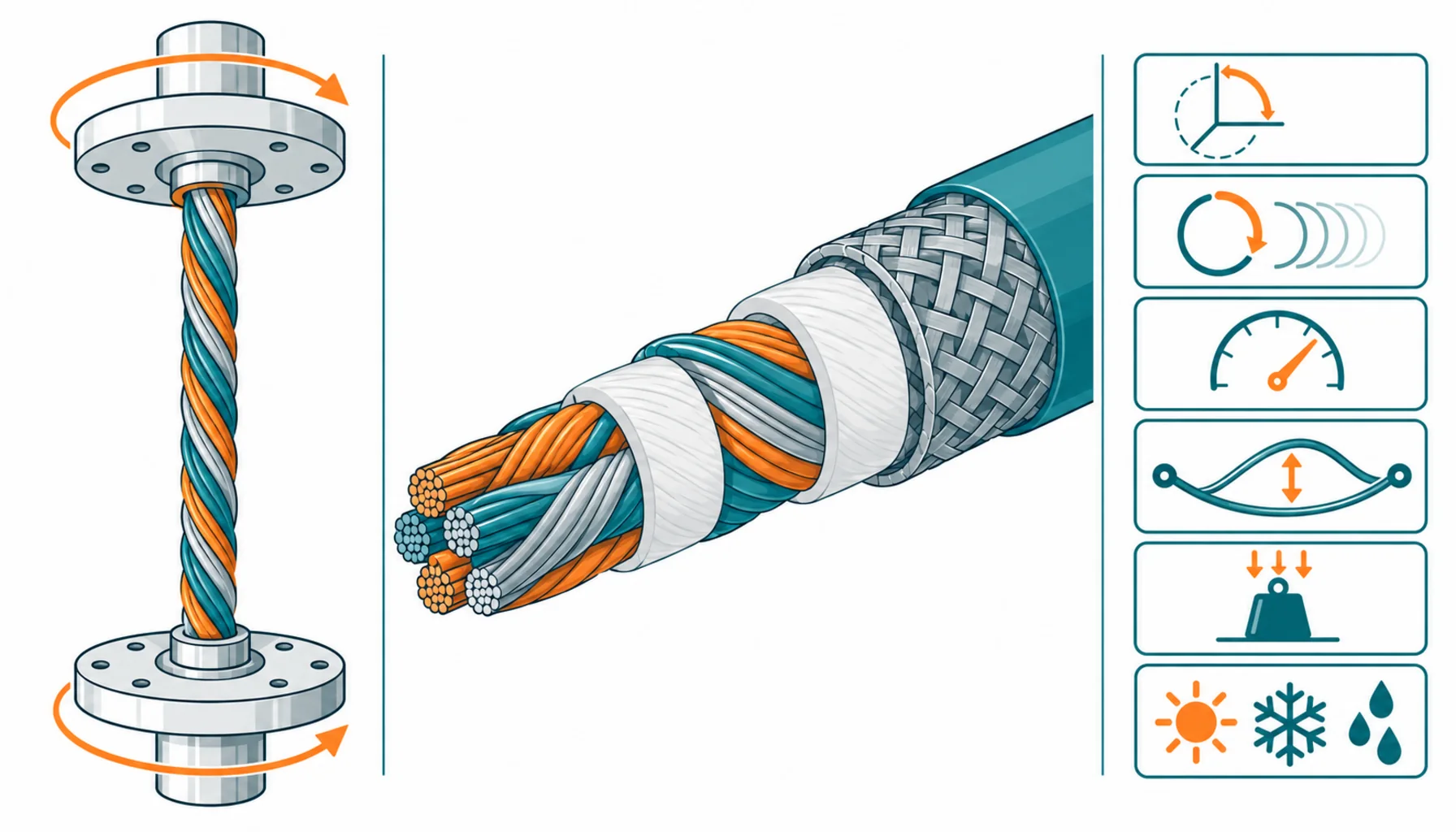
Long-lay, symmetric stranding in bundles. Unlike bending-optimized cable, which uses short lay to help wires slide, torsion cores are stranded in long lay, arranged in concentric or symmetric bundles around a center, so winding tightens one side while unwinding loosens the other — a balanced exchange rather than a one-sided crush. Nothing fights the rotation; everything shares it.
Layer discipline and anti-twist design. Conductor bundles, inner sheath, shield and outer jacket are laid in alternating directions and with matched lay lengths, so each layer’s tendency to wind is offset by its neighbor’s tendency to unwind. Shields get special treatment — short-pitch, elastic braids rather than bonded foils — because a shield that unravels takes the cable’s EMC behavior with it.
Strain relief that does not lock the twist. The cable is only as torsion-capable as its ends allow. Glands and clamps on a torsion axis must hold the jacket without converting end rotation into local crushing — a subtle installation point that separates working installations from repeating warranty claims.
The insulation and jacket materials follow the same flexibility logic as any motion cable — fine stranding needs sound compounds around it, and the material reasoning in what XLPE actually is explains why insulation choice interacts with mechanical duty rather than sitting separately.
Specifying Rotation: The Numbers That Matter
Torsion capability is quoted as an angle, and the angle is a real engineering limit — not a suggestion. Common ratings run from ±90° through ±180° and ±270°, with specialty constructions reaching further for continuous rotation in specific designs. Three numbers define the duty, and all three belong in the RFQ:
Rotation angle per cycle. The maximum twist the cable sees in normal operation — measured at the cable, not at the machine’s spec sheet. A ±180° wrist inside a mechanism that compounds rotations can expose the cable to more twist than the machine nominally rotates; measure or calculate it at the cable entry.
Cycle rate and total cycles. Twists per minute times shift time gives the duty. A robot wrist cycling continuously accumulates rotation cycles far faster than a turntable indexing a few times an hour, and the construction premium should follow the arithmetic.
Speed of rotation and return. Fast wind-unwind cycles add dynamic loading to the torsion duty; slow indexing is mechanically gentler and widens the range of constructions that will survive.
Sizing the conductors follows normal electrical practice — current, voltage, voltage drop — using the standard approach in the cable size selection guide. What is different is that the mechanical envelope constrains the electrical one: the cable must stay within its rated twist angle in every position of every cycle, which is a routing and strain-relief question as much as a cable question.
Installation: Where Torsion Cables Are Actually Killed
Factory construction does the first half of the job; installation does the second. The recurring killers are specific. Clamps fixed too rigidly at both ends prevent the cable from distributing twist along its free length and concentrate it at the terminations — the classic cause of local jacket spiral and core breakage two centimeters from the gland. Insufficient free length denies the cable the room to wind along its axis; torsion installations need deliberate slack, routed so the cable’s natural winding zone is clear of edges and pinch points. And mixing torsion cable into a bending application — dragging it around a chain because it happened to be on the shelf — subjects it to a duty its long-lay construction is not optimized for; the two motion classes are complements, not substitutes, which is why the family differences matter when filling a control and signal loom on a moving machine. Field verification closes the loop: cycle the machine through full rotation before sign-off and inspect the cable for spiral patterns, bagging or gland stress — the same evidence-first habit the supplier audit in the manufacturer checklist applies at the factory gate.
When Torsion Cable Is Not the Answer
The mirror case deserves equal billing. Pure back-and-forth bending — a linear axis in an energy chain — is bending duty, and a torsion construction pays a real premium in strand geometry and lay design for a capability the axis never uses; a bending-optimized construction is the honest choice there. Continuous rotation beyond a few hundred degrees generally leaves cable entirely: slip rings, rotary unions and contactless power transfer exist precisely because unbounded winding will eventually defeat any cable-based solution, however clever its lay. And where the “rotation” is really a cable reel winding and unwinding the cable around a drum — cranes, hoists, carrier systems — that is reel duty with its own construction family. Torsion cable owns one envelope: limited-angle rotation around the cable’s own axis, repeated as part of the work. Name that envelope precisely in the specification and the product class does exactly what it was designed to do.
| Layer | Torsion Design Choice | What It Prevents |
|---|---|---|
| Conductors | Long-lay, symmetric bundles around a center | Core migration and uneven length under winding |
| Core arrangement | Concentric, alternating lay directions between layers | Layer shear and internal abrasion at full twist |
| Shield | Short-pitch elastic braid — never bonded foil | Shield unraveling and EMC loss |
| Inner sheath | Low-friction compound, matched lay | Layer binding at repeated wind-unwind |
| Outer jacket | Flexible, abrasion-resistant compound; PUR common | Spiral cracking at the jacket |
| End fittings | Glands that hold without locking local rotation | Twist concentration at terminations |
| Number | How to Get It | Why It Decides |
|---|---|---|
| Rotation angle per cycle | Measured or calculated at the cable, not the machine nameplate | Must sit inside the construction's rated twist with margin |
| Cycles per shift | Count the actual motion, including returns | Sets duty class and the construction premium you justify |
| Rotation speed | Fastest wind-unwind rate in the cycle | Dynamic loading narrows the field of suitable designs |
| Free length available | Measured on the machine with the routing as built | Twist needs room to distribute; no slack means local failure |
| Electrical load | Current, voltage, voltage drop for the cores carried | Mechanical envelope constrains the electrical sizing |
| Environment | Oil, chips, temperature at the rotating section | Chooses jacket and insulation compounds |
RFQ Checklist: Specifying Rotation Without Ambiguity
These lines turn “we need a cable that rotates” into a quoteable specification:
- Rotation angle per cycle stated at the cable, with margin to the rating
- Cycle count per shift, shifts per day, expected machine life
- Rotation and return speed at the worst section of the cycle
- Free cable length and routing, including what the cable may touch
- Core schedule: power, signal, screens — with separation needs
- Environment: oil, coolant, chips, temperature range at the joint
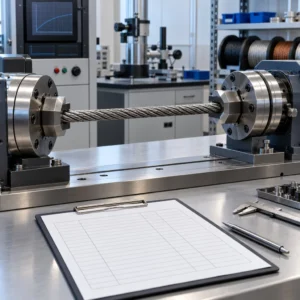
- Torsion test report and construction transparency required as delivery documents
Conclusion
Torsion duty is a different mechanical problem from bending, and it earns a different cable: long-lay symmetric stranding, alternating layer discipline, elastic braided shields and terminations that hold without locking. Specify the twist angle, the cycle count and the free length as precisely as you specify the current, and the construction will absorb millions of windings without complaint. Vague rotation specs are how torsion cables die; measured ones are how they quietly last.
Kexingyu Cable Group (KXYE) supplies torsion-rated cable solutions with the construction details — lay geometry, shield architecture, rated angles and cycles — stated openly in every offer. Describe the rotation, not just the machine, through the RFQ page and the proposal will match the degrees and cycles your cable will actually see.