Sizing UPS and Battery Cables for Data Center Backup Power
Quick Answer: UPS and battery cables are sized from the DC and AC currents they actually carry — not the kVA nameplate — then corrected for battery-room temperature, tray grouping and voltage drop, with fine-stranded Class 5 copper for the terminations.
Introduction
UPS cabling fails differently from the rest of the power system. Feeders sized on a load schedule have margin; battery cables sized on habit often have none. The failure modes are quiet and cumulative — a lug that runs hot because it was crimped with the wrong die, a conductor ampacity eroded by tray grouping nobody recalculated, a DC voltage drop that quietly shortens the runtime the design promised. Each of these traces back to sizing and specification, and each is cheap to prevent on paper and expensive to fix after energization.
The electrical side of the UPS system itself — module ratings, redundancy topologies and runtime math — is covered in our companion guides on UPS sizing for data centers and battery backup time calculation. This article stays on the copper: what current the cable actually sees, how the environment derates it, and what to write into the purchase order so the drums that arrive match the study.
Start From the Current, Not the kVA
The first discipline is separating three currents that sales documents blur together. The UPS input current, the UPS output current and the battery discharge current are different numbers, and each route needs its own calculation. On the AC side, input current follows from apparent power divided by voltage, power factor and efficiency at the actual load point — not at nameplate. On the DC side, battery discharge current is governed by the string voltage: a 480 V lead-acid string discharging 100 kW draws roughly 210 amperes, while a 48 V telecom-style string delivering the same power draws over 2,000 amperes, which is why low-voltage DC plants demand busbar-level thinking and parallel cable sets rather than a single heroic conductor.
With the design current in hand, standard ampacity tables provide the starting cross-section — and immediately require correction. The tables assume reference ambient temperature, a defined installation method and single-circuit conditions. A battery room that holds 35 °C steady-state, with a dozen circuits sharing a tray, can derate a conductor by 20 to 30 percent from its table value. Our guide to cable size selection walks the general derating mechanics; the UPS room and battery room simply apply the same physics with harsher numbers.
Voltage Drop Rules the DC Side
On AC feeders, a few percent of voltage drop is an efficiency question. On the battery circuit it is a runtime question: the inverter draws its input from the battery bus, and voltage lost in the cable is capacity the load never sees, especially at the end of discharge when the string voltage sags toward its cutoff. Best practice keeps total DC drop — positive plus negative legs — within about one percent at maximum discharge current, and the check must be made at end-of-discharge voltage, not at float.
The arithmetic is short but unforgiving: drop equals 2 times length times current times resistance per metre for the round trip, and low-voltage strings leave almost no room. A 48 V plant feeding 2,000 amperes over 5 metres has a budget of roughly half a volt for the entire round trip — which is why such plants run parallel conductors per pole, short bus runs and welded or bolted lattice connections. For 480 V strings the budget is more forgiving, and a single large cross-section per pole usually suffices, with 95 to 500 mm2 copper as the common working range.
Why Class 5 Stranding and Flexibility Matter Here
Battery and UPS cabling terminates on posts, lugs and breaker terminals in cramped cabinets, and it is pulled through the tightest geometry in the building. Class 2 stranded conductors resist the bending that cabinet work demands; Class 5 fine-stranded conductors, per IEC 60228, accept it. The flexibility costs slightly more copper surface treatment and termination care — fine strands need ferrules or experienced crimping to avoid splaying — but the field benefit is real: shorter bend radii inside cabinets, less mechanical stress on battery posts, and easier dressing in troughs packed with other services.
Termination is where sizing meets workmanship. A correctly sized cable on a badly crimped lug is a hot joint waiting for its thermal cycle. The specification should name the termination hardware — compression lugs sized to the conductor class, two-hole connections where current is high — and require torque values on the delivery paperwork. It is no coincidence that recurring field complaints about battery systems, catalogued in our review of common UPS battery problems, so often begin at the connection rather than the cell.
The Battery Room Environment
Battery rooms combine conditions that individually appear mild and jointly punish cable. Temperature runs high because batteries work best warm and rooms are often packed with heat-emitting cells and converters. Ventilated lead-acid rooms add a hydrogen consideration that governs equipment placement, and while the cable itself is not the ignition source risk that unlisted equipment is, sheaths must tolerate the electrolyte mist and occasional water washdown that housekeeping brings. Valve-regulated and lithium installations trade the hydrogen issue for battery management system cabling — multi-core control and communication runs that must be segregated from the power conductors they monitor.
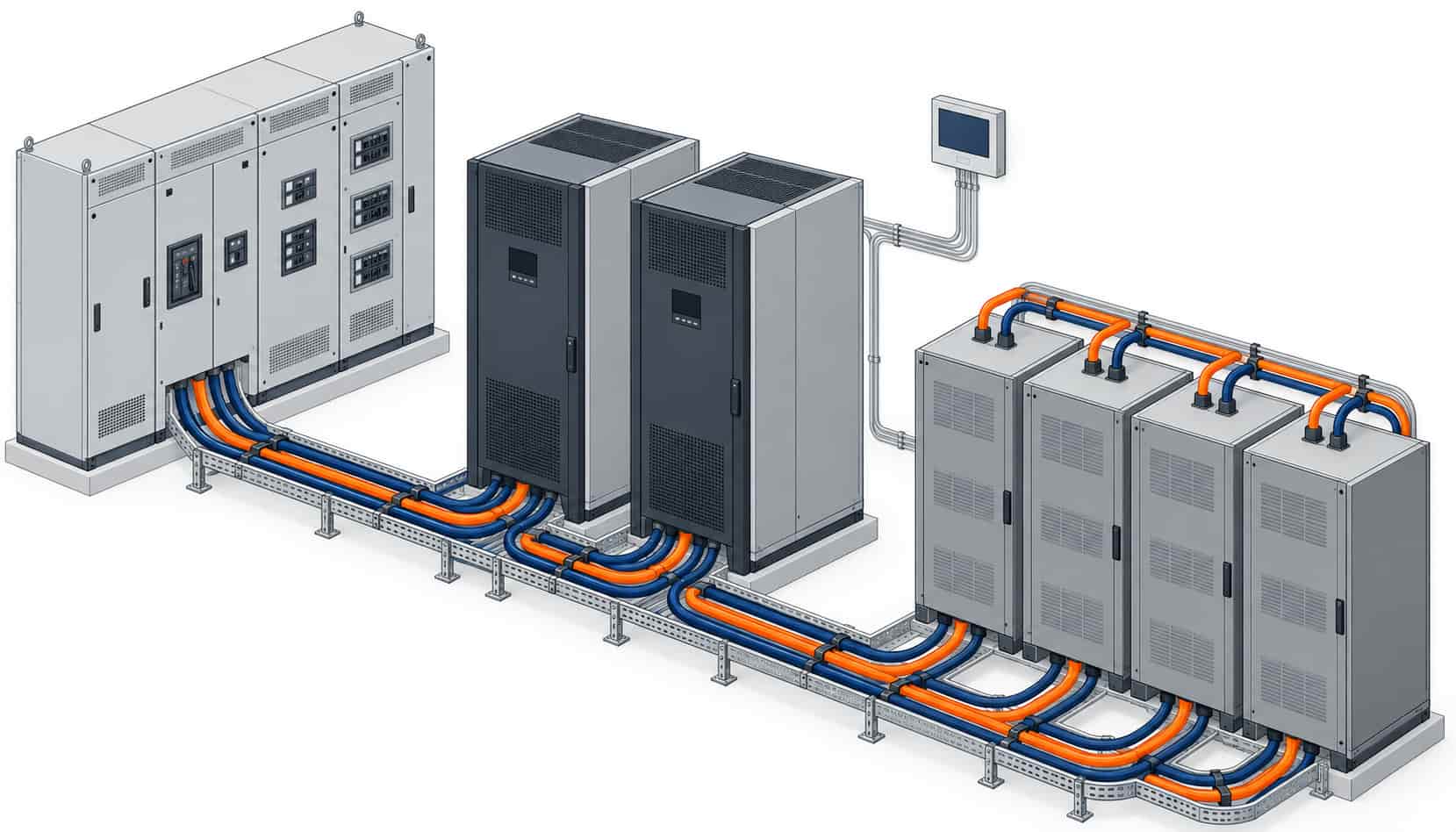
Grouping completes the derating picture. UPS rooms concentrate large single-core sets feeding rectifiers, bypass routes and output feeders into shared trays; the mutual heating between these circuits compounds the ambient correction. The practical sequence that avoids surprises: lay out the tray loading first, count the grouped circuits per section, then apply ambient and grouping factors to every route in the room — and record the calculation in the project file so the next expansion inherits the method rather than the guess.
| Sizing Factor | Why It Matters on UPS Routes | Working Rule |
|---|---|---|
| Design current | Battery discharge current follows string voltage, not kVA nameplate | Compute per route: input, output and DC discharge are three separate numbers |
| Ambient correction | Battery and UPS rooms run 30-45 C sustained | Apply the ambient factor for the room's actual steady temperature, not the reference 30 C |
| Grouping derating | Parallel sets and shared trays are the norm in power rooms | Count grouped circuits per tray section after the layout is fixed, not before |
| Voltage drop | DC drop is lost runtime; budget is tight at low string voltages | Keep round-trip DC drop near 1 percent at maximum discharge, checked at end-of-discharge voltage |
| Conductor class | Cabinet terminations and tight bends demand flexibility | IEC 60228 Class 5 fine-stranded copper for UPS input, output and battery routes |
| Short-circuit withstand | Battery fault current is high and sustained; insulation and screen must survive until the breaker clears | Check the insulation short-circuit rating against the calculated battery fault level, not an assumed grid value |
| Termination | Fine strands splay; hot joints start at the lug | Name compression lug types, crimp tooling and torque values in the specification |
From Calculation to Purchase Order
A sizing study becomes a procureable cable schedule when each route carries four entries: the design current with its correction factors, the resulting cross-section, the conductor class, and the insulation and sheath requirements for the room it passes through. In technical rooms the sheath question now has a default answer — halogen-free low smoke compounds, whose test regimes and zone-by-zone allocation we treat alongside the difference between LSZH and fire retardant cable — while battery rooms may add electrolyte and abrasion resistance to the same LSZH base.
The commercial side rewards early engagement. Class 5 fine-stranded products in large cross-sections are made-to-order items at most factories, with drum lengths cut to the route rather than stocked standard; ordering them with the project’s actual lengths avoids joints in the middle of a critical run. Kexingyu Cable Group (KXYE) supplies the flexible 0.6/1 kV range from 25 to 500 mm2 in Class 5 copper, cut and packed per the cable schedule, and quotes against a copper price linkage so the metal basis agreed at order holds through the delivery window.
| Route Segment | Typical Construction | Key Checks Before Ordering |
|---|---|---|
| UPS input from switchboard | 0.6/1 kV Class 5 copper, single-core parallel sets at high ratings | Ambient and grouping derating; breaker coordination; sheath per room code |
| UPS to battery string, 480 V class | Class 5 flexible copper, 95-500 mm2, single pair per string | DC drop at end-of-discharge; lug type and torque; route length cut-to-size |
| UPS to battery string, 48 V class | Parallel Class 5 conductors per pole or busbar link | Parallel-set balance; round-trip drop budget; short-circuit withstand |
| UPS output to distribution | 0.6/1 kV Class 5 copper, multi-core or parallel sets | Harmonic-related heating review; redundancy path separation |
| BMS and monitoring | Multi-core control and shielded communication cables | Segregation from power conductors; shield earthing scheme per project EMC plan |
When Standard Sizing Tables Are Not Enough
The first limit of any table is that it knows nothing about your room. Derating factors interact multiplicatively, and two projects with identical conductors can differ by 30 percent in delivered ampacity because one loaded its trays before running the numbers. Any offer that quotes cross-sections without restating the ambient, grouping and length assumptions deserves a question, not a purchase order.
The second limit is expansion. UPS rooms grow by increments, and a battery cable sized exactly for today’s string count becomes undersized the day the room doubles — because the new circuits joined the same trays. Sizing with the end-state grouping in mind costs a little copper now and saves a re-pull later. The third limit is lithium transitions: replacing lead-acid strings with lithium changes the discharge profile, the BMS cabling and sometimes the breaker scheme, and a cable schedule copied from the old single-line diagram will miss all three. When the calculation outruns the standard tables — unusual string voltages, extreme ambients, unusual parallel configurations — send the actual parameters to the factory and let the engineering team verify the construction rather than upsizing blindly.
RFQ Checklist: Ordering UPS and Battery Cable
- Single-line diagram of the UPS system with string voltages and module ratings
- Route lengths from UPS to battery strings and between rooms, per run
- Design currents per route: input, output and maximum DC discharge
- Room ambients and tray grouping counts, so the supplier can restate derating assumptions
- Conductor class: IEC 60228 Class 5 for all flexible routes
- Insulation and sheath requirements per room, including halogen-free where specified
- Termination hardware: lug types, crimping class and torque documentation expected
- Drum lengths cut to route, no mid-run joints on critical strings
- Test documentation: routine batch certificates and type test report copies
- Delivery milestones matched to the UPS installation sequence, with pricing basis stated
Send those ten lines and the quotation that comes back is an engineering answer rather than a price guess — and one that survives the site punch list.
Conclusion
UPS and battery cabling rewards the unglamorous work: three currents computed separately, derating applied from the room’s real conditions, DC drop checked at end of discharge, and Class 5 copper terminated with named hardware. None of it is difficult, and all of it is cheaper on paper than on a hot lug.
If you are preparing a data center power room package, work with a manufacturer that treats cable as an engineering item. Kexingyu Cable Group (KXYE) supplies flexible Class 5 power cable, KVV control cable and the full LSZH range from one factory group, cut to your route lengths and quoted against a copper price linkage. Send the single-line diagram and room conditions, and we will return a sized, documented offer per route.