Laying Cable on Wet and Flooded Sites: Protection, Selection and Testing
Quick Answer: Water itself rarely kills a decent cable; the killers are the connections, the route and the tests nobody runs while everything is wet. Lay the site so cable rides above the water line, buy water-tolerant constructions and sealed connections for the runs that cannot be lifted, test insulation on a wet-day schedule, and know which flooded circuits get re-energised and which get replaced.
Introduction
Every construction project meets water eventually: the rainy season, the broken main, the excavation that becomes a pond. Sites that planned their temporary cable for the wet week keep working; sites that treated rain as unusual spend the week repairing circuits and arguing about re-energisation.
The buying task has two halves. Before the water arrives, the route and the specification decide most of the outcome, because a cable on a post does not care that the ground flooded. After it arrives, testing and connection discipline decide which circuits come back and which become the incident report. This guide covers both halves in order, with the spares and stock decisions that hold the season together.
Route Strategy: Winning Before the Rain
The cheapest wet-site cable is the one that never lies in the water. Route strategy costs nothing at design time and outperforms any sheath upgrade.
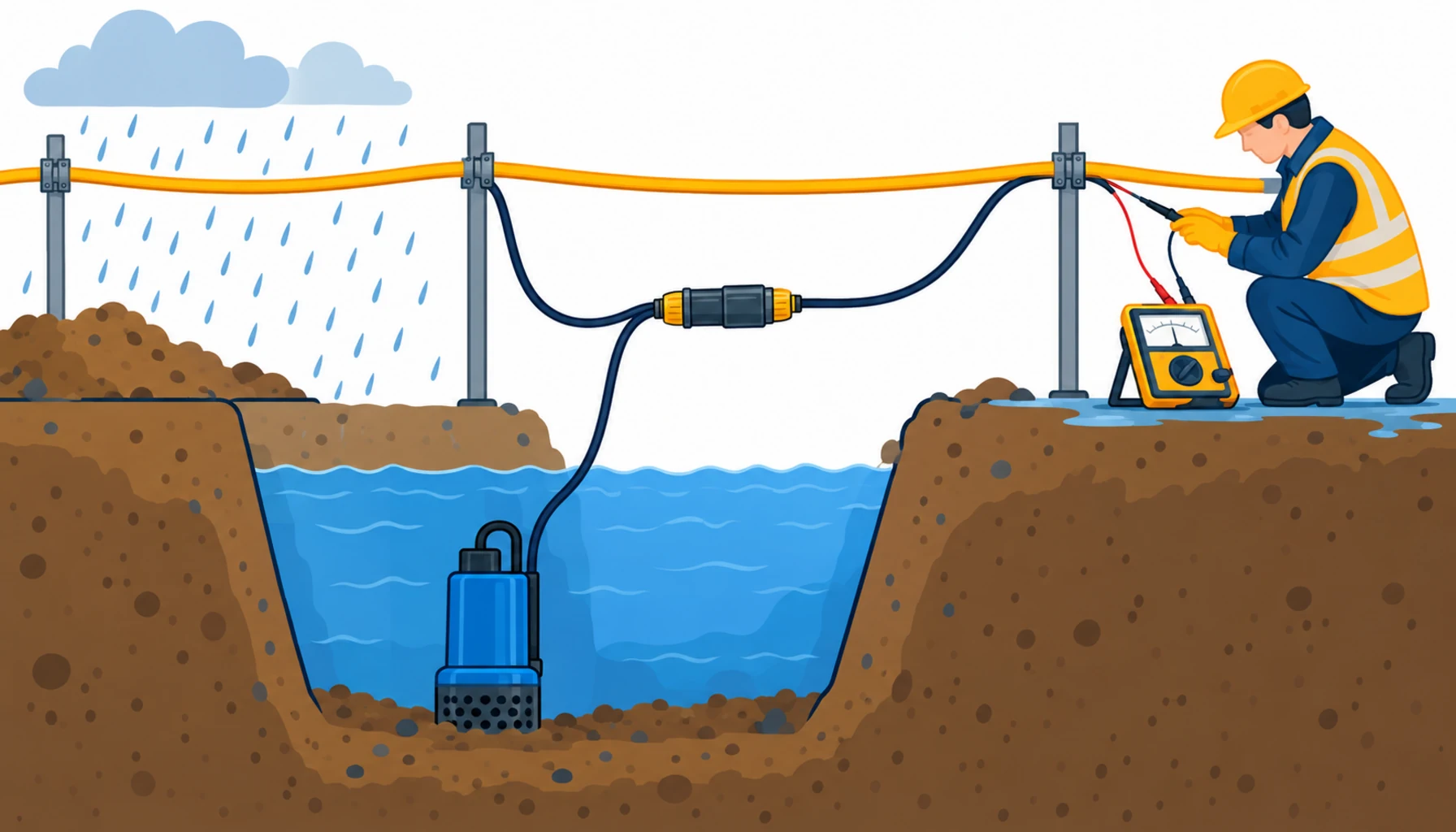
Elevate the permanent lines. The runs that must survive the whole programme, feeds from the supply to the main distribution, belong overhead on poles, scaffold or the structures the site is building anyway. Height is free protection, and it keeps the backbone dry through any flood short of a disaster.
Plan the crossings. Where cable must cross ground that floods, use ramps, ducts or bridges designed for the point, and mark them. A crossing designed once outlasts a dozen emergency re-lays, and it keeps the traffic from cutting the cable that the water weakened.
Drain the low points. Distribution boards standing in puddles are a compliance failure and a fault source. Site the boards high, add drip loops on every entry, and grade the temporary roads so water runs somewhere other than the electrical route. None of this appears on a cable order, and all of it decides the cable’s life.
What to Buy for the Runs That Get Wet
Some runs cannot be lifted: pump supplies in the excavation, circuits across working areas, and anything serving dewatering. These get specified for water contact, not just water resistance.
Sheath and construction. Heavy rubber constructions with robust sheaths take standing water and handling; our water-blocking cable adds longitudinal water blocking so a damaged sheath does not wick water along the core, which is the failure mode that turns one cut into a dead run. For insulation, XLPE holds its properties in wet conditions better than standard PVC over a season; our comparison of XLPE versus PVC cable covers the trade-offs, and our note on low temperature flexible cable matters where the wet season is also the cold one.
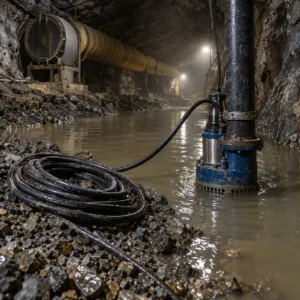
Pump and dewatering supplies. The wettest circuits on any site feed the pumps, and they deserve purpose-built construction: rubber sheathed, sized for the pump’s starting current, and specified for immersion at the pump end. Our flat rubber submersible pump cable is the standard construction for exactly this duty, and our 750 V submersible pump cable covers the higher-voltage dewatering sets. Buying ordinary site cable for a pump supply is the most common wet-site specification error, and it fails at the gland where the cable meets the motor.
| Duty | Water Exposure | What to Specify | Evidence to Demand | Cost and Lead-Time Driver | How It Fails |
|---|---|---|---|---|---|
| Backbone and distribution feeds | Splash and occasional flooding at low points | Overhead routing first, rubber sheaths, drip loops, boards sited high | Route drawing showing water line, sheath data | Routing labour, not hardware; almost free at design | Boards standing in water, drowned entries, route cut at crossings |
| General area circuits | Standing water after rain, mud contact | Heavy rubber flexible construction, supports above the water line, sealed connectors | Ingress ratings per connector, sheath water resistance | Modest premium over indoor-grade; routing discipline is free | Wet connectors tripping RCDs, jackets chafing in the mud |
| Pump and dewatering supplies | Permanent immersion at the pump end | Purpose-built submersible constructions, sized on starting current, sealed pump glands | Immersion rating, gland specification, starting sizing notes | Purpose-built cable costs little more and never substitutes well | Water wicking past the pump gland, undersized starts tripping |
| Buried and ducted runs | Saturated ground all season | Water-blocking construction, ducted where traffic crosses, sealed joints only | Water blocking declaration, joint specification | Blocking adds little; unsealed joints undo it all | Longitudinal wicking from one sheath cut to the board |
Connections: Where Wet Sites Actually Fail
Cable sheaths are engineered for water; site connections are engineered in a hurry, and the difference decides the wet season. A Coupler lying in a puddle, a board entry without a drip loop, a taped joint on a ground run: these are the RCD trips at 6 a.m. every rainy morning.
Buy sealed connections. Weather-rated couplers with declared ingress ratings, glanded entries on every board, and a jointing standard that bans tape as a moisture seal. The premium over the cheapest connectors is small, and wet-site failure data puts the majority of faults at connections, so this is where the specification money belongs.
Position for drainage. Connection points belong above the water line, with drip loops that shed water away from the joint, and off the ground where the site’s own traffic cannot add mechanical damage to the moisture. A connection survey after the first heavy rain finds every bad position on the site in one walk, and it is the most productive hour an electrical supervisor can spend in the wet season.
Testing in the Wet: The Schedule That Decides Re-Energisation
Wet sites need a different testing rhythm, because insulation that read fine in dry weather reads differently after a week of rain, and the reading is the only objective answer to the question everyone asks after a flood: can we switch back on?
The wet-day schedule. Insulation resistance tested on every affected circuit after heavy rain, with results recorded against a baseline; our note on insulation resistance testing covers the method and the acceptable values. Periodic in-service testing through the wet season catches the circuit degrading before it trips; our note on in-service cable testing covers the routine. The records matter as much as the readings, because the re-energisation decision after an incident is an evidence decision.
After a flood. Circuits that stayed energised and protected get tested before trusting them. Circuits that were flooded while energised get inspected, tested and re-tested after drying, with any run that fails twice replaced rather than argued with. Connections and boards that went under are stripped and dried as a matter of course. The site that follows this discipline re-energises in hours; the site that guesses re-energises in days or becomes the incident report.
What to Freeze Before the Order
| Decision | What to State | Evidence to Attach | Cost of Leaving It Open |
|---|---|---|---|
| Route strategy | Overhead backbone, designed crossings, boards above the water line | A route drawing marking the flood levels | The whole system rebuilt by the first real rain |
| Sheath and construction | Rubber flexible builds, water blocking on buried runs | Sheath and blocking declarations | Season-long chafe failures in the mud |
| Pump supplies | Purpose-built submersible cable, sized on starting | Immersion rating and sizing notes | The dewatering effort stopped by its own cable |
| Connections | Sealed couplers, glanded entries, drip loops, tape banned | Ingress ratings per connector type | Morning RCD trips all season at the same joints |
| Test schedule | Wet-day insulation tests against a baseline, records kept | Baseline values and record template | Re-energisation decided by opinion after every flood |
| Flood response | Test-before-trust rules, drying discipline, replacement criteria | A one-page flood procedure | Days of outage and the incident nobody can explain |
The Wet Store: Spares and Seasonal Stock
Wet seasons fail cable at known rates, and the stock rack should reflect those rates rather than good intentions. The circuits that flood are the same circuits every year, and last season’s repair list is this season’s spares order: lengths for the crossing runs, a set for each pump circuit, and the connectors that live in the puddles.
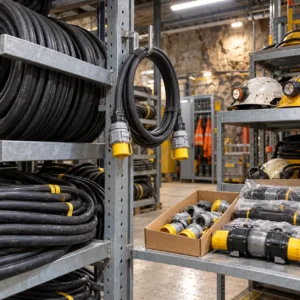
Hold the right shapes. Wet-site spares differ from ordinary stock in two ways. First, complete assembled sets, cable with connectors fitted and tagged, because a repair at night in the rain needs a swap, not a termination job under a tarpaulin. Second, the small hardware in quantity: glands, drip-loop hooks, ramps and sealed couplers, because these are the items that fail weekly and stop a repair that the cable itself would have allowed.
Store it for the condition. A spares drum standing in the flood zone is not a spare. Keep the wet store above the water line, off the ground, with the ends sealed, and rotate the stock so the sets that enter the rack first go out first. A short walk to a dry store is the difference between a twenty-minute repair and a two-day one when the site is under water.
Book the replacement cycle. Budget the wet season’s cable consumption as a line before the season starts, based on last year’s actuals. Sites that fund it this way replace failures immediately; sites that fund it by emergency purchase wait for approvals while the excavation floods, and the waiting is always the expensive part. The wet store, like the flood procedure, is a purchase decision made in the dry, and it belongs in the original RFQ as a spares schedule the supplier prices against.
Cost Structure and Lead Time
The wet-site premium is concentrated in a few places: water-blocking and submersible constructions, sealed connectors, and the supports that keep the rest out of the water. Each is small against the cost of one flooded week, and the routing decisions that matter most cost nothing at all.
Standard rubber flexible constructions ship from stock, and the submersible and water-blocking families are catalogue products, so the wet-season order can be placed reactively in most markets. The exceptions are long water-blocking lengths and factory-sealed pump sets, which carry real lead time and belong in the pre-season order rather than the emergency one. But the start of the wet season is the worst possible buying moment, because every site in the region is ordering at once; place the wet-weather stock order before the season, phase it against the programme, and hold the spares the flood procedure will call for. Warranty terms deserve a read on any cable bought for permanent wet duty, and our note on power cable warranty terms lists the clauses that decide whether an immersion failure is covered.
When a Wet-Site Specification Is Not the Answer
When the trip is the RCD doing its job. A circuit that trips in the rain has a wet connection, and re-setting it without finding the joint is how sites learn about fault current. Fix the connection.
When the pump is the fault. Pumps that trip their supplies often have water in the motor, not a bad cable. Test the pump before re-ordering the feed.
When the flood exceeds the design. A site under meaningful flood water is an electrical emergency, not a specification problem; isolate first, and let the procedure decide what comes back.
When the season never ends. A site that runs wet for most of the year is a marine problem, and permanent wet-location design, not temporary-site practice, is the right frame.
RFQ Checklist
- Route drawing marking flood levels, crossings and board positions
- Rubber flexible constructions declared for all outdoor circuits
- Water-blocking construction for buried and ducted runs
- Purpose-built submersible cable for pump supplies, sized on starting
- Connector ingress ratings and drip loop specification
- Baseline insulation resistance values and wet-day test schedule
- One-page flood response procedure with re-energisation criteria
- Wet-season stock order placed before the season starts
- Assembled spare sets stored dry, off the ground, ends sealed
- Spares for the pump circuits and the crossing runs
- Warranty terms reviewed for immersion duty
- Connection survey after the first heavy rain each season
Conclusion
Wet-site cable is bought well when the route beats the water first, the runs that do get wet are built for it, the connections are sealed and sited for drainage, and the testing schedule turns re-energisation from an argument into a reading. Hold the spares the season will actually consume, funded as a line rather than an emergency. Freeze that set of decisions before the season, and the rain becomes weather instead of an electrical event, and the programme keeps its dates.
Kexingyu Cable Group (KXYE) has manufactured cable in Quanzhou since 1996, supplying water-blocking, submersible and heavy rubber flexible constructions for wet sites and dewatering duty, with declarations and test support against every order. Send us your site’s worst water, and we will come back with the constructions and the schedule. The fastest route is a request for quotation.