
PDU Basics: Rack vs Floor-Mounted Power Distribution Units
Power distribution units are the last—and most quoted—meters of the power path, and the rack-versus-floor choice shapes cabling, monitoring and cost for the life of the hall
Introduction
Between the UPS output and a server’s power supply sits equipment that most buyers spend the least time specifying and the most time living with. The power distribution units—the floor-mounted panels that gather UPS output into branch circuits, and the rack-mounted strips that deliver it to individual devices—are where capacity becomes outlets, where monitoring becomes billing data, and where the elegant A/B redundancy designed on the single-line either survives to the plug or quietly disappears at a shared panel.
“PDU” is used loosely in the market. It can mean a $200 power strip, a 400 kVA engineered cabinet with its own transformer, or an intelligent per-outlet switching device. The three occupy the same paragraph in quotations and utterly different places in a power architecture. Choosing between them—and between the floor and rack formats—is not a detail decision; it determines cable trays, breaker coordination, per-rack density limits and how much of the hall’s electrical behavior anyone can actually see.
This guide places the PDU in the power train, explains the floor-mounted and rack formats, compares them across the aspects that matter, and closes with a selection table and specification checklist. For the wider equipment context, start from our data center power equipment range.
What a PDU Does in the Power Train
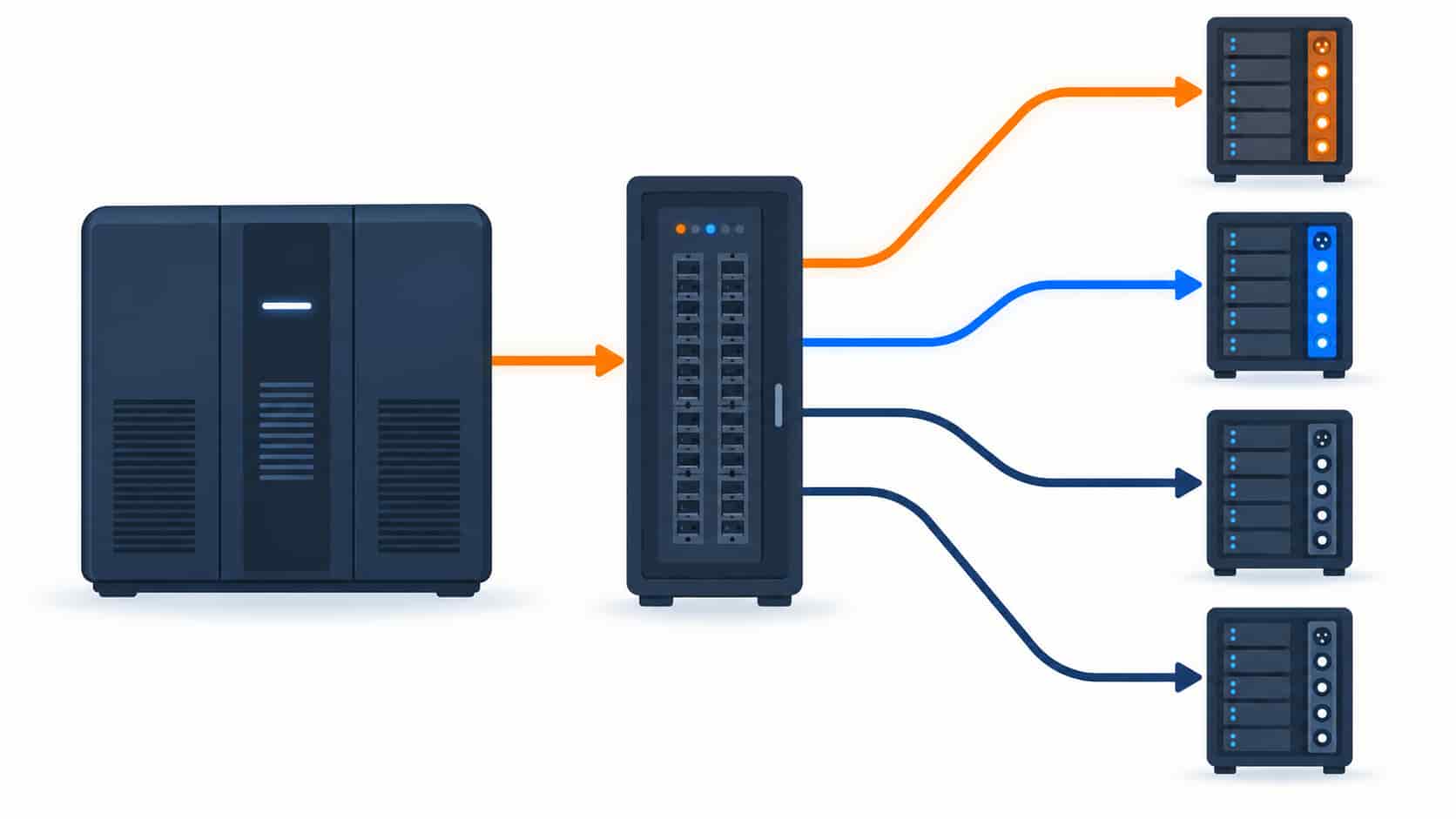
The power path runs utility to switchgear to transformer to UPS—and then stalls unless something converts one large conditioned output into hundreds of small, protected, measurable feeds. That is the PDU’s job. A floor-mounted PDU receives the UPS output at high capacity, distributes it through branch breakers, and often steps voltage down through an integral transformer—our guide to transformer capacity sizing applies directly when that transformer is inside the PDU cabinet. The rack PDU takes one branch circuit and divides it into individually protected outlets at the cabinet.
Three functions ride along with the distribution. Protection: branch breakers and outlet fusing sized so a single fault trips one circuit, not a row. Measurement: from a simple input meter to per-outlet energy data, which is what colocation billing, capacity planning and carbon reporting are all actually made of. And redundancy enforcement: in A/B designs, the PDU layer is where the two paths must remain separate down to each power supply—one PDU per path, per rack, no exceptions. A power train that is redundant at the UPS and shared at the PDU is redundant on paper only.
Floor-Mounted PDUs: The Backbone Panel
The floor-mounted (or large standalone) PDU is a cabinet on the white-space floor—or more often in the electrical annex—receiving UPS output in the tens to hundreds of kilowatts and breaking it into branch circuits for a group of racks, a row, or a zone. Inside, depending on design: an isolation or step-down transformer, a main protective device, a set of branch breakers, and terminal space for the feeders that run to the racks. It is the electrical backbone of the hall’s last stage, and it is engineered equipment—short-circuit ratings, thermal calculations, breaker coordination—closer to switchgear than to power strips.
Its strengths are aggregation and oversight. One floor PDU serves dozens of racks, so per-kilowatt distribution cost is low, branch protection lives in one serviceable place, and the panel gives facilities teams a natural measurement point for each zone. Its costs are physical: dedicated floor area, feeder cable runs with their tray space and copper, and a single cabinet whose transformer loading becomes a per-zone capacity ceiling. In many modern high-density halls, engineered busway systems are replacing part of the floor-PDU role—serving rows overhead with tap-off boxes—but the aggregation and protection function it performs remains.
Rack PDUs: The Last Meter
The rack PDU—vertical 0U strips or 1U units inside each cabinet—is where power becomes outlets. The product ladder climbs in intelligence: Basic units distribute and protect, nothing more. Metered units add a meter at the input, so the rack’s total draw is visible. Monitored units measure per branch and per outlet, feeding capacity planning and tenant billing. Switched units add per-outlet on/off control—remote reboot, outlet sequencing, and the ability to shed load in an emergency—plus environmental sensor integration on many models.
The last meter matters more than its length suggests. Outlet type and plug standard must match the equipment fleet—mixed C13/C19/C21 and national plug inventories are a daily friction source in international deployments. Phase balancing across the PDU’s inputs determines how cleanly the upstream transformer carries the load. And in A/B redundant designs, every dual-corded device takes one feed from PDU A and one from PDU B—two rack PDUs per cabinet, each on its own path, sized so either alone can carry the full rack load with one feed down.
Rack vs Floor-Mounted: The Comparison
The formats are complements, not competitors—in most halls they appear in the same power path. The comparison shows where each earns its place:
| Aspect | Floor-Mounted PDU | Rack-Mounted PDU |
|---|---|---|
| Role | Aggregation panel: UPS output to branch circuits for a zone of racks | Final distribution: one branch circuit to individual outlets in a cabinet |
| Capacity class | Tens to hundreds of kVA per cabinet | Roughly 3â36 kW per rack unit; higher with busway |
| Form and install | Floor cabinet, hard-wired feeders, dedicated footprint | 0U vertical strip or 1U unit, mounted in the rack in minutes |
| Protection | Main and branch breakers, optional integral transformer | Branch breakers and outlet-level overcurrent protection |
| Monitoring depth | Panel and branch-level metering | Up to per-outlet metering, switching and environmental sensing |
| Cost profile | High per cabinet, amortized across many racks | Low per unit, multiplied across every rack in the hall |
| Change flexibility | Fixed zones and branch counts; changes mean electricians | Move, add and change racks by unplugging and re-racking |
Monitoring: From Power Strips to Per-Outlet Intelligence
The intelligence tier is where PDU budgets quietly expand and quietly pay back. Per-outlet monitoring turns the electrical layer into data: which rack draws what, which tenant exceeded reservation, which circuit is drifting toward its breaker limit before it trips. For colocation operators, switched and monitored rack PDUs are the billing infrastructure—revenue depends on the meter. For enterprise halls, the same data feeds capacity planning and the utilization reporting that separates a 40% efficient facility from a 70% one.
Switching adds operational reach: remote reboot of a hung device without dispatching a technician—decisive for lights-out or remote sites—and controlled power sequencing when a rack re-energizes after maintenance, preventing the inrush pile-up that trips a freshly restored branch. The discipline the intelligence requires is honest data plumbing: PDU telemetry must integrate with the DCIM or BMS platform, with device names that match the floor plan, or the per-outlet capability produces per-outlet confusion.
Placement and Architecture Patterns
Two architecture patterns dominate. In the classic pattern, floor PDUs sit at the edge of each zone receiving UPS output, feeders run under raised floor or overhead tray to each rack, and dual rack PDUs complete the A/B delivery inside the cabinet. Separation is enforced at every stage: separate floor PDUs, separate feeders on separate paths, separate rack strips. In the busway pattern, an overhead busway per row replaces much of the floor-PDU distribution—tap-off boxes deliver to racks directly—which suits high-density and high-churn halls; rack PDUs still perform the last-meter role.
Placement decisions are physical as much as electrical. Underfloor feeder routes constrain cooling airflow; overhead tray constrains cable length and bend radius; rack strip position (vertical rear-post 0U versus 1U in the mount space) trades outlets against rack units. None of these is difficult; all of them are expensive to change after the racks are populated, which is why the PDU layout belongs in the hall design review, not in the procurement follow-up.
Choosing the Right Mix
Most facilities deploy both formats—the real decision is the intelligence tier per rack type and the aggregation pattern per zone. The table maps common needs:
| If Your Need Is⦠| Reach For | Why |
|---|---|---|
| Serving a zone of racks from one UPS output | Floor-mounted PDU | Aggregation, branch protection and zone metering in one engineered panel |
| Per-tenant power billing in colocation | Monitored or switched rack PDU | Per-outlet metering is the billing-grade data source |
| A/B redundant delivery to dual-corded racks | Two rack PDUs per rack, one per feed | Each power supply rides its own path end to end |
| High-density racks above ~30 kW | Busway with tap-offs, or high-amp rack PDU | Last-meter capacity beyond conventional strips |
| Budget build with basic compliance only | Basic rack PDU + floor panel | Distribution and protection without intelligence overhead |
| Lights-out or remote site operations | Switched rack PDU | Remote reboot and sequencing without a site visit |
Common Mistakes in PDU Procurement
Four recurring errors dominate PDU regret. First, outlet mismatch: ordering strips with the wrong plug and outlet mix for an international equipment fleet, discovered at installation. Second, phase and circuit imbalance across the hall—rows that look tidy but load their upstream transformer lopsidedly, burning capacity in the heaviest phase while the lightest idles. Third, buying capacity without headroom discipline: racks populated to their strip’s breaker limit run one firmware update away from nuisance trips, and A/B designs that ignore the one-feed-down case overload the survivor precisely when redundancy matters. Fourth, intelligence without integration—per-outlet PDUs whose data never reaches the monitoring platform, or whose naming conventions drift from the floor plan until the data is unusable.
A fifth, procurement-specific: assuming PDU availability rides with the UPS order. Distribution gear shares the current switchgear market’s queues—our 2026 lead-time review describes the pattern—so rack PDUs and floor panels belong in the same early ordering conversation as the equipment they serve, not in a later procurement wave.
PDU Specification Checklist
Whatever the mix, quotations become comparable when these are pinned:
- Capacity and input: kVA/kW per unit, input voltage and phases, breaker ratings, and the one-feed-down case for A/B designs.
- Outlet plan: outlet counts by type (C13/C19/local standards), plug standards of the equipment fleet, spacing for bulky power supplies.
- Intelligence tier: basic/metered/monitored/switched per rack class; metering accuracy class; per-outlet vs per-branch resolution.
- Integration: network protocols (SNMP/Modbus/IPMI), DCIM platform compatibility, naming and location conventions.
- Protection coordination: branch breaker curves coordinated with upstream devices so one fault trips one circuit.
- Physical fit: 0U/1U form, mounting hardware, cable entry direction, floor PDU footprint and front/rear access.
- Standards and testing: applicable IEC/EN safety references, short-circuit ratings for floor panels, routine test reports.
- Spares and support: controller replacement policy for intelligent units, firmware update commitments, warranty terms.
Conclusion
PDU selection is the unglamorous half of power quality: the UPS manufactures clean power, and the distribution layer decides whether that power arrives at each server as a protected, metered, redundant feed or as a tangle of compromises. Floor-mounted units aggregate, protect and measure zones; rack PDUs deliver the last meter with as much intelligence as the operation needs. Almost every serious hall uses both, deliberately.
Specify the outlet plan with the same care as the kVA, keep the A/B separation intact down to each power supply, and make the monitoring data actually land in a platform someone reads. When you are ready to procure the layer, the team at KXY E-Power Group supplies distribution equipment together with the UPS, switchgear and storage systems around it—sized and coordinated as one power train.
Frequently Asked Questions
Recent Posts
Voltage Stabilizers vs UPS: Do You Need Both?
Voltage Stabilizers vs UPS: Do You Need Both? One device fixes how high or low the voltage is; the other fixes whether there is voltage
Energy Storage for Data Centers: A Growing Backup Power Option
Energy Storage for Data Centers: A Growing Backup Power Option Batteries have always backed up data centers in the form of UPS strings. Grid-scale BESS
Thermal Runaway in Lithium Batteries: What BESS Buyers Should Understand
Thermal Runaway in Lithium Batteries: What BESS Buyers Should Understand How thermal runaway starts, how it propagates, and which evidence buyers should require before approving