
Data Center Power in Southeast Asia: Market Dynamics and Equipment Strategy
The fastest-growing data center corridor in the world sits on five very different power grids—and the equipment strategy that works in one market can quietly fail in another.
Introduction
For most of the past decade, Southeast Asia was where data center demand lived and capacity did not. Singapore’s moratorium on new data centers pushed developers across the causeway into Johor and across the strait into Batam; Jakarta’s scale and cloud appetite pulled in hyperscale investment; Bangkok, Manila and Ho Chi Minh City followed with their own waves of AI-driven demand. The region now hosts some of the fastest capacity growth rates anywhere, and every megawatt of that growth is, first and foremost, a power project.
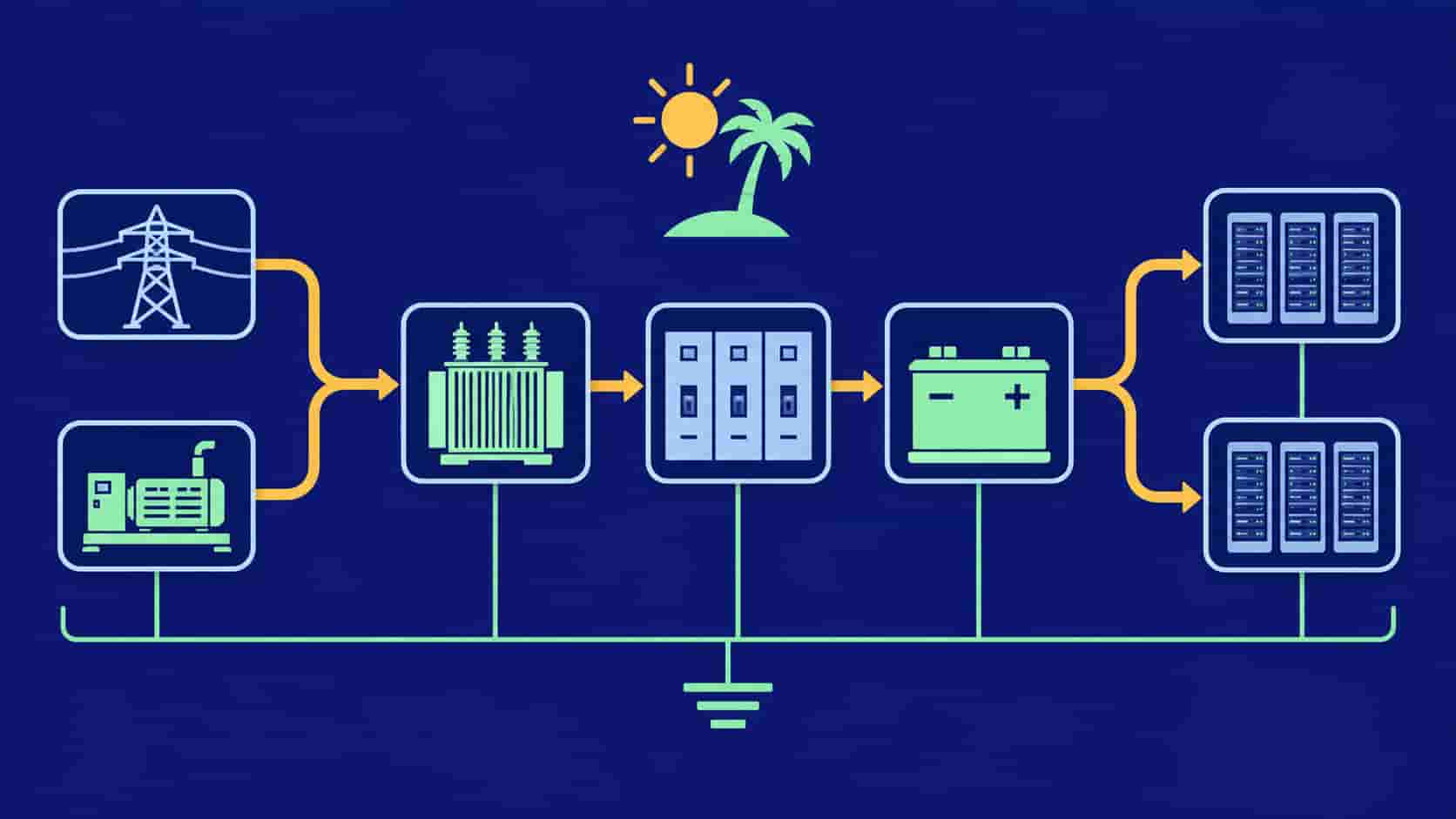
That is the lens of this article. We are not ranking land prices or fibre routes; we are looking at what the Southeast Asia build-out means for the electrical equipment behind it—transformers, switchgear, generators, battery storage—and for the developers, EPC contractors and investors who must buy it in a supply chain that has not recovered its old reflexes. The fundamentals of data center electrical design are covered in our data center power hub; here the focus is regional: which markets differ, why equipment lead times dominate project schedules, and what a realistic 2026-era procurement strategy looks like.
Why the Market Moved South
Three forces converged to redirect regional growth. Policy: Singapore’s land-and-power constraints capped its own expansion and explicitly pushed developers toward cross-border capacity in Johor and Batam, creating overnight a new build-out corridor with hyperscale-grade requirements. Cloud and AI demand: regional cloud regions, video consumption and now AI training clusters multiplied forecast loads faster than any grid plan anticipated. Economics: land, labour and energy costs across Indonesia, Malaysia, Thailand, Vietnam and the Philippines undercut Singapore dramatically, while governments courted investment with industrial-park power allocations and tax incentives.
The result is a region building in five years what mature markets built in fifteen—and discovering that power equipment is the binding constraint on every schedule.
Five Markets, Five Different Power Problems
Treating “Southeast Asia” as one market is the first analytical mistake. The five principal markets differ in grid reliability, regulatory structure and the practical equipment consequences that follow. The table condenses the differences that matter most to power procurement.
| Market | Power Reality for Data Centers | What It Changes in Equipment Terms |
|---|---|---|
| Singapore | Extremely reliable grid, tight capacity allocations, green-energy mandates pushing efficiency and renewables | Premium on high-efficiency transformation; space and thermal optimisation; sustainability reporting drives electrical metering granularity |
| Johor / Malaysia | The designated overflow corridor; utility fast-tracking supply to industrial parks, water and power allocation now the gating items | Large phased transformer orders tied to park allocations; robust MV distribution inside campuses; lead-time discipline decides who builds first |
| Indonesia (Jakarta, Batam) | Archipelago grid with strong growth and island-specific constraints; Batam builds capacity specifically to serve Singapore demand | On-site generation heavier than peers expect; fuel logistics and gas supply clauses matter; power quality mitigation on weaker island feeders |
| Thailand (Bangkok region) | Mature industrial base, dependable but tightening supply, energy costs under scrutiny; flood memory still shapes siting | Vertical-elevation and flood-rated electrical rooms; mixed grid-plus-generator designs; efficiency-driven transformer and UPS selections |
| Vietnam & Philippines (HCMC, Manila) | Fastest relative growth from a smaller base; grids improving but outages and voltage dips still part of design life | Deeper battery bridging and generator autonomy; voltage-dip ride-through specifications; more conservative redundancy choices |
Read the table vertically and a pattern emerges: the more reliable the grid, the more the electrical scope optimises for efficiency and reporting; the weaker the grid, the more it buys autonomy—storage, generation, ride-through. Equipment strategies that ignore this gradient import either too much generator into Johor or too little battery into Manila.
What the Equipment Shortage Means Here
The global electrical equipment shortage that began in 2021 has a distinct regional shape. Southeast Asia sits at the end of long supply lines from every major manufacturing region, competing with North American and European utilities for the same transformer and switchgear capacity. Lead times that were once measured in weeks now run to many months for switchgear and well beyond a year for large power transformers—our analysis of the 2026 data center switchgear and transformer shortage walks through the causes and the regional exposure.
For Southeast Asian projects the consequences are concrete. A Johor campus that finalises its load study and then begins transformer procurement has already lost most of a year. A Jakarta project that leaves switchgear ordering to the EPC’s mobilisation phase finds panel slots booked by competitors who ordered earlier. The projects that move on time are the ones that treat electrical equipment like real estate: scarce, location-specific and bought ahead of need.
Planning discipline matters as much as early ordering. Our switchgear lead-time planning guide sets out how to sequence orders against design maturity, and the distinctions that decide which items can wait and which cannot are compared in our piece on switchgear versus transformer lead times for EPC contractors. The short version for the region: transformers are the critical path almost everywhere, switchgear is the second constraint, and both reward buyers who standardise configurations across phases.
Sizing and Specifying Power for Tropical Sites
Beyond lead times, the tropics add engineering requirements that temperate-region templates miss. High ambient temperature and humidity de-rate transformers, derate generator output, and demand aggressive thermal management in every electrical room. Monsoon and flood history shape whether electrical rooms sit on grade or on platforms. Salt-laden coastal air—relevant from Batam to coastal Johor—pushes outdoor equipment toward higher enclosure protection and coated heat exchangers.
Resilience philosophy is the other regional differentiator. Where grid quality is strong, N-1 redundancy with short generator ride-through suffices; where it is not, designs deepen the battery layer. Battery storage is entering Southeast Asian data center designs both as bridging capacity and as a grid-interface buffer, with the same grid-forming and integration questions that mature markets confront—our article on energy storage for data center backup covers the technical ground. The hybrid pattern—battery for seconds and minutes, generators for hours—is becoming the regional default, not the exception.
Equipment Priorities by Project Stage
Because lead times dominate the calendar, the useful way to organise procurement is by project stage: what to order, in which order, and what can safely wait. The table is the version we walk through with regional developers.
| Equipment | When to Lock It | Why It Cannot Wait | What to Standardise Across Phases |
|---|---|---|---|
| Power and distribution transformers | At concept-stage load definitionâ12 to 24 months ahead of need | Longest lead items in the chain; capacity is allocated by order date, not by project priority | Voltage class, impedance family, losses class and footprint per phase increment |
| MV switchgear and RMUs | When single-line diagrams stabiliseâ9 to 15 months ahead | Panel manufacturing slots book out; late orders inherit the next available window | Panel families, busbar ratings and protection relaying platform |
| Generators and fuel systems | With mechanical designâ6 to 12 months ahead | Engine allocations and exhaust after-treatment supply both move in waves | Engine platform, tank sizing philosophy and paralleling controls |
| UPS and battery storage | With electrical detailed designâ6 to 10 months ahead | Power module supply chains tighten unpredictably; capacity shortages recur | Topology and module platform; battery vendor and thermal design |
| Busway, cable and distribution boards | Latest of the majorsâ4 to 8 months ahead | Shorter leads, but site-measurement dependency punishes early hard commitments | Busway ratings and jointing system; cable standards per market |
When Regional Optimism Is Not a Strategy
The growth story is real, but three assumptions keep failing in project reviews:
- “Utility supply will arrive with the park.” Grid reinforcements move at utility capital-cycle speed, which rarely matches private build schedules. Design the campus to be self-sufficient longer than the utility letter promises.
- “We will buy when the design is final.” In this market, final design minus equipment lead time equals delay. The buyers winning slots are committing to standardised platforms before the last engineering detail closes.
- “One market, one template.” Copying a Johor electrical design into Manila imports the wrong autonomy depth; copying Manila’s generator fleet into Singapore buys standby capacity the grid will never call. Regional programs need regional engineering, not a master template.
Conclusion
Southeast Asia’s data center boom is, in electrical terms, a race between demand growth and equipment supply. The demand side is well documented; the supply side is where projects are actually won. The winners are ordering transformers at concept stage, standardising switchgear platforms across phases, sizing autonomy to each market’s grid reality rather than a regional average, and treating lead times as the governing constraint of the master schedule.
None of this diminishes the opportunity—the region’s growth remains exceptional. It simply moves the decisive competition indoors: from land auctions and lease rates to factory slots, standardisation discipline and the quality of the supply chain behind every megawatt.
Frequently Asked Questions
Short answers to the questions developers and EPC teams ask about powering data centers in the region.
Recent Posts
Voltage Stabilizers vs UPS: Do You Need Both?
Voltage Stabilizers vs UPS: Do You Need Both? One device fixes how high or low the voltage is; the other fixes whether there is voltage
Energy Storage for Data Centers: A Growing Backup Power Option
Energy Storage for Data Centers: A Growing Backup Power Option Batteries have always backed up data centers in the form of UPS strings. Grid-scale BESS
Thermal Runaway in Lithium Batteries: What BESS Buyers Should Understand
Thermal Runaway in Lithium Batteries: What BESS Buyers Should Understand How thermal runaway starts, how it propagates, and which evidence buyers should require before approving