
Vietnam's Industrial Park Boom: What It Means for Power Equipment Demand
Every new factory gate in Vietnam opens onto an electrical question—and the answers are drawing transformers, switchgear and packaged substations into the country at a pace that reshapes procurement across the region.
Introduction
Vietnam has become one of the world’s most reliable manufacturing stories: electronics assembly scaling from phones to semiconductors, furniture and textiles feeding global retail, and a “China plus one” flow of investment that keeps announcing new plants in Bac Ninh, Bac Giang, Hai Phong, Long An and Binh Duong. Each announcement is also a power announcement. Industrial parks are being planned, energised and expanded faster than their electrical infrastructure was ever designed to grow, and the gap between those two clocks is where this article lives.
The demand shows up in a very specific equipment basket: medium-voltage transformers for park substations, packaged and prefabricated substations for fast deployment, switchgear lines for the park networks, and increasingly generation and storage for parks that cannot wait for the grid to firm up. This article maps the demand—how park power is structured, how load grows in stages, what equipment each stage pulls, and the constraints that shape procurement. For readers new to the equipment itself, our transformers and substations resources carry the engineering detail.
Why Manufacturing Moved North—and Kept Moving
Three currents feed the park boom. Cost and geography: Vietnam offers competitive labour with ports, roads and power corridors close to southern China’s supply chains—hours, not weeks, from component sources. Trade architecture: a deep bench of free-trade agreements (CPTPP, EVFTA, RCEP) gives manufacturers tariff positions that diversification strategies reward. Supply-chain strategy: the “China plus one” logic moved from hedging to policy at many multinationals, and Vietnam—alongside peers—captured the qualification lines: electronics first, then components, then the suppliers of suppliers.
The result is not one boom but a rolling one: parks fill, announce phase two, and open new parks on adjacent land. Power demand compounds in a pattern the electrical infrastructure must chase rather than lead.
How a Vietnamese Industrial Park Gets Its Power
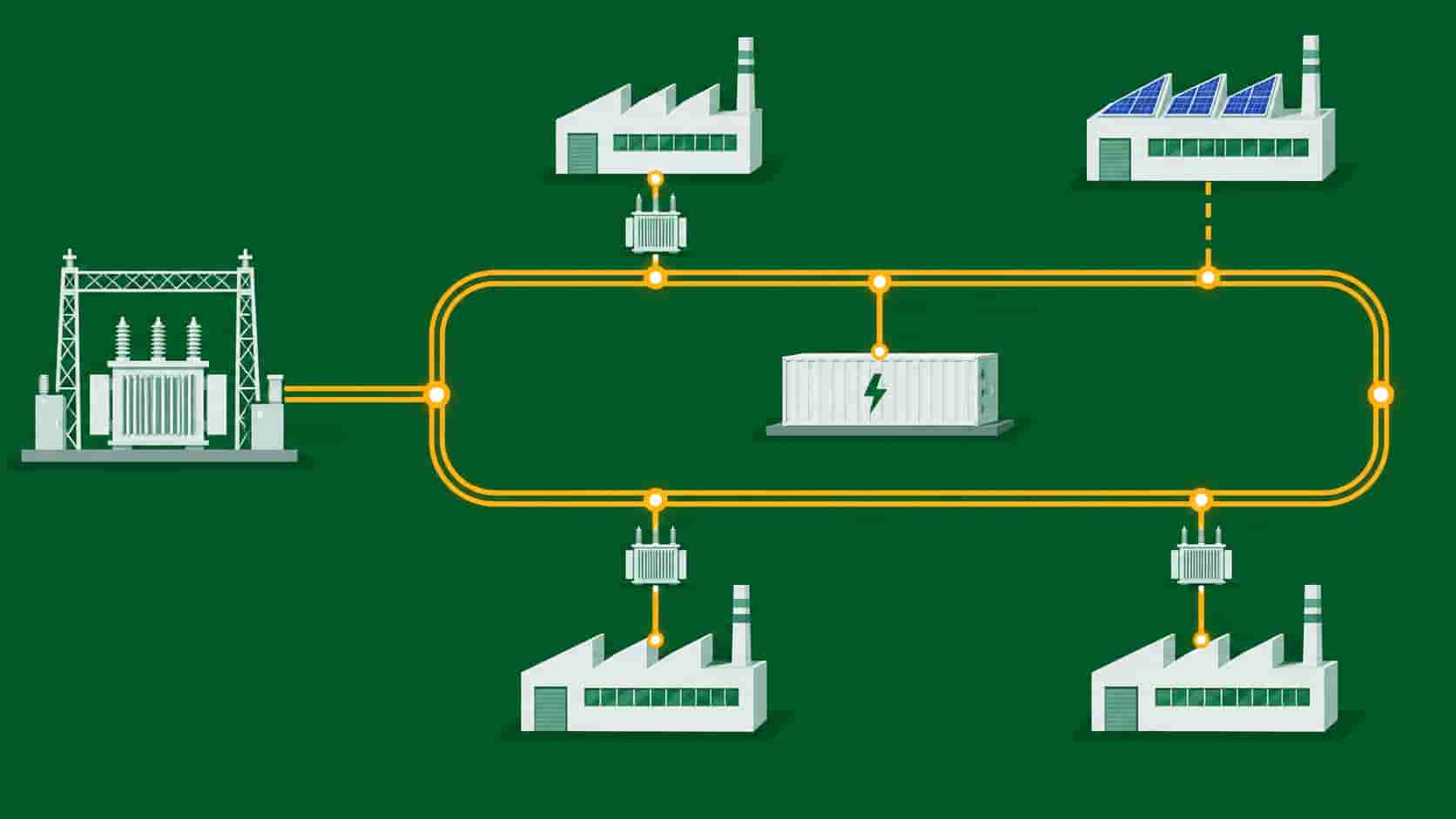
The typical architecture runs from the national utility (EVN and its regional subsidiaries) through the park’s own network to the tenants. A dedicated 110 kV (occasionally 220 kV) substation feeds the park’s medium-voltage ring—commonly 22 kV—from which each tenant’s own transformer and low-voltage board draws. Park developers build and operate this middle layer, coordinate with EVN on capacity allocations, and lease powered land: the electrical readiness of the plot is part of the product they sell.
Three consequences follow for equipment demand. First, the park substation is the anchor asset—large transformers, protection and control—bought early and bought big. Second, the tenant layer repeats with every factory: a distribution transformer, MV switchgear or ring main unit, and LV distribution, multiplied across dozens to hundreds of lots. Third, deployment speed is the competitive variable: a park that can say “energised plots in six months” wins tenants from one that cannot, which is exactly where packaged and prefabricated substations earn their place—our article on prefabricated substations covers the deployment logic.
The Demand Curve of a New Park
Load in a new park does not arrive smoothly; it arrives in phases, each with its own equipment signature. The table is the version park developers and their suppliers work from.
| Stage | Load Character | Power Problem | Equipment Action |
|---|---|---|---|
| Land preparation and first anchors | Construction power plus two or three anchor factories | Grid connection queue; capacity allocation negotiation with EVN | Mobilise temporary generation; order the park 110 kV substation earlyâthis is the long-lead anchor; reserve transformer slots |
| Fill phase | Factories energising in waves; load climbs steeply | Ring loading rises; voltage dips as motor-heavy tenants start | Add 22 kV rings and switching stations; tenant transformers in repeat volumes; protection coordination updates per phase |
| Densification | High-value tenants, clean rooms, cold chain, data rooms | Power quality and reliability expectations rise above basic supply | Voltage conditioning; dedicated feeders for sensitive tenants; UPS and storage for critical loads |
| Expansion and renewables | Phase-two land; rooftop solar; sustainability reporting | Export limits, harmonics, dispatch coordination | Storage integration; grid-code compliance equipment; second substation or mobile unit while it is builtâour mobile substation piece covers the bridge |
The staging matters for suppliers too: parks in fill phase buy tenant-layer equipment in steady monthly volumes, while parks entering expansion buy one-offs with long leads. Reading which phase a park occupies tells a supplier what to quote and tells a park operator what to order before it becomes urgent.
What the Equipment Demand Looks Like
Aggregated across dozens of active parks, the Vietnamese demand basket concentrates on a short list of equipment families. The second table summarises the demand and the procurement points that recur.
| Equipment Family | Demand Driver | Procurement Points That Recur |
|---|---|---|
| Park substations (110/22 kV transformers and protection) | One or more per park; anchor of the whole supply | Longest lead itemâorder at planning stage; size from the ten-year park master load, not phase one; protection scheme agreed with EVN early |
| Tenant distribution transformers | Every factory lot; repeat volumes across fill phase | Standardise ratings across the park for spares economics; losses class priced into evaluationârating logic in our transformer sizing guide |
| MV switchgear, RMUs and ring network | Park rings, switching stations, tenant intakes | Coordination study across park and tenant protection; maintenance-friendly designs for park operating crews |
| Packaged and prefabricated substations | Speed of energisation as competitive variable | Factory-integrated and tested; delivered on plinths ready to connectâdeployment logic in our prefabricated substation guide |
| Generation and storage | Connection queues, reliability commitments, rooftop solar growth | Grid-forming storage for firming; hybrid control where diesel bridgesâsee our generator-storage hybrid guide; battery thermal design for tropical humidity |
Two regional notes colour every line. Humidity and heat push all outdoor equipment toward sealed enclosures, coated steel and verified tropical-duty test data. And the utility interface—the 110 kV connection, the metering boundary, the protection agreement—runs on EVN processes, which rewards suppliers and designers who already know them.
Constraints That Shape Procurement
Four constraints currently govern what parks can actually buy and when. Connection queues: EVN capacity studies and grid reinforcements take time, and parks that assume “the grid arrives when we do” build on hope—phased capacity agreements and interim generation are the working answers. Global transformer lead times: the shortage described in our transformer lead-time analysis applies with full force; park substations ordered late become the schedule’s critical path. Tropical duty: equipment rated for temperate catalogs underperforms in Vietnamese summers—humidity, salt air near the coast and sustained high loads test cooling and sealing. Power quality expectations: as tenants upgrade from assembly to precision processes, the park’s electrical product must upgrade with them, or the park’s rents cannot.
What Tenants and Park Operators Should Ask
The demand boom rewards buyers who interrogate the power supply as hard as the rent. Tenants evaluating space should ask: what is the committed capacity per plot and its upgrade path; what voltage dips does the ring history show; what redundancy exists for my class of load; who owns and maintains the tenant substation. Park operators should ask suppliers the mirror questions: lead time with slot reservation in writing; witnessed FAT scope; tropical-duty evidence; spares stocking inside Vietnam; and references from parks in fill phase—the demanding ones. The parallel is direct: parks are buying power readiness, and suppliers who answer in specifics win the volume business that fill-phase parks generate.
Conclusion
Vietnam’s industrial park boom is a power-equipment story told one substation, one ring and one tenant transformer at a time. The demand is deep and phased: anchor substations bought early and engineered for the master plan, tenant equipment bought in disciplined repeat volumes, packaged substations and storage bought wherever speed or reliability sells the plot. The constraints—connection queues, transformer lead times, tropical duty—are all manageable with the same discipline: order long-lead items at planning stage, standardise the repeat items, and demand regional-duty evidence from every supplier.
For equipment suppliers, Vietnam is a market that rewards preparation: those who understand the park phases, the EVN interface and the fill-phase buying rhythm are positioned for the steadiest demand in the region. For park developers and tenants, the electrical infrastructure is the product’s backbone—buy it with the same care as the location itself.
Frequently Asked Questions
Short answers to the questions investors, tenants and suppliers ask about park power in Vietnam.
Recent Posts
Voltage Stabilizers vs UPS: Do You Need Both?
Voltage Stabilizers vs UPS: Do You Need Both? One device fixes how high or low the voltage is; the other fixes whether there is voltage
Energy Storage for Data Centers: A Growing Backup Power Option
Energy Storage for Data Centers: A Growing Backup Power Option Batteries have always backed up data centers in the form of UPS strings. Grid-scale BESS
Thermal Runaway in Lithium Batteries: What BESS Buyers Should Understand
Thermal Runaway in Lithium Batteries: What BESS Buyers Should Understand How thermal runaway starts, how it propagates, and which evidence buyers should require before approving