
FAT vs SAT: Understanding Factory and Site Acceptance Testing
Two tests stand between a purchase order and a working substation—one in the factory, where problems are cheap to fix, and one on site, where the equipment finally meets the system it will serve for thirty years.
Introduction
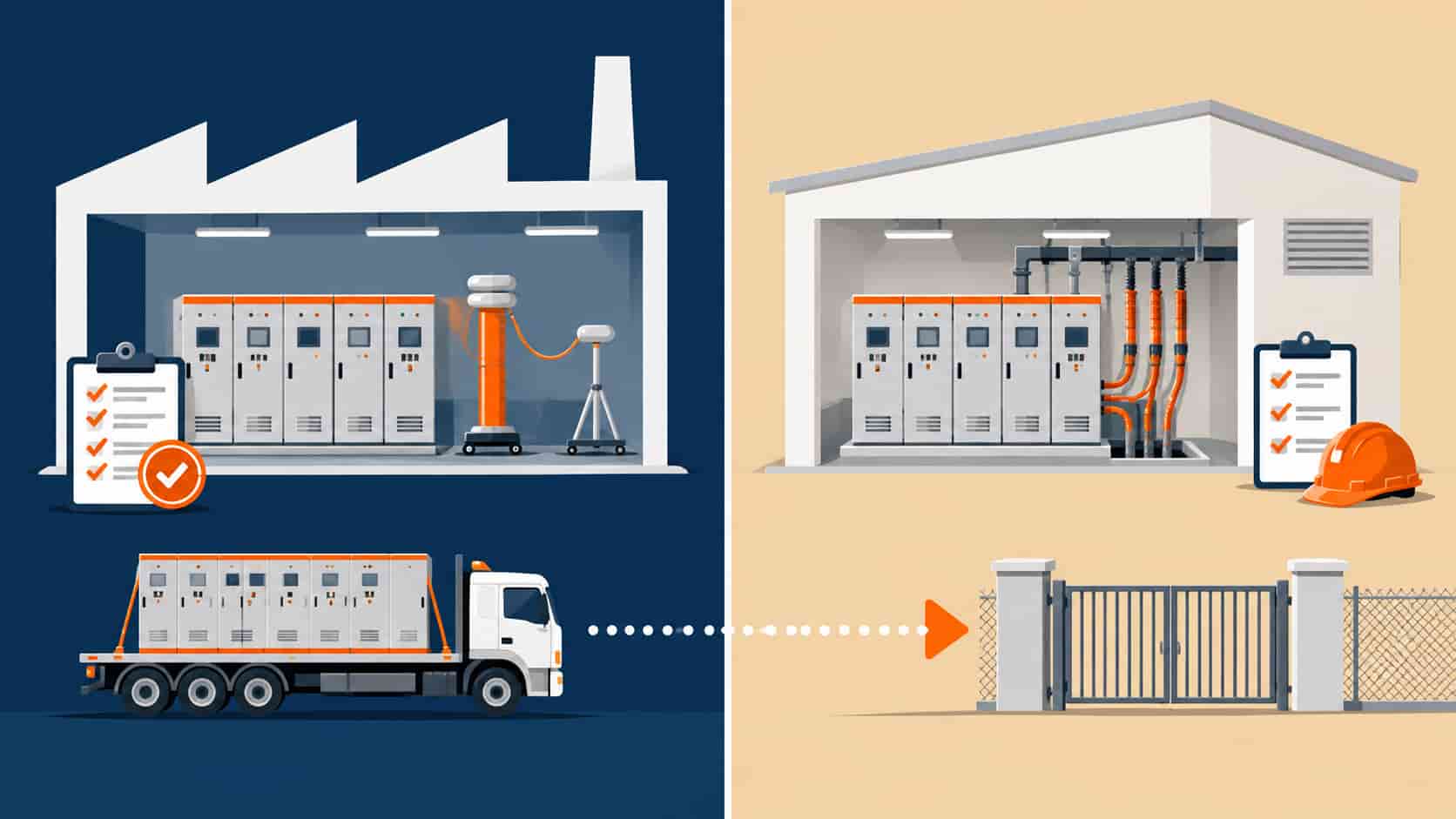
Factory acceptance testing and site acceptance testing answer two different questions about the same equipment. FAT asks: did the manufacturer build what we specified, and does it work in the conditions the factory can create? SAT asks: did the equipment survive the journey, was it installed correctly, and does it work as part of this particular system? Buyers who treat the two as one box-ticking exercise usually discover the difference during commissioning, when it is the most expensive possible moment to learn it.
The stakes are easy to underestimate. A transformer or switchgear lineup fails at FAT, the factory fixes it before shipment—days of schedule, absorbed in the workshop. The same defect surfaces at site acceptance, and the cure involves retests on site, travel, disputed responsibility between installer and manufacturer, and a commissioning date that slips while committees decide whose defect it was. The test regime is not paperwork; it is the schedule protection mechanism for the whole delivery.
This guide sets out what each test actually covers, who attends, the test items that matter for the equipment families that dominate imports—switchgear, transformers, LV boards and their controls—and how to write the testing regime into a contract so it protects both sides.
Why Two Tests Exist
It is tempting to ask why a factory test does not make the site test redundant. The answer is everything that happens between the two. Equipment is packed, lifted, shipped for weeks, stored, lifted again, installed and connected to systems it has never met. Cables get landed on terminals that were correct in the factory. Protection settings get loaded for a different network. A shipping brace gets removed—or not. Each stage adds a population of defects that no factory test can reach.
The two tests also have different economic logic. In the factory, the manufacturer controls everything: instruments are calibrated, reference standards are on hand, skilled test staff and spare parts are in the building. A defect found here is the manufacturer’s to fix at their cost, on their schedule. On site, responsibility is shared among shipper, installer, commissioner and manufacturer—and proving whose problem a failure is becomes the main event. The industry’s answer is to front-load detection: test hard at the factory so that the site test confirms instead of discovers.
FAT: What Happens in the Factory
The factory acceptance test is a formal event with a protocol, witnesses and a verdict—not a production test with visitors. It runs the equipment against the contract specification, typically covering the routine tests already performed on your specific unit plus the type-level checks agreed in the protocol, and it ends with a signed report that later becomes the reference document for the site test and any warranty discussion. The structure below is the version buyers work from.
| Aspect | FAT (Factory) | SAT (Site) |
|---|---|---|
| Where | Manufacturer's test floor, controlled conditions | Installed location, connected to the real system |
| Purpose | Prove the equipment meets the contract specification | Prove transport, installation and interfaces preserved that performance |
| Typical scope | Dielectric and routine tests, functional and interlock checks, witness items from the protocol | Re-verification after installation, interface and control checks, energization trials |
| Who attends | Factory test engineers plus buyer's witness or third-party inspector | Installer, commissioning engineer, buyer's engineer, often the manufacturer's supervisor |
| Pass criteria | Protocol values within tolerance; report signed by witnesses | Protocol values repeated on site; system-level behaviour as designed |
| If it fails | Factory rectifies and retests before shipmentâthe cheapest place to fail | Responsibility split across parties; rectification competes with the project schedule |
One habit separates strong buyers from the rest at FAT: they bring the specification, not just the protocol, and they check coherence—nameplate against order, rating against type-test bracket, serial numbers across the routine report. The FAT guide for switchgear on this site, why FAT testing matters, walks that witness role in detail for switchboard lineups.
SAT: What Changes on Site
Site acceptance testing is narrower but less controlled. The equipment is now one component of a live system, so the test shifts from “does this panel work” to “does this installation behave.” Re-verification comes first: insulation resistance and, where specified, applied voltage checks after installation and before energization, because transport and site work are exactly when insulation gets bruised. Then the interface checks that no factory could run—control wiring to the SCADA master, interlocks to adjacent equipment, protection settings loaded for this network rather than the factory default.
SAT also carries the first energization, which is why the sequence discipline matters: checks in a defined order, clear hold points, and a rule that no step proceeds on assumption. A structured SAT that ends in a clean energization is the visible result of a FAT that left nothing to discover.
The Test Items That Matter
Protocols differ by product family, but the recurring items group into five. What changes between factory and site is how each one is run and what it proves.
| Test | At FAT | At SAT |
|---|---|---|
| Insulation and dielectric | Power-frequency and impulse tests per the design standard, on the assembled unit | Insulation resistance and applied-voltage re-checks after installation, before energization |
| Functional and interlock | Every operating mechanism, interlock and indication exercised against the logic drawings | Interlocks re-proven against adjacent, now-connected equipment |
| Protection and metering | Relay verification against the agreed settings file; metering accuracy checks | Settings loaded for the actual network; primary injection where the protocol demands |
| SCADA and communications | Protocol simulation against the specified point list | End-to-end with the real master stationâthe test no factory can fully run |
| Energized and load trials | Not possible at the factory beyond test-station power | First energization, load transfer and, for generating sets, the parallel-running trials described in our generator and storage hybrid systems guide |
Reading the specification correctly matters here: the design standards define what the equipment must withstand, while the acceptance protocol defines how the buyer will be shown that it does. For switchgear lineups, the framework behind the protocol comes from the IEC 62271 series—our guide to the IEC 62271 standard explains which parts of the standard generate which test.
When Skipping a Test Is Not the Answer
Compressed schedules create pressure to merge the two tests or waive the site repeat, and the request always sounds reasonable: the FAT passed, the installer is confident, the energization date is fixed. The three failures that follow are predictable. Transport damage surfaces as an insulation reading that would have failed a ten-minute site re-check. A wiring error made during installation—an interface no factory can test—shows up at first operation instead of first test. And a setting loaded for the wrong network converts commissioning into diagnostics.
The proportionate version of “skipping” is scaling, not waiving. A standard LV distribution board may justify a witnessed FAT with a routine-test review and a site check by the commissioning engineer, while a custom switchboard controlling a substation justifies witnesses at both events. Match the depth to the equipment’s cost and criticality—and for the transformer and substation families where both costs are highest, the equipment range overviews in our transformers and substations section carry the family-specific testing expectations.
Writing Acceptance Testing into the Contract
The testing regime only protects you if the contract makes it real. The clauses that do the work:
- Two protocols as annexes—one for FAT, one for SAT—each listing tests, methods, values, tolerances and hold points, agreed before production starts;
- Witness rights: the buyer or a named third party attends FAT and first energization, with reasonable notice defined in days;
- Pass and failure handling: rectify and retest at the factory at the manufacturer’s cost for FAT failures, and a responsibility matrix for SAT failures—equipment versus installation versus settings;
- Payment linkage: milestones tied to a signed FAT report and, for larger packages, to SAT completion—not just to shipment;
- Document obligations: signed reports, calibrated-instrument references and as-tested records delivered with the shipping documents, so the SAT team inherits a full dossier;
- A reading aid for the buyer’s team: single-line diagrams against which every functional check runs—our guide to reading switchgear single-line diagrams is the orientation piece for new engineers.
One supplier across the package simplifies the whole regime: the FAT report that the SAT team receives was written by the same company that will supervise the site tests, and responsibility for the interface between the two never has to be argued between vendors.
Conclusion
FAT and SAT are not duplicates of each other; they are the two halves of a promise. The factory test proves the equipment was built right while it is still cheap and fast to correct. The site test proves nothing in the journey, the installation or the interface broke that promise before the equipment met the network it will serve.
Buyers who write both protocols into the contract, witness them in proportion to the equipment’s criticality, and tie payments to the signed reports turn acceptance testing from a formality into the strongest schedule protection they own. The commissioning date you keep is usually decided months earlier, on the factory test floor.
Frequently Asked Questions
The questions buyers ask most about factory and site acceptance testing.
Recent Posts

Power Cable Warranty Terms: What to Demand and What to Watch For
Power Cable Warranty Terms: What to Demand and What to Watch For Quick Answer: A usable warranty names its scope, duration, evidence standard, exclusions and

The Cable Sample Approval Process: What to Test Before Mass Production
The Cable Sample Approval Process: What to Test Before Mass Production Quick Answer: Sample approval tests the supplier’s claims while changes are still cheap —

Cable Drum Packaging for Export: Specs, Marking and Transit Protection
Cable Drum Packaging for Export: Specs, Marking and Transit Protection Quick Answer: Export packaging is a technical specification: drum size for weight and bend radius,