
Why One-Stop Power Equipment Sourcing Saves EPC Contractors Time
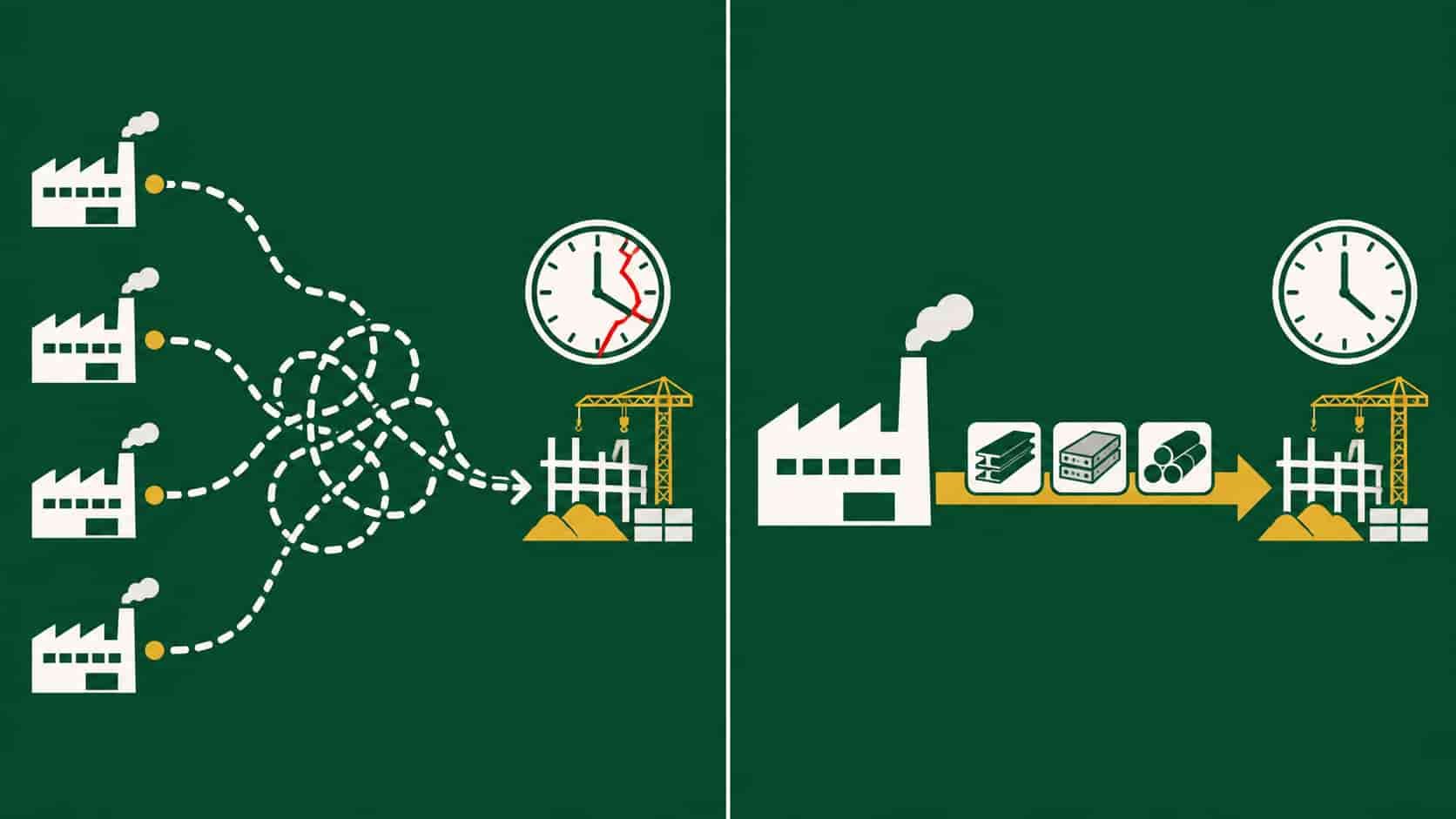
The hours do not disappear into the equipment—they disappear between suppliers: into coordination calls, interface mismatches and delivery windows that never quite line up.
Introduction
An EPC contractor’s equipment list for a substation or an industrial power package reads like a shopping street: transformers from one factory, MV switchgear from another, LV boards from a third, cables from a fourth, plus the panels, inverters or storage containers that modern projects keep adding. Each supplier is individually rational—specialized factories, competitive pricing. But the project does not experience the list as separate purchases; it experiences it as one intertwined schedule in which every delivery date depends on several others.
That is where the time actually goes. Not into manufacturing, which happens whether you buy from one supplier or five, but into the seams between them: aligning technical interfaces across vendors who never speak to each other, reconciling five sets of documentation formats, chasing five production schedules for one milestone, and standing at the site gate watching a transformer arrive while the switchgear that connects to it sits in a factory three weeks behind. One-stop sourcing—placing the package with a single coordinated supplier—attacks exactly those seams.
This guide is specific about the claim, because “one supplier saves time” is only true when it is engineered. It sets out where the hours are actually lost in multi-supplier procurement, what a coordinated package changes, where the savings concentrate, and—equally important—when splitting the order remains the better decision. The equipment families in scope are the usual package contents: the transformer and substation line-up, switchgear, LV boards, cables and their accessories.
Where Multi-Supplier Procurement Loses Time
The losses are structural, which is why they repeat across projects regardless of which vendors are chosen. The first is interface engineering: every boundary between two suppliers—a busbar connection, a cable termination, a protection communication link, a foundation detail—must be designed by one side, confirmed by the other, and checked by you. Five suppliers means a dozen such boundaries, each with its own drawing exchange and approval cycle. The second is schedule interlock: your site readiness date must satisfy whichever supplier is slowest, and the fastest supplier’s equipment waits in storage, sometimes degrading warranty terms that start at dispatch. Interdependencies multiply the effect—cable packages ordered after the switchgear frequently arrive after it too, and the way cable sourcing delays propagate into EPC timelines shows how one late family holds the whole erection sequence.
The third loss is administrative multiplication. Five vendors generate five documentation sets, five inspection trips, five warranty regimes and five claims procedures—and when something fails at an interface, the investigation begins with both suppliers explaining why the other one is responsible. None of this is inefficiency inside any single company. It is the cost of the structure itself, which is why buying more carefully from the same five suppliers never quite eliminates it.
What a One-Stop Package Actually Changes
A genuine one-stop supplier does more than invoice everything. The engineering changes first: interfaces between transformer, switchgear, panels and cable entries are designed once, inside one organization, and the connection details that used to be a drawing negotiation become internal coordination. The schedule changes next: one production plan governs the whole package, delivery slots are sequenced for installation order rather than factory convenience, and one documentation set arrives in one format with one serial-number structure.
Site effects follow. Equipment arrives in a sequence that matches the erection program, so storage time and double-handling shrink. Commissioning benefits from coherent protection settings and consistent component brands across the lineup. And when anything fails, there is one responsible party instead of an interface dispute—the single most underrated time-saver in the whole arrangement. Projects that push the model further, such as prefabricated substations delivered as factory-integrated units, show the logical endpoint: interfaces verified at the factory, not on your slab.
Multi-Supplier Versus One-Stop, Side by Side
The table puts the structural differences in one view. The point is not that one column wins every row—it is that the right column for your project depends on which rows cost you the most time.
| Aspect | Multi-Supplier Sourcing | One-Stop Sourcing |
|---|---|---|
| Interface engineering | Every boundary is a cross-vendor negotiation with drawing cycles | Designed internally; boundaries become coordination, not correspondence |
| Schedule control | Site date must satisfy the slowest of several independent plans | One production plan sequences deliveries to installation order |
| Documentation | Formats, numbering and languages differ by vendor | One coherent set with consistent structure across the package |
| Testing and FAT | Separate tests per vendor; system behaviour tested only on site | Package-level testing possible before shipment, including interfaces |
| Claims and responsibility | Interface failures start a responsibility debate between vendors | One responsible party from design through warranty |
| Price transparency | Every line item quoted separately and comparable | Package pricing with less line-level visibilityâtrust and audit matter more |
The last row deserves honesty: one-stop sourcing trades some price transparency for coordination. Contractors who manage this well ask for package pricing with the main line items broken out, and audit the parts list—the savings come from the schedule, not from overpaying for the privilege.
Where the Time Savings Concentrate
Across projects, the saved hours cluster in five stages. None of them is exotic; each is a seam that the single-supplier structure closes.
| Stage | Time Saved | How |
|---|---|---|
| Bid and award | Weeks of clarification cycles compressed | One enquiry, one technical Q&A loop, one comparison instead of parallel negotiations |
| Engineering | Interface drawing exchanges largely eliminated | Boundary details designed internally across the package |
| Delivery coordination | Storage and double-handling minimized | Deliveries sequenced to erection order under one plan |
| Commissioning | Fewer first-energization surprises | Consistent components, settings and documentation across the lineup |
| Fault resolution | Days of responsibility triage removed | One supplier investigates and fixes without inter-party dispute |
Add the rows up and the pattern explains why contractors with tight programs adopt the model on schedule-critical packages even when unit prices are marginally higher: the premium is real but bounded, while the schedule exposure it removes is open-ended. The arithmetic changes again where lead times dominate—when switchgear and transformer lead times diverge, a coordinator who sequences the whole package around the longest item protects the milestone better than a contractor doing it vendor by vendor.
When Splitting the Order Is Still the Better Call
One-stop sourcing is a tool, not a doctrine, and three situations regularly argue for splitting. First, client or engineer specifications that name particular brands or approved vendors—the package supplier simply is not available, and pretending otherwise wastes a bid cycle. Second, concentration risk: placing every product family with one factory couples your project to that factory’s capacity, finances and fire safety; a diversified split is deliberate insurance on programmes large enough to survive losing a package. Third, genuinely specialized scope—high-end GIS, complex protection platforms, engineered generator-storage hybrids—where the best specialist adds engineering value no generalist replicates; system-level packages like a generator and storage hybrid system belong with a supplier who engineers that system daily.
The practical resolution is hybrid: one coordinated supplier for the standard backbone—transformer, MV/LV switchgear, boards, cables—with named specialists retained for the genuinely special scope, and a written interface matrix assigning every remaining boundary to an owner. Most of the one-stop savings survive; the specialist value survives too.
Choosing a One-Stop Supplier Who Can Deliver
The model only saves time if the supplier can actually coordinate—and that is a checkable claim. Ask to see the internal engineering route for a previous package: how interfaces were documented, how the delivery sequence was planned, how package FAT was organized. Ask which product families they manufacture versus trade, because a coordinator who makes the transformer and the switchgear will run interfaces differently from one who resells both. Confirm the documentation sample matches your systems, and put the delivery sequencing obligation in the contract, not the brochure. Suppliers who coordinate well demonstrate it with artifacts; the ones who merely assemble quotes demonstrate that too.
A Practical Checklist for the Next Package
- Map every interface between product families before deciding how to split the order
- Count the suppliers’ schedules your site date currently depends on—then price that coordination
- For one-stop packages, ask for package pricing with main line items broken out and auditable
- Require the delivery sequence to follow erection order as a contractual obligation
- Request a package-level FAT where interfaces can be verified before shipment
- Keep named specialists for genuinely special scope and assign remaining interfaces in a written matrix
- Verify the supplier’s coordination claims with artifacts from a previous package, not presentations
Conclusion
The one-stop proposition is not that a single supplier is cheaper or better at making equipment—it is that most of the time an EPC contractor loses lives at the seams between suppliers, and seams are what consolidation removes. Interface engineering, schedule interlocks, documentation multiplication and responsibility disputes are structural costs of fragmentation, and they survive every attempt to manage them better inside the fragmented structure.
Used where it fits—standard package scope, tight programs, suppliers who can demonstrate coordination—one-stop sourcing converts those seams into internal engineering tasks and hands the contractor a schedule with fewer moving parts. Used where it does not fit, it merely relocates the risk. The difference is a procurement decision made early, with the interface map in one hand and the checklist above in the other.
Frequently Asked Questions
Recent Posts
Energy Storage for Data Centers: A Growing Backup Power Option
Energy Storage for Data Centers: A Growing Backup Power Option Batteries have always backed up data centers in the form of UPS strings. Grid-scale BESS
Thermal Runaway in Lithium Batteries: What BESS Buyers Should Understand
Thermal Runaway in Lithium Batteries: What BESS Buyers Should Understand How thermal runaway starts, how it propagates, and which evidence buyers should require before approving

What Cables Does a Data Center Need? The Complete Cable List
What Cables Does a Data Center Need? The Complete Cable List Quick Answer: A data center needs eight cable families — medium voltage feeders, low