Fire-Rated Circuits in Data Centers: From BS 6387 to Practice
Quick Answer: Fire pump, alarm and smoke-extraction circuits must keep conducting during the fire itself — specified as fire-rated cable tested to BS 6387 C-W-Z or GB/T 19216, not merely flame-retardant cable.
Flame retardant and fire rated are different promises, and confusing them in a data center specification produces circuits that will not do their job on the one day they are needed. Flame retardant cable stops fire from spreading along itself. Fire rated cable keeps carrying current while the building burns around it. A data center needs both — and the circuits that need the second property are a short, critical list that every authority having jurisdiction will inspect.
Introduction
A data center fire is a low-probability event with an asymmetric cost: the building may survive, but whether the facility protects its occupants and reopens quickly depends on the circuits that fought the fire. Fire pumps must run, alarms must sound and locate the incident, smoke extraction must clear escape routes, and emergency lighting must show the way out — all while the fire is active. These circuits are therefore specified for fire survival, and the test regimes behind that phrase are stricter than anything else in the cable schedule.
This article maps the practice: which circuits need fire rating in a data facility, what the BS 6387 C, W and Z categories and GB/T 19216 actually test, how the three main constructions — rigid mineral insulated BTTZ, flexible mineral insulated BBTRZ and NG-A (BTLY), and mica-taped WDZN-YJY — differ in duty and installation, and what the RFQ must state so the fire-rated scope arrives certified. The wider fire performance landscape, including why flame retardant LSZH still belongs on the general wiring alongside these circuits, is developed in our LSZH versus fire retardant cable comparison. The switching equipment these circuits serve is covered system by system in our data center power collection.
Which Circuits Must Survive the Fire
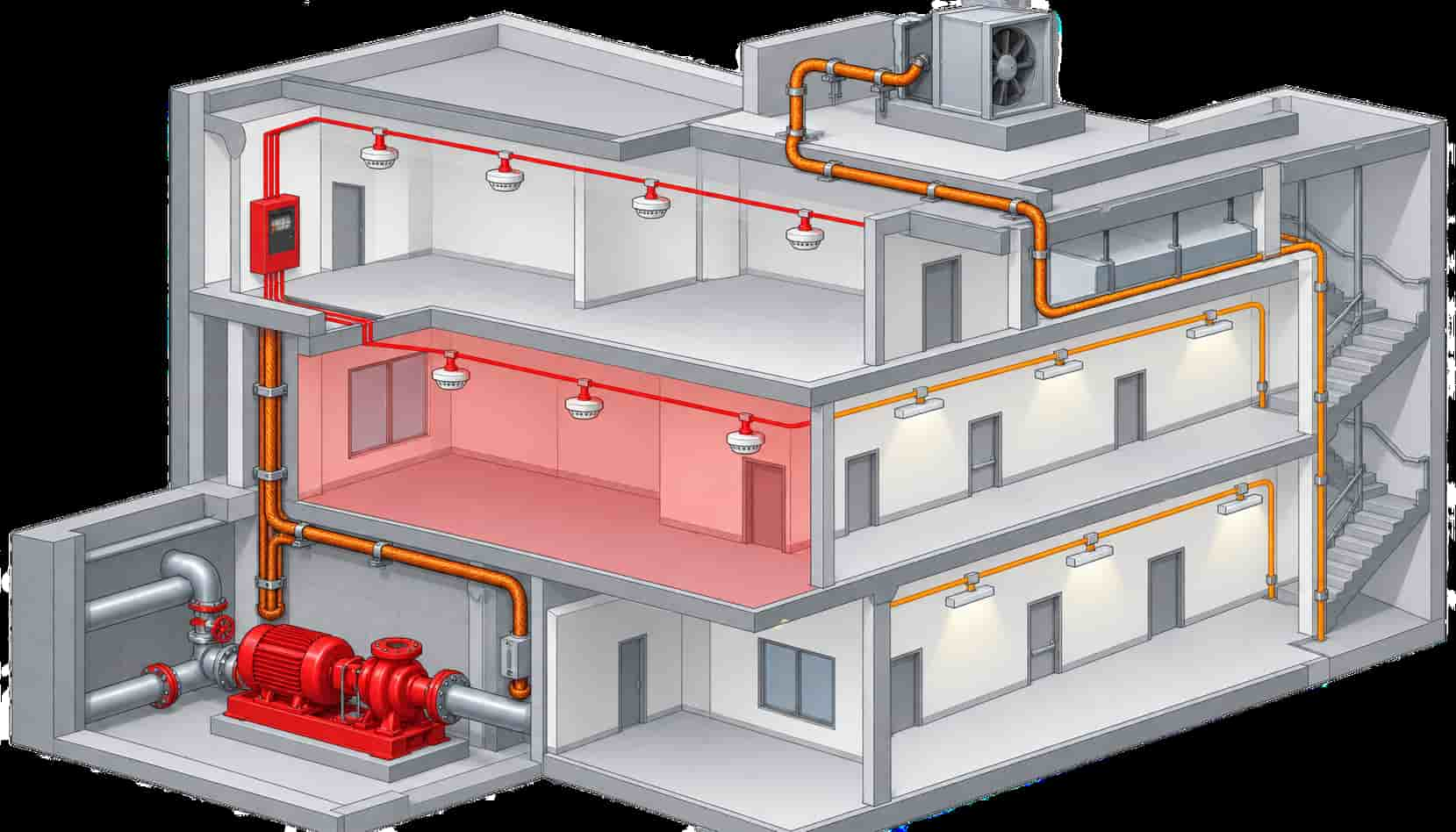
The life-safety list is short and consistent across jurisdictions: fire pump supply and control, fire alarm and detection loops, smoke control and extraction fans, emergency lighting and exit signage, and increasingly the fire command and suppression release circuits that tie these together. Some authorities add the power supplies for fire dampers and door hold-opens. What unites them is duty during the event, not merely afterward — each must conduct while exposed to flame at 750-950 °C, sometimes while water is being sprayed on it, sometimes after mechanical shock.
Data centers add a second, commercially motivated list: circuits whose survival protects the equipment, such as control and interlock wiring that shuts down cooling safely or isolates electrical zones. These are design choices rather than code mandates, but specifying fire-rated control cable on them is common practice in high-value facilities, and it uses the same product families as the mandated list.
| Circuit | Why It Must Survive | Typical Construction | Test Regime |
|---|---|---|---|
| Fire pump supply and control | The pump fights the fire; it cannot depend on the fire sparing it | Rigid BTTZ or flexible BBTRZ / NG-A (BTLY) | BS 6387 C-W-Z; GB/T 19216 |
| Fire alarm and detection loops | Detection must locate and report the incident while it burns | Fire-rated multi-core, often WDZN-YJY or MI variants | BS 6387 C; GB/T 19216 |
| Smoke extraction fans | Clears escape routes; motors draw heavy current in the fire | MI cable sized for motor starting current | BS 6387 C-W-Z |
| Emergency lighting and exit signage | Guides evacuation through the event | Fire-rated wiring, frequently WDZN-YJY | BS 6387 C; IEC 60331 |
| Suppression release and fire command | Releases gas suppression and coordinates the response | Fire-rated control cable, shielded where noisy | IEC 60331; BS 6387 C |
What BS 6387 C-W-Z Actually Tests
BS 6387 is the reference most international buyers write into specifications, and its letters are the whole vocabulary. Category C tests fire survival alone: the cable carries rated current while exposed to flame at 950 °C for three hours. Category W adds water — the same flame exposure with water spray applied, simulating sprinkler operation over the fire. Category Z adds mechanical shock: the cable is struck at intervals during the flame exposure, simulating falling structure. A cable marked C-W-Z has survived all three, which is why fire pump circuits typically demand the full string.
The parallel Chinese regime, GB/T 19216, tests fire survival under flame with impact, and IEC 60331 provides the international flame-only benchmark. The regimes are not interchangeable in wording but they overlap in intent, and a specification should name the exact standard and category — “fire resistant to BS 6387 category C, W and Z” — rather than the phrase “fireproof cable”, which commits a supplier to nothing testable. The relationship between the IEC, BS and GB rulebooks, useful when one project references several, is mapped in our overview of MV and LV cable standards across IEC, GB and BS.
Three Constructions, Three Duties
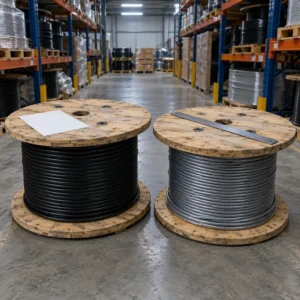
Rigid mineral insulated BTTZ cable is the classical answer: copper conductors pressed into compressed magnesium oxide powder inside a solid copper sheath. It is incombustible by material, not by additive — there is nothing organic in the current path to burn — and it holds the highest survival ratings with no aging concern. Its costs are mechanical: it cannot be bent repeatedly, termination requires special tooling and trained installers, and water ingress at unsealed ends must be managed on site.
Flexible mineral insulated designs — BBTRZ and NG-A (BTLY) — wrap the conductor with ceramic-forming tape and mineral insulation inside a metal sheath or armor, achieving comparable fire survival with ordinary installation practice: they bend, they terminate with standard glands, they pull through congested risers. For most projects outside the fire pump room itself, flexible MI delivers the rating the schedule demands at an installation cost the contractor can absorb. Between MI and the general fire-resistant family sits WDZN-YJY: mica-glass tape over the conductor inside a low smoke zero halogen construction. It survives the required duration at lower cost and installs like ordinary cable, which is why it dominates alarm, lighting and suppression control circuits, while the strictest duties still justify metal-sheathed mineral construction.
| Construction | Fire Survival Level | Installation Reality | Best Fit |
|---|---|---|---|
| BTTZ rigid MI | Highest; incombustible mineral core, C-W-Z routinely | Special tooling, trained crews, bend limits, end sealing | Fire pump supplies; shortest critical runs |
| BBTRZ flexible MI | C-W-Z achievable; ceramic tape and mineral insulation | Bends and terminates like heavy power cable | Smoke extraction; risers; pump rooms with tight routing |
| NG-A (BTLY) flexible MI | C-W-Z achievable; aluminum-sheathed variant family | Standard glands; lighter handling than rigid MI | Life-safety feeders in congested buildings |
| WDZN-YJY mica-taped LSZH | Fire duration per GB/T 19216 or IEC 60331 duty | Installs exactly like ordinary LSZH cable | Alarms, emergency lighting, suppression control |
Installation Practice Decides the Rating
A fire-rated circuit is a system, and its weakest point is usually the installation rather than the cable. Support spacing must survive the fire, not just the inspection: clips and brackets that melt in the flame leave even a surviving cable hanging across the fire zone. Gland and termination kits must match the construction — MI terminations are engineered parts, not improvised field assemblies. And routing matters: a fire-rated cable run through the fire compartment it serves protects nothing, so life-safety routes take protected paths planned with the same rigor as the critical power routes in commercial critical power backup planning.
Certification closes the system. Batch-applicable type test reports for the exact construction and category, marked on the drums as delivered, are what an inspector accepts; a factory ISO certificate is not. This is the same evidentiary discipline that governs supplier verification generally — our guide to vetting a cable manufacturer in China covers what to inspect at the source for fire-rated production lines specifically.
When Fire-Rated Cable Is Not the Answer
Fire rating solves survival, not ignition spread, and it is not a substitute for the LSZH specification on general wiring. Specifying expensive mineral insulated cable throughout the data hall would inflate the budget without improving the code outcome — the code wants survival on the listed circuits and flame spread control everywhere else. Conversely, substituting mica-taped WDZN-YJY on a fire pump supply because it installs more easily can fail the third-party review, because the pump’s C-W-Z duty is exactly where flexible MI or rigid MI earn their specification.
There is also a system boundary: fire-rated cable does not rescue an unprotected route. If the riser the circuit passes through has no fire compartmentation, the circuit’s survival rating fights the whole building’s fire exposure alone. The honest design pairs the cable rating with routing, compartmentation and support discipline — the cable is one layer of the fire strategy, never all of it.
RFQ Checklist: Ordering the Fire-Rated Scope
Fire-rated orders live or die on named standards, so the RFQ should state:
- Circuit list with the duty of each: pump, alarm, extraction, lighting, suppression control
- Exact test standard and category per circuit: BS 6387 C-W-Z, GB/T 19216, IEC 60331
- Construction choice or the performance envelope for the factory to propose: BTTZ, BBTRZ, NG-A (BTLY), WDZN-YJY
- Routed lengths and support spacing data so clips survive the design fire
- Termination kit requirements matched to each construction
- LSZH performance where the sheath must also meet IEC 60754 and IEC 61034
- Type test report copies applicable to the delivered batches, named per drum
- Drum labeling with circuit ID and fire category for site verification
- Delivery schedule aligned to the construction sequence of the fire systems
- Copper price linkage terms, since MI constructions are copper-intensive end to end
Conclusion
Fire-rated circuits are the short list of conductors whose job begins exactly when everything else fails. The specification logic is compact: name the circuits, name the test category — BS 6387 C-W-Z or GB/T 19216 — and match the construction to the duty, from rigid BTTZ at the fire pump through flexible MI on the feeders to mica-taped WDZN-YJY on the alarm and lighting loops. Then install it so the rating survives contact with the building.
Kexingyu Cable Group (KXYE) produces the complete fire survival family — BTTZ, BBTRZ, NG-A (BTLY) and WDZN-YJY — under one quality system, with type test documentation issued per batch and copper price linkage for project-scale orders. Send the circuit list and the routing study, and we will return a standards-named offer that the inspector can verify drum by drum.