How Much Copper Does an AI Data Center Use? The Numbers Behind the Buildout
Quick Answer: Plan on one to five tonnes of copper per delivered megawatt — and because copper dominates cable cost, AI-era buildouts turn a technical detail into a commodity market story. Every conversation about AI infrastructure eventually arrives at the same two constraints: power and the metal that carries it. Copper sits inside nearly every conductor between the grid and the chip, and the sheer scale of data center construction has made the industry a line item in global copper demand forecasts. For buyers and planners, though, the useful question is not the headline number — it is how much copper a specific project will order, and where it sits.
Introduction
Commodity analysts including S&P Global Commodity Insights and CRU now track data center copper demand as its own category, and their headline projections agree on direction: AI-era construction multiplies cable demand per site even as efficiency improves elsewhere. Grid operators and cable makers feel it first, because data center campuses order in months what residential networks order in years. The buildout context — how fast capacity is being added and where — is tracked in our review of data center power demand growth.
This article answers the question bottom-up instead of top-down: a transparent, engineering-based estimate of copper per megawatt, a worked example you can re-run with your own project numbers, the reasons AI designs push the figure upward, and the commercial machinery — copper price linkage above all — that keeps a multi-tonne order inside its approved budget. The equipment scope that surrounds the cable is covered in our data center power collection.
The Bottom-Up Math: Copper per Megawatt
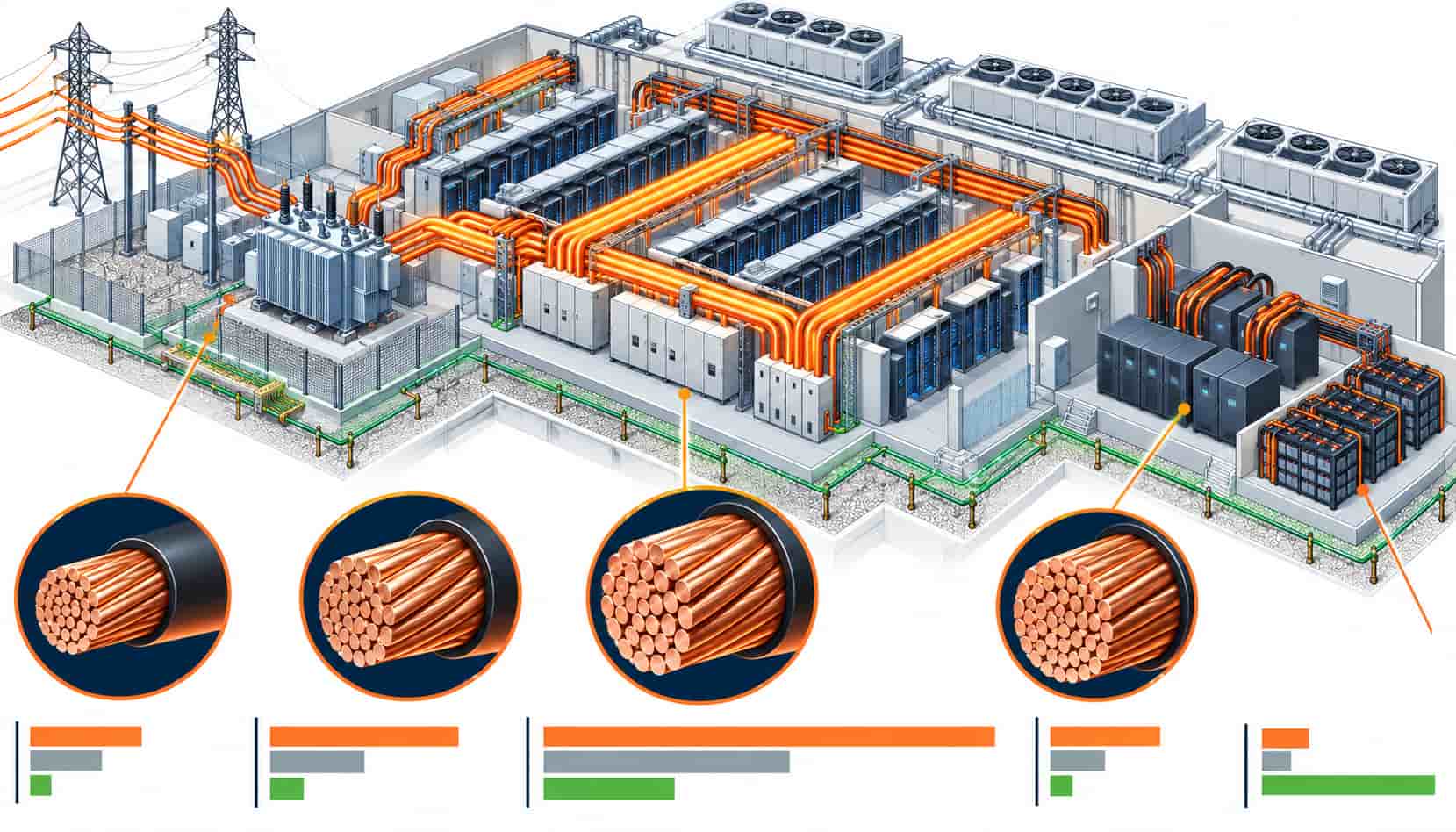
The arithmetic is straightforward once you know copper’s density and conductor weights. Copper weighs about 8.85 tonnes per cubic metre, so a single-core cable with a 185 mm² cross-section carries roughly 1.64 kilograms of copper per metre. A 500-metre feeder run of three such conductors holds about 2.5 tonnes of copper in one route. Multiply that shape of calculation across every hop of the power chain — MV feeders, LV distribution, UPS strings, grounding — and the project total emerges.
Run it as a worked example. A 30 MW campus with conventional topology might carry: a dozen MV feeder routes at 1-2.5 tonnes each, twenty or more large LV distribution routes at 1-3 tonnes each, dozens of smaller feeders and risers adding another 20-30 tonnes, plus UPS connections, control wiring and a grounding network of several tonnes. The tally lands somewhere between 60 and 120 tonnes — call it two to four tonnes per delivered megawatt, with compact topologies and short routes at the bottom of the range and sprawling multi-building campuses at the top. AI density pushes the same math further: higher per-rack current means larger cross-sections or parallel sets, and liquid-cooled rows concentrate more load — hence more copper — into the same floor area.
| Cable Family | Typical Cross-Sections | Copper per 100 m (3-phase) | Share of Project Copper |
|---|---|---|---|
| MV feeders | 185-630 mm² single-core | 490-1,670 kg | Highest per metre; moderate total length |
| LV distribution | 95-400 mm² | 250-1,060 kg | Largest total â many routes at heavy sections |
| UPS and battery | 25-500 mm² flexible | 65-1,330 kg | Short runs but heavy sections |
| Grounding and bonding | 25-120 mm² bare and insulated | 65-320 kg | Network-wide; adds several tonnes per campus |
| Control and BMS | 0.75-2.5 mm² multi-core | 2-7 kg | Negligible mass, high count |
| Structured cabling | Cat6A/Cat8, thin conductors | under 5 kg | Negligible mass; counted in network budget |
Why AI Designs Push the Number Up
Three forces move a campus from the low end toward the high end of the range. First, density: a 30 kW rack draws six times the current of a 5 kW rack, and current is what conductor cross-section exists to carry — the sizing method and its correction factors are detailed in our cable size selection guide. Second, redundancy: A/B designs physically duplicate the heavy routes, so 2N topologies roughly double the distribution copper on every critical path. Third, distance: campuses with remote generator yards, centralized UPS plant and staged transformation run longer heavy feeders than compact single-building designs, and voltage drop on long runs is fixed with more copper, not smaller conductors.
Offsets exist. Higher distribution voltage trims current a few percent, aluminum conductors substitute in long non-critical runs where termination reliability allows, and better ampacity math — honest derating instead of blanket oversizing — removes hidden copper from every schedule. But the AI-era direction of travel is unmistakable, and it is why cable procurement now sits closer to the commodities desk than it did five years ago.
The Commercial Side: Managing a Multi-Tonne Copper Exposure
Copper is the dominant cost driver in power cable — typically half or more of the finished price — and it moves daily. A project that approves a cable budget in January and delivers in October has been exposed to two metal markets, and the quotes that looked sharp at approval can be quietly stale by delivery. This is why serious project buyers now treat the metal basis as a contractual term rather than a price detail: a copper price linkage fixes the commercial basis at order and settles the metal component against a named reference — for Chinese suppliers, the Yangtze spot copper price is the common benchmark — at delivery or at agreed milestones.
The same exposure explains why conductor honesty matters commercially as well as technically. A quotation below the metal market has only two explanations: an arithmetic error or a substitute conductor — copper-clad aluminum, recycled blends, or thin-wall insulation outside the standard. Verifying conductor material and purity before shipment is part of the broader supplier vetting discipline covered in our cable manufacturer checklist for China sourcing, and the certification paperwork that should accompany the metal claims is summarized in the power cable certifications checklist.
| Lever | How It Works | Buyer Action |
|---|---|---|
| Copper price linkage | Metal basis settled at delivery against a named reference price | Make it a contract term, not a handshake |
| Phased ordering | Order per construction phase to shorten each exposure window | Align cable releases with the delivery sequence |
| Honest ampacity | Real derating removes hidden oversizing | Require correction factors documented per route |
| Topology choices | Voltage, busway and transformer siting trim feeder lengths | Fix distribution voltage early in design |
| Conductor verification | Batch conductor resistance tests prove the copper is real | Insist on test reports per shipment |
What This Means for Cable Buyers
Three practical consequences follow from the numbers. First, copper belongs in the project risk register next to lead times: a 100-tonne order is a commodity position whether or not anyone calls it that. Second, the schedule and the metal strategy must be built together — phased releases, named reference prices and verification steps decided before the first purchase order, not negotiated after a market move. Third, supplier selection now includes metallurgical credibility: factories that publish batch conductor resistance data and hold consistent purity give auditors and quantity surveyors something to reconcile.
There is also a planning upside. Because the copper mass concentrates in a known set of families — MV feeders, LV distribution, UPS connections, grounding — a project that models those four scopes early holds a defensible copper forecast within a week of having the load schedule, and can lock the metal basis while the design is still fluid rather than after drawings freeze.
When the Copper Question Is Not the Right Question
Total tonnes make headlines, but they are a poor procurement metric on their own. Optimizing for minimum copper can push designs toward longer, thinner, more congested routes that trade metal mass for installation cost and future inflexibility — a saving the project repays at every subsequent modification. The better objective is copper per delivered megawatt at the required availability, with honest ampacity, disciplined routing and documented quality; the tonnage follows.
And the aluminum question deserves its own evaluation rather than a reflexive answer. Aluminum cuts conductor cost per ampacity substantially on long runs, but termination reliability, jointing practice and protection coordination all change, and in the critical path of a data center the termination risk usually outweighs the metal saving. The honest comparison is done per route, with the project’s own maintenance reality in view — not copied from another industry’s economics.
RFQ Checklist: Getting a Copper-Intelligent Quote
To receive offers that hold up against the metal market, send the supplier:
- Load schedule and single-line diagram with design currents per route
- Cable schedule with routed lengths, cross-sections and correction factors applied
- Named copper reference price and settlement mechanism for the linkage terms
- Delivery phases and quantities per release, aligned to construction sequence
- Conductor material specification: bare copper, purity class, IEC 60228 resistance evidence
- Batch test report requirement covering conductor resistance per shipment
- Alternative-material policy: where aluminum is acceptable and where it is not
- Drum lengths matched to routing and phased site pulls
- Documentation package: type tests, certifications, marking requirements
- Validity period of the offer stated against the metal market
Suppliers who answer those ten lines precisely are the ones who have priced real copper on a real schedule; the rest have priced a hope. Kexingyu Cable Group (KXYE) quotes project cable scopes with Yangtze-spot copper price linkage, batch conductor resistance documentation and phase-matched deliveries — send the schedule and we will return a line-by-line offer whose metal basis survives the build.
Conclusion
The copper in a data center is not a mystery — it is arithmetic sitting in plain sight across a few cable families. One to five tonnes per delivered megawatt, concentrated in MV feeders, LV distribution, UPS connections and grounding, pushed upward by AI density and duplicated redundancy paths, and managed commercially through copper price linkage and phased ordering.
Model your four heavy scopes early, put the metal basis in the contract, and verify the conductor in every batch. Do that, and the commodity story stops being a risk and becomes a line item you control. When you are ready to price the scope, bring the load schedule to Kexingyu Cable Group (KXYE) — we will show you exactly where your tonnes sit.