Expanding a Live Data Center Without Redesigning Cabling
Quick Answer: Expanding a running data center is a cable logistics exercise: spend the banked spare ways, phase deliveries around maintenance windows, and keep as-built documentation honest. Every operating data center expands — more racks, higher density, a new hall behind the old one. The projects that go smoothly share one trait: the original design left room, and the expansion spent that room instead of fighting the installed base. The ones that hurt share the opposite trait: every new feeder became a negotiation with cables that were already there, live, and in the way.
Introduction
Expansion is where a data center’s original engineering discipline pays dividends or collects debts. Spare breaker ways, reserved tray positions, labeled routes and honest as-builts make adding a row an installation task; their absence makes it an archaeology project conducted next to energized switchgear. The difference costs nothing at design stage and everything at expansion stage.
This article works the expansion problem from the cable side: what the original design can bank for the future, how to assess the installed base before touching it, how to phase deliveries and installations around a facility that never stops running, and what documentation keeps the expanded plant as auditable as the original. The upstream capacity question — whether the grid connection and equipment train can even support the new load — is treated in our guide to grid expansion equipment, and the equipment rooms the expansion ties into are covered in our data center power collection.
What the Original Design Should Have Banked
Expansion capacity is designed, not found. The original project that anticipated growth banked specific, physical things: spare breaker ways on distribution boards, tray positions and spare conduit ducts along every main route, floor penetrations sized for future feeders, and gland plates drilled or at least marked on every panel. Electrical headroom counts too — transformers and switchgear rated with a growth margin rather than to the last kilowatt — because cable can only spend headroom that exists upstream.
If you are reading this before building, treat that list as a specification item, not a hope: state spare ways, spare tray percentage and future penetration positions in the design documents, and make their delivery a commissioning checklist line. If you are reading it before expanding, the same list is your first survey instrument — what the installed base banked determines which expansion strategies are even available.
| Strategy | What It Requires | Disruption Level | Best Fit |
|---|---|---|---|
| Spend banked spare ways and trays | Original design reserved capacity | Minimal | Planned growth in the same halls |
| Add busway extensions | Busway spine with spare length capacity | Low; plug-in at the row | Density increases in existing rows |
| New feeders through reserved routes | Spare ducts, penetrations, tray positions | Low-moderate | New rows or new halls adjacent |
| Rebalance existing loads | Honest monitoring data on current routes | None to minimal | Stranded capacity in underloaded routes |
| New upstream train | Grid capacity and space for added equipment | High; project-scale | Density step-changes beyond the original design |
Assess Before You Touch: Surveying the Installed Base
The first expansion deliverable is a survey, not an order. Verify the as-built against reality — routes drift over years of modifications — and check the four resources every expansion consumes: spare ways on the boards that will feed the new load, physical tray and duct capacity along the routes it will take, upstream electrical headroom at the transformer and switchgear, and documentation quality, because a route that nobody can trace is a route that nobody can safely extend. The upstream verification, from grid connection to equipment capacity, follows the logic in our transformer capacity sizing guide.
The survey also audits the condition side. A ten-year-old hall’s expansion is the natural moment to apply the lifecycle lens — thermography on the routes that will carry more load, insulation resistance trends on the circuits that will be worked around, and honest grouping calculations on the trays that will gain circuits. Growing into a tired feeder is how expansions manufacture their own outages, and the monitoring data that prevents it costs far less than the downtime it avoids.
Installing Hot-Work-Free Next to Live Plant
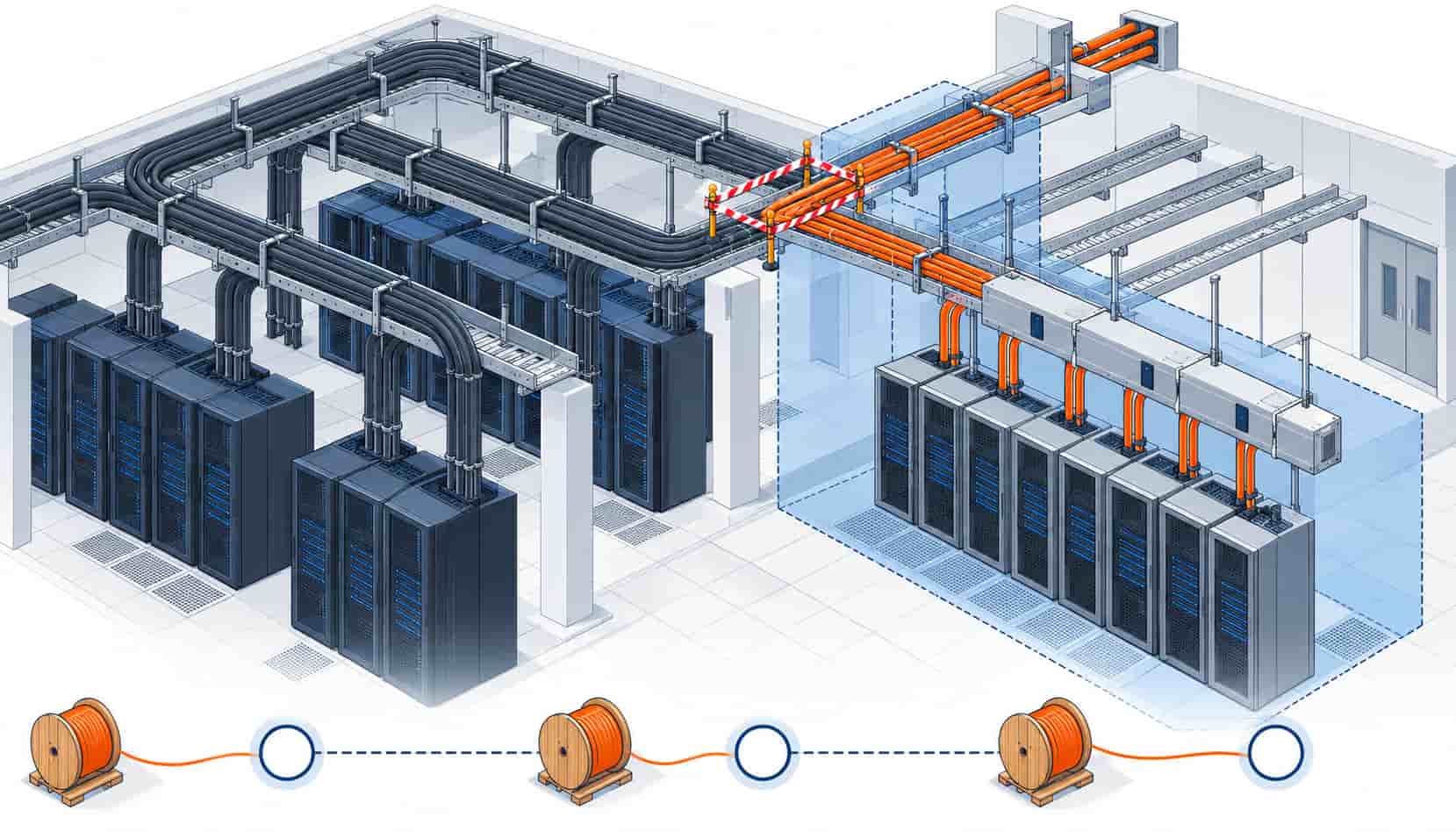
The defining constraint of live expansion is that everything old is energized. The installation method follows from that: new routes prefer spare tray positions and reserved ducts so no work happens over or under live cable; any crossing of existing routes is planned, permitted and executed under the facility’s permit-to-work regime; and every circuit lands on its spare way during a maintenance window with the switching sequence rehearsed on paper first. Facilities with strong permit discipline expand quietly; facilities without it expand excitingly, once.
Prefabrication is the second method lever. Cable assemblies cut, terminated and labeled at the factory — drum lengths matched to measured routes rather than floor-plan estimates — mean the site work is pulling and landing, not cutting and splicing. The same factory-integration logic that shortens new-build schedules, discussed in planning around switchgear lead times, applies double in live halls, where every on-site hour is a scheduled, supervised hour.
Phasing Deliveries Around a Running Facility
Expansion cable arrives in phases matched to shutdown windows, construction sequence and storage reality — a running hall has no warehouse corner for forty drums. Phase the order by maintenance calendar, hold the metal basis steady with copper price linkage across the phases, and label every drum with its route and phase so site teams pull what the window allows and nothing else. Deliveries that ignore the windows create their own logistics incidents: cable stored in aisles, drums cut to lengths the route never needed, and installations half-finished when the window closes.
Documentation closes the loop. Every expanded route enters the as-built the week it lands — schedule line, path ID, route label, test record — because the next expansion, five years out, will rely on this one having left an honest map. Where the expansion adds UPS capacity rather than only load, the architecture choice between modular and standalone plant shapes the cable scope too, and is compared in our modular versus standalone UPS guide.
| Check Item | Requirement | Why It Matters |
|---|---|---|
| As-built survey first | Verify routes against drawings before ordering | Drawings drift; cables do not forgive |
| Upstream headroom | Confirmed at transformer, switchgear, grid | Cable spends headroom, cannot create it |
| Route resources | Spare ways, tray positions, penetrations identified | They are the expansion's raw material |
| Condition check | Thermography and IR trends on affected routes | Do not grow into a tired feeder |
| Hot-work-free method | Spare routes, permits, rehearsed switching | Everything old is energized |
| Phased delivery | Per maintenance window, drums labeled by phase | A running hall has no warehouse |
When Expansion Is Not the Answer
Some expansions are redesigns wearing an expansion’s clothes. If the survey finds no spare ways, no tray capacity, no upstream headroom and no documentation, the honest comparison is between a new train and a new building — and pretending the brownfield can absorb the load with creative cable routing is how a capacity project becomes a reliability incident. Set the decision criteria before the survey: if fewer than half the banked resources exist, the expansion is project-scale, and it deserves project-scale engineering rather than improvisation.
Density ambition has a similar boundary. Doubling rack density in a hall whose feeders, cooling and upstream plant were sized for the original density is not an expansion — it is a rebuild staged in place, and the cable scope is only one of its reopening costs. The lifecycle lens applies to the facility itself: every hall has an economic density ceiling, and expansion planning should find it before the order does.
RFQ Checklist: Ordering Expansion Cable
Expansion orders succeed on matching the installed base, so include:
- Survey summary: spare ways, tray capacity, headroom confirmed per route
- As-built extracts for every route the expansion touches
- New cable schedule aligned to existing labeling and path conventions
- Measured routed lengths — not floor-plan estimates — per route
- Factory-terminated assemblies where site cutting is undesirable
- Delivery phasing matched to maintenance windows and site storage reality
- Copper price linkage held across all phases of the expansion
- Batch test reports keyed to route IDs for the as-built file
- Termination kits matched to existing boards and equipment
- Drum labeling by route and phase, both ends marked
Conclusion
Expanding a live data center without redesigning its cabling is entirely possible — but only when the original design banked the resources, the expansion surveys before it orders, and every phase lands with its documentation. The cable strategy is logistics: spend the reserves, phase around the windows, install hot-work-free, and leave an honest map for the next team.
Kexingyu Cable Group (KXYE) supports phased expansion orders with measured-length drums, factory-terminated assemblies, phase-keyed documentation and copper price linkage held across the delivery calendar — so the expansion adds capacity, not archaeology.