
BBTRZ Flexible Mineral Insulated Cable vs BTTZ: Which to Choose
Quick Answer: BTTZ trades installability for absolute fire survival; BBTRZ keeps strong fire resistance while bending like ordinary cable — demanding endurance picks BTTZ, practical routing picks BBTRZ. Both cables carry a fire-resistance rating. Both get called "mineral insulated" by their makers. And yet on site they behave like different species: one kinks if you look at it wrong, the other installs with a standard crew and standard tools. Choosing between them isn't about which is better — it's about which failure mode your project can afford.
Introduction
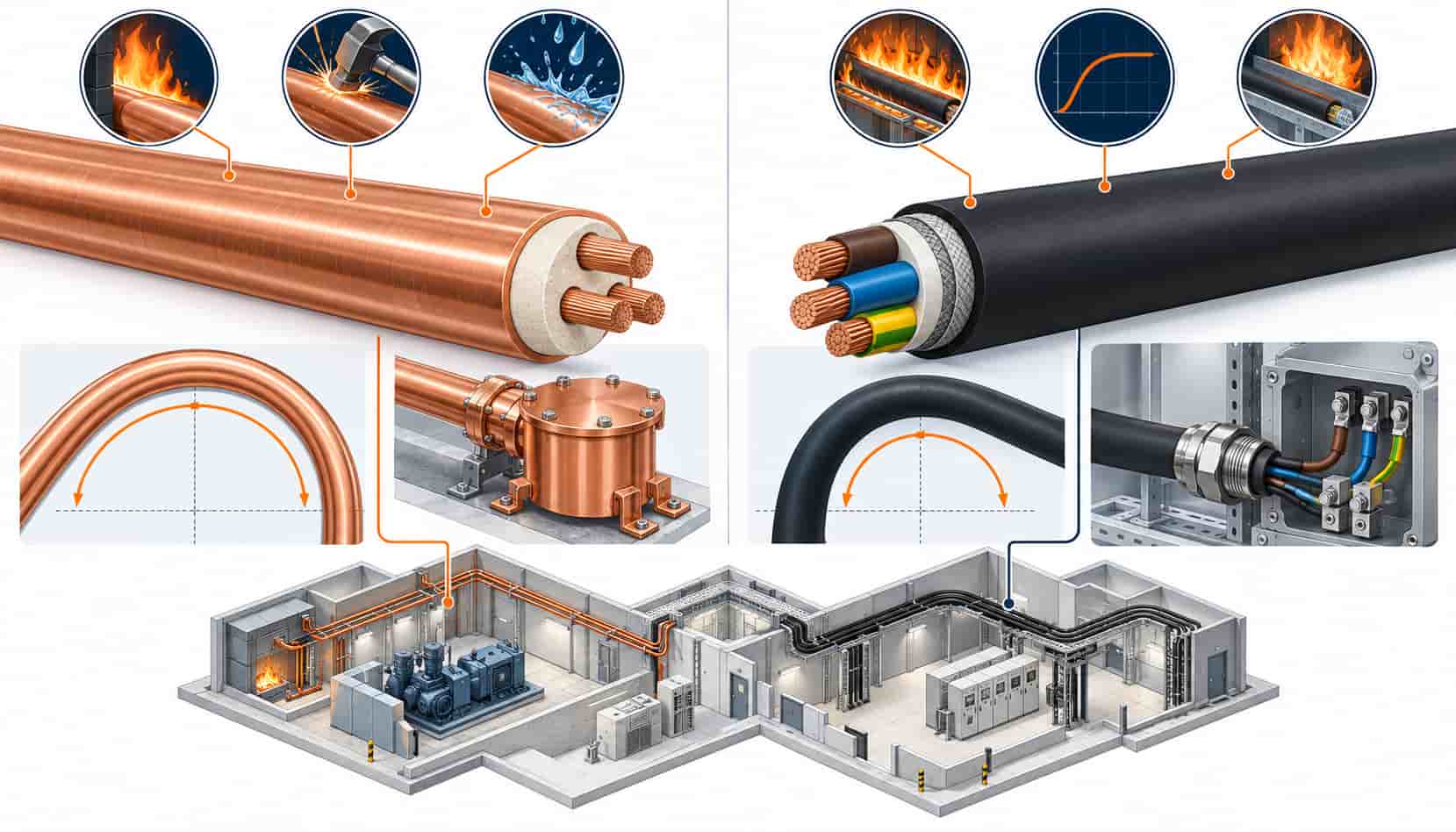
Chinese fire-resistant practice offers two mineral-family answers to the same question: how do we keep circuits live through fire? BTTZ answers with pure inorganic construction — copper conductors, compressed magnesium oxide, seamless copper sheath. BBTRZ answers with a flexible hybrid — mineral-based insulation that survives flame while the cable still behaves like normal LV cable on the drum, in the tray and at the gland. This article compares them on the five axes that actually decide orders — construction, fire performance, installation, moisture behavior and cost — then gives a route-driven selection rule. The insulation fundamentals they share with ordinary cable are covered in our XLPE primer.
Two Philosophies of Fire Survival
BTTZ’s philosophy is subtraction: no organics, nothing to burn, survival measured against flame plus impact plus water spray. BBTRZ’s philosophy is engineered resilience: mineral-based insulation — typically mica-glass tapes combined with mineral-filled compounds over the conductor, plus a ceramifying silicone or mineral layer that hardens in fire — wrapped in an LSZH sheath. The BBTRZ cross-section does contain some organic material, and it says so honestly in its ratings: it survives the fire-test curve, at a defined temperature and duration, rather than shrugging off fire physics entirely.
| Aspect | BTTZ (Rigid MI) | BBTRZ (Flexible MI) |
|---|---|---|
| Construction | Copper conductor, MgO insulation, seamless copper sheath | Copper conductor, mica plus mineral insulation, LSZH sheath |
| Fire behavior | Nothing to burn; survives flame, impact, water spray | Holds circuit through rated fire curve (temperature à duration) |
| Flexibility | Rigid; large bend radius, kinks under abuse | Bends and pulls like normal LV cable |
| Installation crew | MI-experienced hands, pots and seal kits per end | Standard crew, standard tools and glands |
| Moisture sensitivity | High at open ends â MgO is hygroscopic | Low â polymer sheath, normal handling |
| Cost per meter | Highest in the fire-resistant family | Meaningfully lower, closer to premium XLPE |
| Best fit | Life-safety feeders where survival is absolute | Fire-resistant routes that must install fast and bend often |
Fire Performance: Different Tests, Different Promises
Read the ratings as different promises. BTTZ promises survival beyond the test: insulation integrity through direct flame at around 950°C, plus mechanical impact and water spray — the fire, the fire fighting and the collapse. BBTRZ promises rated survival: the cable holds its circuit through the standard fire-resistance curve for its class, which is precisely what most life-safety specifications require and what mica-tape constructions like WDZN-YJY also deliver. The standards families that define these curves are mapped in our IEC, GB and BS standards guide.
The specification error runs in both directions. Demanding BTTZ-class survival on routes whose standard only requires the rated curve is money burned on unused margin; accepting a flexible cable where impact-plus-water survival is written into the code is a compliance failure discovered at audit. Match the promise to the paragraph in your specification.
Installation: Where the Decision Usually Gets Made
On paper the fire rating decides; on site, installation usually does. BTTZ demands measured routes with bend feasibility confirmed, factory seals intact until termination, skilled termination with pots and sealing kits — the accessory discipline in our cable accessories checklist becomes structural, not optional — and post-install insulation testing with dry-out procedures. BBTRZ installs like the LV cable every crew already handles: drum, rollers, standard bend radii, standard glands, standard tests.
For projects with compressed schedules, vertical risers, tight riser corners or crews without MI experience, that difference isn’t a preference — it’s schedule risk and termination-quality risk. Many mixed projects use both: BTTZ on the few absolute-survival feeders, BBTRZ on the wider fire-resistant network, each where its failure mode is acceptable.
Moisture, Aging and Service Life
BTTZ’s only vulnerability is the hygroscopic mineral at open ends — sealed correctly, the cable body is effectively permanent. BBTRZ behaves like a polymer cable: its sheath handles normal moisture, and its aging follows mineral-compound and LSZH norms rather than XLPE’s. The failure mechanisms relevant to long service — thermal, mechanical, environmental — are catalogued in our cable failure causes guide, and both constructions remove most of them relative to ordinary cable. Neither construction, though, substitutes for correct derating and route discipline; fire resistance doesn’t excuse thermal abuse.
| Check Item | Requirement | Why It Matters |
|---|---|---|
| Spec paragraph read | Rated curve required, or impact-plus-water survival? | The two cables promise different fires |
| Route bend survey | Tight corners and risers identified | Rigid MI cannot forgive geometry |
| Crew competency honest | MI termination skills available or absent | Termination quality decides BTTZ outcomes |
| Moisture exposure | Storage and site humidity assessed | Open MgO ends fail in humid storage |
| Schedule pressure | Skilled-hours budget vs standard-crew speed | BBTRZ installs on LV-cable tempo |
| Budget honesty | Premium paid where survival is absolute | Unused margin is burned money |
Cost: What Each Premium Buys
BTTZ’s cost sits in material (solid copper, double metal cross-section with the sheath), in skilled termination hours and in installation discipline. BBTRZ’s sits between BTTZ and premium XLPE, with installation costs indistinguishable from ordinary cable. The rational comparison is total installed cost against the specification paragraph. Where only the rated curve is required, BBTRZ typically delivers compliance at a fraction of BTTZ’s total cost; where the code demands survival through impact and water, BTTZ’s premium is simply the price of the property. Copper price movement affects both — the linkage mechanics are covered in our manufacturer checklist — but BBTRZ’s lower copper intensity softens the swing.
When the Hybrid Answer Is Not the Answer
Some specifications try to split the difference with ordinary fire-resistant XLPE (WDZN-YJY) where the mineral families are genuinely indicated — typically on long vertical risers or in high-impact environments. And some insist on BTTZ everywhere out of caution, turning a fire-safety decision into a budget event. The honest process is the paragraph-first rule: read what the specification actually requires the cable to survive, survey what the route can actually install, and pick the cheapest construction that meets both. Sometimes that’s BTTZ, sometimes BBTRZ, and often a deliberate mix.
Armor and mechanical protection decisions interact with this choice on exposed routes — the framework is in our armored versus unarmored guide, and the data center application angle in our data center power collection.
RFQ Checklist: Ordering Mineral Family Cable
Whichever construction wins, make it verifiable by writing these into the RFQ:
- Fire-survival requirement quoted from the spec: rated curve or impact-plus-water
- Construction chosen per route, with the reason noted in the schedule
- Voltage class, core counts and conductor sizes per circuit
- Measured routed lengths with bend feasibility for any BTTZ runs
- Termination and sealing kits per end, matched to equipment
- Moisture handling: sealed drums, storage terms, post-install IR testing
- Batch fire-test certificates keyed to drum IDs
- Copper price linkage across the delivery calendar
- Crew competency statement for MI terminations, where applicable
- Delivery phased to installation fronts
Conclusion
BTTZ and BBTRZ aren’t competitors; they’re different answers to different questions. BTTZ answers “what survives everything” and charges accordingly. BBTRZ answers “what survives the specified fire while installing like ordinary cable.” Read the specification paragraph, survey the route, and let the failure mode you can’t afford make the choice.
Kexingyu Cable Group (KXYE) supplies both mineral families with batch fire-test certificates, matched termination kits and route-driven specification support — so the construction that arrives is the one the project actually needs.
Recent Posts
Thermal Runaway in Lithium Batteries: What BESS Buyers Should Understand
Thermal Runaway in Lithium Batteries: What BESS Buyers Should Understand How thermal runaway starts, how it propagates, and which evidence buyers should require before approving
Energy Storage for Data Centers: A Growing Backup Power Option
Energy Storage for Data Centers: A Growing Backup Power Option Batteries have always backed up data centers in the form of UPS strings. Grid-scale BESS
YJV vs YJY: Reading Chinese Cable Designations Like a Local
YJV vs YJY: Reading Chinese Cable Designations Like a Local YJV vs YJY: Reading Chinese Cable Designations Like a Local Quick Answer: YJV and YJY