Voltage Drop in Long Cable Runs: Calculations Every Buyer Should Check
Quick Answer: On long runs voltage drop — not ampacity — sizes the conductor: a feeder can pass the thermal check and still deliver 8 percent less voltage than the load needs. Short circuits are thermal problems; long circuits are voltage problems. A cable that carries its current at comfortable temperature can still deliver a load voltage too low to run it, and the failure mode is insidious: motors start sluggish and overheat, drivers trip on undervoltage, lights dim, and nothing ever "fails" enough to point at the cable. The drop calculation is a two-line formula that prevents all of it, yet it's the check most often skipped in the quotation stage — because the ampacity table sits open and the drop formula does not. This guide puts the formula back in the schedule, with the limits and the fixes.
Introduction
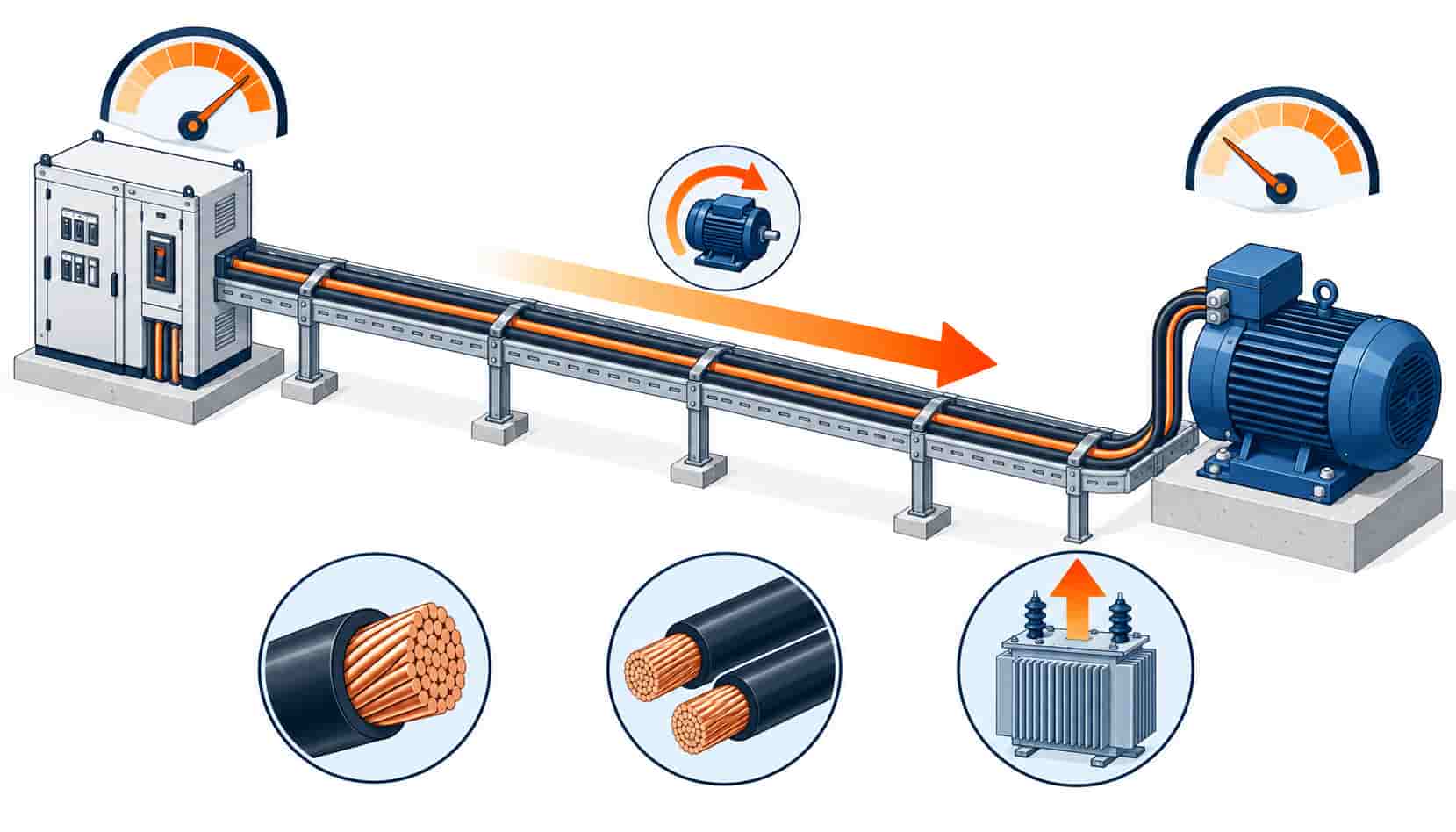
A cable’s resistance consumes voltage along its length, and the consumption is proportional to the distance: double the run, double the drop. For short runs the loss is trivial and ampacity governs. For long runs — a feeder to a remote pump house, a riser to a rooftop plant, a collector line in a solar field — the loss grows past the load’s tolerance long before the cable warms past its limit. This is why professional sizing is a two-constraint problem: the conductor must carry the current thermally and deliver it within the voltage budget, and on long runs the second constraint sizes the cable. The base sizing arithmetic is worked through in our cable size selection guide; this guide covers the second constraint and what buyers should verify about it in any schedule they receive.
The Formula: Simple Enough to Check by Hand
For a three-phase circuit the voltage drop is roughly: drop (volts) equals the line current times the route length times a reactance-plus-resistance factor taken from the cable’s table, times the square root of three — and dividing by the system voltage turns it into a percentage. Single-phase versions drop the root-three. The cable datasheet publishes the resistance and reactance per kilometer that feed the calculation, and the whole check takes minutes with a calculator. The buyer’s discipline is running it independently: take the schedule’s conductor size, the route length, the load current and the datasheet’s per-kilometer values, and verify the percentage lands inside the budget. The calculation also exposes the quiet variables that schedules forget — the actual route length including vertical runs and spare length, the starting current for motor circuits, and whether the load end or the worst midpoint governs. A schedule that quotes a drop percentage without its inputs is asking to be trusted; the buyer checks it instead, using the manufacturer’s published resistance data — the reading habit is the one in our equipment datasheet reading guide.
| Circuit Duty | Typical Limit | Why Tighter | Sizing Consequence |
|---|---|---|---|
| General power, lighting | 3-6% total (code-dependent) | Equipment tolerance bands | Run-length check decides upsizing |
| Motor feeders, running | ~5% steady state | Torque falls with voltage squared | Often sizes larger than ampacity |
| Motor starting | 10-15% transient | Start current 6-8Ã running | Starting case can govern the size |
| Data center distribution | 1-2% per stage | Stacked stages multiply; UPS windows | Short drops via unit placement |
| PV collector / long DC runs | 1-2% design target | Losses are revenue, not just tolerance | Economics balance copper vs yield |
The Limits: Where the Budget Comes From
Codes and standards set drop budgets because equipment tolerances demand them: most plant tolerates a few percent of undervoltage continuously, motors deliver torque proportional to voltage squared, and electronics ride through narrower windows still. The common grammar allocates the budget across the chain — a few percent to the feeder, a few to the branch — so the load at the end sees the total. The specification should state the budget per stage explicitly rather than inherit a default, because the budget is a design decision with cost consequences: one extra percent of allowance can move a long feeder up a conductor size, and two percent of tolerance given away at schedule stage is bought back at copper price. Motor circuits carry a second, harsher check — the starting case. Six to eight times running current through the same resistance produces a transient drop that can stall a long-run motor or trip its contactor, so the starting percentage is verified even when the running case passes comfortably.
The Fixes: What to Do When the Drop Exceeds the Budget
A failing drop check has three honest remedies, and choosing among them is where engineering judgment earns its keep. Upsizing the conductor is the direct fix — resistance falls with cross-section, and each size step buys roughly a proportional reduction — but on very long runs the copper cost grows steeply. Paralleling two smaller cables halves the effective resistance at less copper than one equivalent-size single, and adds pulling flexibility, at the cost of two terminations per end and shared-fault behavior worth checking. Raising the distribution voltage is the structural fix — the same power at twice the voltage needs half the current and loses a quarter of the percentage drop — and it is why long collector and feeder runs justify a voltage step that shorter runs would never pay for. Beyond these, relocated distribution — moving the transformer or panel closer to the load — sometimes deletes the problem entirely. The wrong remedies are folklore: a “bigger breaker” does nothing to the drop, and hoping the load tolerates it transfers the loss to the equipment’s warranty. Where the fix changes the schedule materially, the sourcing timeline consequences of late cable changes are the pattern recorded in our cable sourcing delays guide.
Where Drop Problems Concentrate
Three project families generate most of the world’s voltage-drop surprises. Long industrial feeders — pumps, conveyors, remote process loads — combine distance with motor starting transients, and the starting case governs more schedules than the running case. Data centers stack the budget: utility intake to switchboard, switchboard to UPS, UPS to PDU, PDU to rack — and each stage consumes its allowance, so the per-stage drops are designed tightly, with unit placement doing the work that conductor size would otherwise do at scale; the power architecture behind those stages is covered in our data center power guide, and the battery-side arithmetic that rides the same train is in our UPS backup time guide. Renewable plants monetize the drop directly: every percent lost on a collector circuit is revenue, so the design target sits near one to two percent and the copper-versus-yield trade is run as economics rather than as compliance. In all three families the calculation is the same; what changes is who pays for the lost volts.
| Remedy | Effect on Drop | Cost Profile | Watch For |
|---|---|---|---|
| Upsize conductor | Resistance falls with cross-section | Copper cost grows per size step | Direct but steep on very long runs |
| Parallel two smaller cables | Roughly halves resistance | Less copper than one equivalent single | Extra terminations; shared-fault behavior |
| Raise distribution voltage | Half the current, quarter the percentage | Transformer and switchgear changes | Structural fix for genuinely long runs |
| Relocate distribution closer | Deletes the distance | Civil and equipment relocation | Sometimes the cheapest total answer |
When Voltage Drop Is Not the Answer
Drop governs long runs, and knowing its limits keeps it in its place. Short runs are thermal problems — a ten-meter feeder never fails a drop check, and upsizing it “for voltage drop” is superstition. Very high voltage circuits drop little in percentage terms because the same power is less current, and their sizing returns to thermal and short-circuit constraints. And the drop calculation says nothing about protection: a circuit can pass its drop budget and still need its breaker settings verified for the fault current at the far end, which falls with distance just as voltage does. The complete schedule verifies thermal rating, voltage drop and protection coordination as three separate checks — and the buyer who receives one without the other two is reading an incomplete document, whatever the cable’s price advantage. The supplier-level verification that keeps such documents honest follows the checklist logic in our power cable manufacturer checklist.
RFQ Checklist: Verifying the Drop Calculation
Make the drop check auditable, so include:
- Route length per circuit stated, including vertical runs and spare length
- Load current, power factor and starting current where motor-driven
- Drop budget per stage explicit (feeder, branch) with the code clause cited
- Calculated drop percentage stated beside each long-run circuit
- Resistance and reactance per km taken from the offered cable’s datasheet
- Starting-case drop checked separately for every motor feeder
- Remedy named where the check fails: upsize, parallel, or raise voltage
- Per-stage stacking verified for multi-stage architectures (UPS chains, collectors)
- Batch conductor resistance reports verified against the datasheet values
- Protection coordination checked separately at the far-end fault level
Conclusion
Voltage drop is the quiet constraint that governs long runs, and the calculation is short enough to check by hand in the time it takes to approve a quotation. Run it on every circuit past a few dozen meters, state the budget it must meet, and apply one of the three honest remedies when it fails — and the cable that arrives carries its voltage as well as its current.
Kexingyu Cable Group (KXYE) publishes complete resistance and reactance data per construction and supports drop calculations from measured values, so the percentage in your schedule rests on the cable that actually ships — verified and export-ready.