
Copper Purity in Cable Conductors: Grades, Risks and How to Verify Them
Quick Answer: Cable conductors use electrolytic tough pitch copper at about 99.9 percent purity — the buyer's defense is the resistance test per length and batch reports keyed to the drums shipped. Two cables can look identical on a drum, weigh the same and carry the same printed designation, yet differ in resistance by several percent for their entire service life. That happens when the copper inside one of them was never what its datasheet claimed. Copper is the most expensive raw material in any power cable and the easiest place to hide a margin: a slightly recycled melt, a shorter strand, a touch of alloy. A buyer who understands purity reads conductor resistance values the way a jeweler reads a hallmark. This guide covers the grades, the failure economics and the verification you can write into a purchase order.
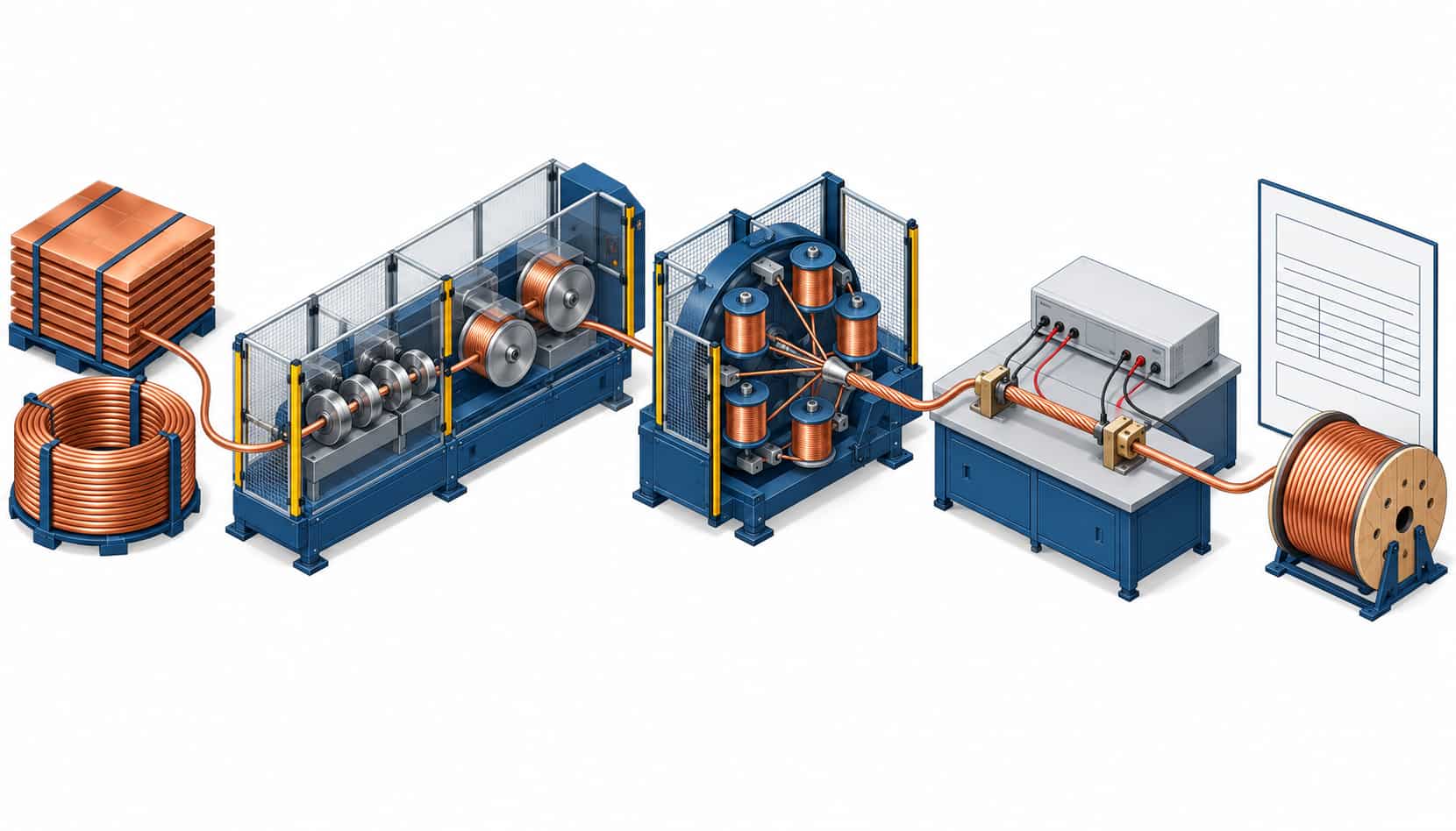
Introduction
Electricity cares about one property of copper: how many electrons come back. Conductivity is the whole commercial story. The standard for annealed high-conductivity copper sits at 100 percent IACS, and anything that enters the melt that isn’t copper pushes that number down. So purity in cable is never an aesthetic question. It’s priced directly into losses, ampacity and voltage drop, and it’s fixed at the moment of manufacture with no chance of repair later. The standards give the buyer a precise instrument here. Conductor classes and their maximum resistance values are defined in the same framework as cable size selection, so a reported ohms-per-kilometer value isn’t an opinion but a pass or fail against a published limit. Purity is also where the quietest quality fraud lives, which is why the failure catalog in common cable failure causes reads partly as a copper story: warm feeders, tripped protections and premature terminations all trace back to conductors that measured wrong from day one.
What "Copper Purity" Actually Measures
Purity in cable copper means two things: the total share of everything that isn’t copper, and, more specifically for cable, the oxygen content and the volatile elements that ride with it. Electrolytic tough pitch copper, the workhorse grade, is refined electrolytically to about 99.9 percent copper with a controlled oxygen content around 200 to 400 ppm. The oxygen is deliberate, because it scavenges impurities during melting and leaves a clean, highly conductive metal. The elements that damage conductivity most per unit are the ones that dissolve into the copper lattice: phosphorus in excess, arsenic, tin, nickel from mixed scrap. That’s why the metallurgy of the melt matters more than the shine of the finished wire. Conductivity is graded on the IACS scale, where annealed standard copper is 100 percent. A melt contaminated by a few tenths of a percent of dissolved impurities can drop that number visibly, and the drop is permanent. No annealing, stranding or processing recovers it. This is also why copper for cable is bought as cathode of declared grade and drawn in-house or from declared rod. The further the melt is from a traceable source, the wider the purity spread.
The Grades: ETP, FRHC and Oxygen-Free
Three grades cover nearly all cable practice. Cu-ETP (electrolytic tough pitch, UNS C11000) is the default conductor copper worldwide, with conductivity slightly above 100 percent IACS when annealed, excellent drawability, and economics that fit power cable volumes. Cu-FRHC (fire-refined high conductivity) is refined by fire rather than electrolysis. Quality can approach ETP, but the process tolerates more scrap input, so consistency depends on the refinery’s discipline. Reputable FRHC is acceptable; anonymous FRHC is a question mark. Cu-OFE (oxygen-free electronic, UNS C10200) removes oxygen to a few ppm for applications where hydrogen embrittlement or outgassing matters. It’s rarely necessary for power cable and commands a premium, so an offer built on “oxygen-free” copper is usually either over-specification or a story rather than a melt practice. What matters for a buyer isn’t chasing the exotic grade but pinning the ordinary one. The specification should name Cu-ETP or equivalent with a conductivity and resistance requirement, so that “high purity” becomes a number someone must test.
| Grade | Typical Purity and Oxygen | Conductivity (annealed) | Cable Practice |
|---|---|---|---|
| Cu-ETP (C11000) | â99.9% Cu, 200â400 ppm oxygen | â100â101% IACS | Default grade for power and building wire |
| Cu-FRHC (C11040-class) | Fire-refined, grade depends on process | â99â100% IACS when controlled | Acceptable from disciplined refineries; verify per heat |
| Cu-OFE (C10200) | â¥99.99% Cu, <10 ppm oxygen | â101% IACS | Special applications; rarely justified for power cable |
| Recycled-content copper | Traceable remelt of declared scrap | Must still meet the standard's limit | Permitted only with testing; risk rises with anonymity |
| Alloyed or contaminated melt | Dissolved P, Sn, Ni, As above limits | Falls below the limit â permanently | Not acceptable; caught only by resistance testing |
Recycled Copper: Where the Risk Actually Lives
Recycled copper isn’t automatically bad. Remelted cathode-grade scrap is a legitimate, established part of the supply chain, and the risk sits with the uncontrolled melt. Scrap streams mix radiators, motor windings and tinned wire. Tin and lead from soldered scrap, nickel from motor windings and phosphorus from deoxidized scrap dissolve into the melt and can’t be removed by fire refining alone. A factory buying anonymous low-grade scrap rod saves a percentage on the most expensive input and passes the difference to the conductor’s resistance for life. The defense is structural, not a matter of trust. Copper should enter the plant as cathode or rod of declared grade with intake records per heat, and the batch report’s resistance values close the loop by measuring the finished conductor against the standard’s limit. Where the buyer’s project stakes justify it, the audit verifies the intake side, using the same floor discipline described in the power cable manufacturer checklist, while the certificate layer that governs the finished product is the one covered in the power cable certifications checklist. Recycled copper that passes the resistance test is acceptable copper. Recycled copper nobody tested is a hidden margin.
How Purity Shows Up in Performance
Purity converts to three performance numbers a buyer already tracks. First, resistance. A conductor a few percent over the standard’s limit runs warmer at rated current, and warmth compounds: higher resistance means higher temperature, and higher temperature raises resistance further, so a marginal conductor lives its life closer to its thermal ceiling. Second, ampacity and voltage drop. Tables assume the standard’s maximum resistance, so a contaminated conductor silently invalidates the sizing math and adds losses on every meter of run. On a data hall’s feeder schedule that’s kilowatts, year-round. Third, mechanical quality. Contaminated or over-scrap melts draw with more inclusions and surface defects, and the annealed wire fails bend and elongation checks that clean copper passes easily. Poor elongation shows up later as breaks at terminations during pulling. None of these announce themselves on delivery day. They surface as a warm feeder in year three or a service fault in year five, which is exactly why verification belongs at the factory gate rather than the failure scene.
| Check | Where It Runs | What It Catches |
|---|---|---|
| Conductor resistance per length | Factory routine test, every length | Undersizing, short stranding, contaminated melt â the sum of all shortcuts |
| Intake records per heat | Raw material warehouse | Anonymous rod, missing declared grade, unmapped melt source |
| Tensile and elongation test | Factory sample test per batch | Over-scrap melts, poor annealing, inclusions |
| Bend test on finished wire | Sample test | Brittle or included wire that cracks at terminations |
| Stranding geometry and compaction | Production floor sampling | Fewer wires than the class requires, thin strands hiding size shortfall |
| Drum-ID keying of report values | Batch report review | Generic "per batch" reports unmoored from the shipped drums |
Writing Copper Quality into the Purchase Order
Purity becomes enforceable the moment it becomes a numbered requirement. The specification should name the conductor grade (Cu-ETP or equivalent with the applicable standard), state the conductor class by the IEC 60228 framework referenced in our MV and LV cable standards guide, and require the batch report to show resistance values against the standard’s limit for every drum shipped. Intake discipline belongs in the contract too: heats traceable to declared cathode or rod sources, records available on request. The certification layer, meaning which tests are performed, by whom and how the report is keyed, is the regime described in the China certification checklist, and copper quality is simply its expression at conductor length. A buyer who writes these lines pays nothing extra when the supplier is honest, and everything when the supplier is not.
When Purity Is Not the Answer
Purity is necessary but not sufficient, and three neighboring axes can sink a conductor made of perfectly pure copper. Stranding and compaction matter as much as the melt: a conductor of pure copper stranded one class short fails the same resistance test and produces the same warm feeder. The distinction between material and geometry shortcuts is drawn in the conductor-class discussion of our cable size selection guide. Annealing and handling matter too. Clean copper work-hardened by aggressive drawing fails bend tests that purity alone would pass, and installation damage such as tight bends, crushed ducts or careless glands destroys conductors that left the factory flawless. Purity also can’t rescue a design chosen wrong: the wrong insulation, the wrong size for the load, the wrong environment. Verify the copper, then verify the rest of the chain with the same discipline.
RFQ Checklist: Specifying Conductor Copper
Put the copper on the record, line by line:
- Conductor grade named: Cu-ETP or equivalent, per the governing standard
- Conductor class stated with the applicable maximum resistance
- Conductor resistance reported per drum ID against the standard’s limit
- Intake records per heat available for the heats used in the order
- Tensile, elongation and bend results included in the batch report
- Stranding geometry per the declared class, with wire counts on request
- Oxygen-free copper claims required only if the application justifies them
- Right of third-party verification of the delivered drums stated
Conclusion
Copper purity is the part of cable quality that’s most expensive to fake and easiest to verify. The grades are simple, with ETP as the default, FRHC acceptable with discipline, and oxygen-free only when justified. The verification is already built into the standards: resistance per length against a published limit, keyed to the drums that arrive at your site.
Kexingyu Cable Group (KXYE) draws conductors from declared-grade cathode with per-heat intake records and ships conductor resistance values against the standard’s limits, keyed to drum IDs. The copper you bought is the copper that arrives, measured and documented.
Recent Posts

Power Cable Warranty Terms: What to Demand and What to Watch For
Power Cable Warranty Terms: What to Demand and What to Watch For Quick Answer: A usable warranty names its scope, duration, evidence standard, exclusions and
The Cable Sample Approval Process: What to Test Before Mass Production
The Cable Sample Approval Process: What to Test Before Mass Production Quick Answer: Sample approval tests the supplier’s claims while changes are still cheap —
Cable Drum Packaging for Export: Specs, Marking and Transit Protection
Cable Drum Packaging for Export: Specs, Marking and Transit Protection Quick Answer: Export packaging is a technical specification: drum size for weight and bend radius,