
Power Cable Warranty Terms: What to Demand and What to Watch For
Quick Answer: A usable warranty names its scope, duration, evidence standard, exclusions and remedy mechanics — a warranty missing any of these is a sentence, not a commitment. Every cable quotation carries some version of the word "warranty". The word costs nothing to print. The substance behind it ranges from a genuine multi-year commitment backed by traceable evidence down to a single sentence designed to expire on contact with a claim. Cable defects surface years after delivery, whether a warm feeder in year two or an insulation fault in year five, so the warranty is the buyer's only instrument that reaches into the future. Reading it critically before signing isn't legalism. It's the last step of the technical specification.
Introduction
Cable occupies an unusual position in warranty discussions: the product is buried, inaccessible and expected to last decades, yet the warranty that matters is decided in the first months of service. A manufacturing defect announces itself early, while almost everything that fails later is installation, environment or overload. So the negotiation is about precision, not length. A buyer who demands “ten years warranty” gets a longer sentence. A buyer who demands the right scope, the right exclusions discipline and a workable claim chain gets an instrument that pays. The warranty also draws its strength from everything upstream of it: the evidence regime that makes defects provable, which is the batch report structure covered in the power cable certifications checklist, and the supplier’s durability as a company. That’s why warranty conversations and supplier-vetting conversations are the same conversation, the one structured in the power cable manufacturer checklist. Buyers of other power equipment have already learned this lesson the long way. The battery storage sector turned warranty depth into a headline purchase criterion, as seen in BESS cycle life and warranty terms, and cable deserves the same scrutiny.
What a Cable Warranty Actually Covers
The core of a manufacturing-defect warranty is narrow, and it should be: defects in materials and workmanship, meaning conductor undersized or contaminated against the standard, insulation or sheath thickness below minimum, compound substituted against the specification, or construction not matching the approved datasheet. These are the defects the factory’s own test regime could and should have caught, which is precisely why the manufacturer carries them. Everything else lives outside: damage in transit (a carrier matter, bounded by the packaging spec and receiving protocol), damage during storage or installation, overload and fault currents beyond rating, and normal aging. Buyers sometimes push to widen the scope into site performance guarantees, like “cable shall perform for 20 years”, and discover that no manufacturer can underwrite someone else’s installation. The better trade is depth in the narrow scope. A warranty that clearly covers construction non-conformity against the standard, with the batch report as the proof standard, is worth more than a poetic sentence about decades. The failure modes a defect claim will invoke are cataloged in common cable failure causes, and reading that list against a draft warranty shows immediately which clauses will matter.
The Anatomy of a Usable Warranty
Five components decide whether a warranty functions. Scope: the defect categories covered, tied to the governing standard and the approved datasheet rather than to adjectives. Duration: the industry norm for power cable is 12 to 24 months, and the date the clock starts matters more than the number. Starting from commissioning is fair to the buyer; starting from shipment can consume most of the window in ocean freight and site storage, so the cap structure (“whichever comes first, with a minimum X months after commissioning”) is the clause to negotiate. Evidence standard: what a claim must show, such as drum IDs, batch report values, an independent or joint test result, agreed in advance so the claim is a lookup rather than a fight. Remedy: replacement or repair of the defective length, with response time and cost bearing stated, including freight, labor and re-testing. And survival: what happens if the product is discontinued or the construction changes. The warranty should bind to the drums shipped, not to a product line that may no longer exist.
| Component | What It Decides | The Clause to Demand |
|---|---|---|
| Scope | Which defects are covered | Manufacturing defects in materials and workmanship, judged against the governing standard and approved datasheet |
| Duration | How long the cover runs | 12â24 months from commissioning, with a shipment-date cap that guarantees a minimum window |
| Evidence standard | What a claim must show | Drum IDs matched to batch reports; independent or joint test protocol pre-agreed |
| Remedy | What the supplier does | Replacement or repair of defective lengths, response time stated, freight and re-test costs on the supplier when the claim holds |
| Survival | What if the product line changes | Warranty binds to the drums shipped and their documentation, not to a continuing product line |
Exclusions: Where Warranties Go to Die
Exclusions are legitimate; a factory cannot underwrite a backhoe. But they’re also where over-drafted warranties hide their emptiness, and three patterns deserve a red pen. The first is the blanket installation exclusion drafted so broadly that any fault found after energization is presumed installer-caused. The workable version excludes installation damage but allocates the burden of proof to the party alleging it, with the batch report as the tiebreaker. The second is the storage exclusion without a storage standard. Excluding “improper storage” while never defining proper storage turns every humid warehouse month into a dispute; the fix is attaching the storage conditions (sleepers, sealed ends, UV shade) to the warranty so compliance is checkable. The third is the void-if-cut clause. Once a cable is cut to length for installation, some warranties treat the product as unprovable, which is precisely backwards: the drum ID, meter marks and retained samples exist to keep the chain alive through installation. The negotiating principle is simple. Every exclusion should name a specific, provable condition, not a category of blame. Vague exclusions are one of the recurring traps in cross-border equipment purchasing cataloged in international power equipment sourcing mistakes.
The Claim: Evidence Chain from Fault to Remedy
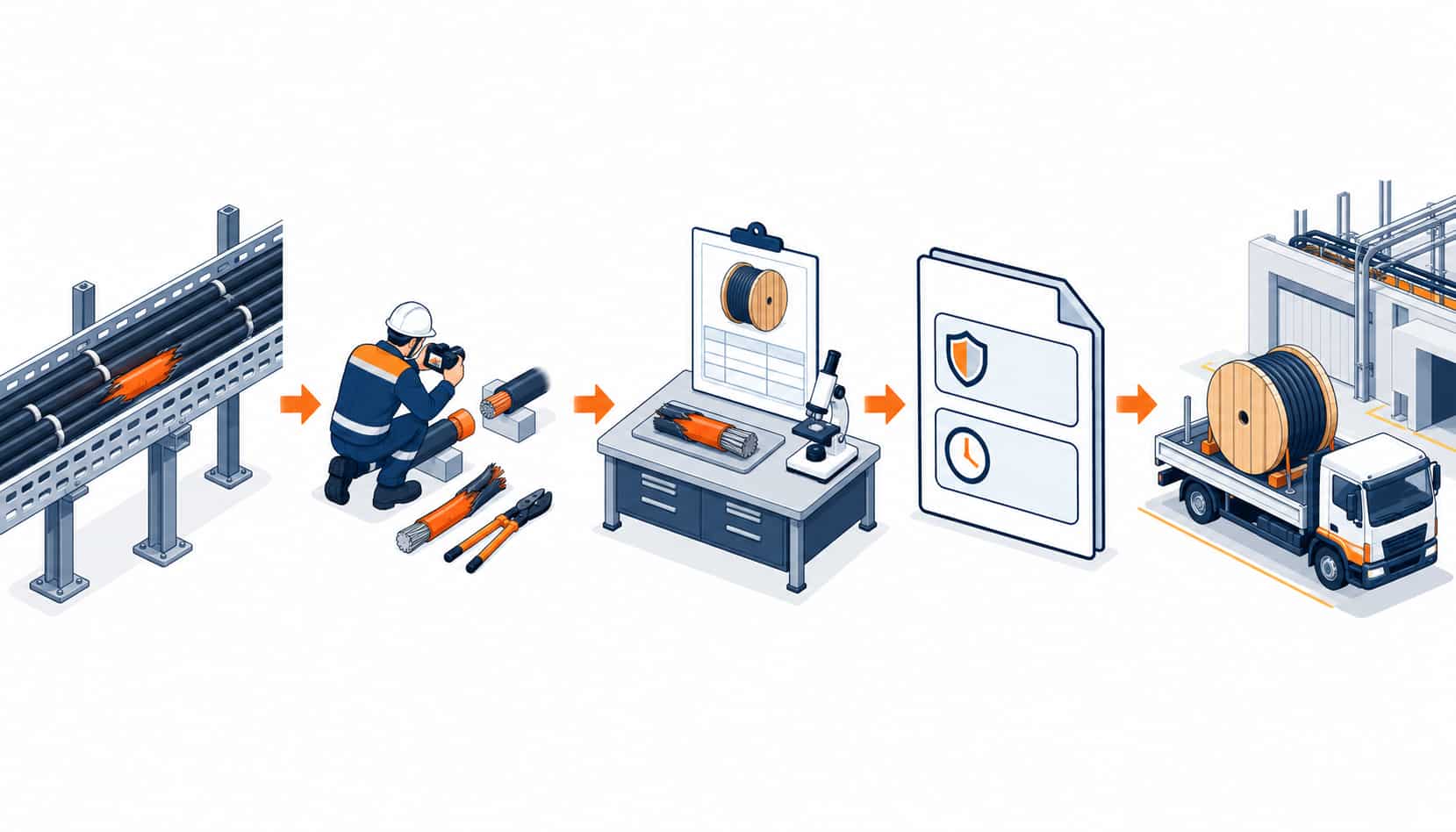
A claim succeeds when the chain was built before the fault. It starts at the drum: the drum ID printed at the factory keys the failing length to its batch report, and the report’s resistance values, dimensions and test conditions become the benchmark the failed section is measured against. The claim file then needs the failure evidence, including the damaged section preserved, photographs of the failure point and its surroundings, and the installation record where available, plus a test conclusion, ideally from a joint cutting or an independent laboratory under a protocol agreed in the warranty. From there the remedy mechanics run: notification within the stated window, supplier response within the stated time, replacement or repair executed with costs borne per the clause when the claim holds. What makes claims fast isn’t goodwill but pre-agreement. Every element negotiated in advance is a lookup, and every element left vague is a negotiation conducted while your circuit is out of service. The project-level logistics of coordinating such evidence across an EPC site are part of the broader sourcing discipline in sourcing power equipment for China EPC projects.
| Step | Evidence Required | What Kills the Claim |
|---|---|---|
| Identify the drum | Drum ID on the failing length, matched to shipping documents | Unmarked drums; report keyed "per batch" only |
| Compare against baseline | Batch report values vs measured values on the failed section | No report, or report with no limit column |
| Preserve the failure | Cut-out section, photos of failure point and context | Fault section discarded or re-terminated before inspection |
| Establish cause | Joint cutting or independent lab test per pre-agreed protocol | Blame asserted without test; protocol disputed after the fact |
| Execute remedy | Notification in window; supplier response per stated time | Notification window missed because the clock ran from shipment |
Warranty Economics: Pricing the Promise
A warranty is worth what stands behind it, and three factors price it. Supplier longevity: a 24-month warranty from a company that has shipped cable for decades and will for decades more is real money, while the same sentence from a trading company one re-registration away from disappearing is wallpaper. That’s why the vetting stage, not the contract stage, is where warranty value is created. Evidence infrastructure: warranties backed by drum-ID traceability and batch reports resolve in weeks; warranties without evidence infrastructure resolve in litigation. And financial instruments: for large projects, performance bonds or retention sums convert the warranty from a promise into a funded obligation, at a cost the buyer pays in working capital and should weigh against the supplier’s track record. The economics explain a familiar pattern. The supplier whose price is 3 percent lower and whose warranty is one vague sentence is usually the more expensive one.
When a Warranty Is Not the Answer
Three limits belong in every buyer’s head. A warranty compensates; it does not keep the lights on. A feeder that fails in year two is a project problem long before it is a claim payment, which is why redundancy, testing and inspection upstream are worth more than any remedy clause. A warranty can’t reach what happens after delivery, whether installation damage, storage abuse or overload, and pretending otherwise via over-broad scopes only produces warranties that expire on contact. And a warranty isn’t a substitute for verification. The regime that catches defects at the factory, the audit, the sample approval and the per-drum batch reports, is what makes the warranty a rarely used instrument. The best warranty outcome is the one nobody files, and that outcome is manufactured upstream, not drafted downstream.
RFQ Checklist: Warranty Lines to Put in the RFQ
Convert the anatomy into RFQ language, item by item:
- Scope stated: manufacturing defects in materials and workmanship per the governing standard
- Duration 12–24 months from commissioning, with a shipment cap guaranteeing a minimum window
- Evidence standard pre-agreed: drum IDs, batch reports, joint or independent test protocol
- Exclusions specific and provable; storage and installation standards attached
- Remedy mechanics stated: replacement or repair, response time, cost bearing on valid claims
- Warranty binds to shipped drums and their documentation, not the product line
- Retention samples defined and retained by both parties for the warranty period
- Performance bond or retention offered for orders above the agreed threshold
Conclusion
A cable warranty earns its place in the contract the same way the cable earns its place in the trench: by being specific, testable and backed by evidence. Scope, duration, evidence standard, remedy and survival are five clauses, each demanding a number or a document rather than an adjective, and together they turn the warranty from decoration into an instrument.
Kexingyu Cable Group (KXYE) stands behind its cable with a written warranty tied to drum-ID traceability and batch reports, so a claim is a lookup against recorded evidence. The preferred outcome, like our customers’, is a warranty that never needs filing.
Recent Posts
The Cable Sample Approval Process: What to Test Before Mass Production
The Cable Sample Approval Process: What to Test Before Mass Production Quick Answer: Sample approval tests the supplier’s claims while changes are still cheap —
Cable Drum Packaging for Export: Specs, Marking and Transit Protection
Cable Drum Packaging for Export: Specs, Marking and Transit Protection Quick Answer: Export packaging is a technical specification: drum size for weight and bend radius,

Copper Purity in Cable Conductors: Grades, Risks and How to Verify Them
Copper Purity in Cable Conductors: Grades, Risks and How to Verify Them Quick Answer: Cable conductors use electrolytic tough pitch copper at about 99.9 percent