UAE and Dubai: Cable Standards and Suppliers for Gulf Data Centers
Quick Answer: The UAE is the Gulf’s most active data center market, and its cable opportunity runs through two layers: utility and civil-defence approvals, and free-zone hyperscale pace.
The UAE made itself the Gulf’s computing hub the way it built everything else: early, deliberately and at scale. Dubai’s free zones host one of the region’s densest clusters of carrier-neutral and hyperscale facilities. Abu Dhabi adds state-backed digital programs and AI infrastructure, and the northern emirates add capacity year by year. For cable suppliers, the market combines Gulf characteristics — heat, conformity paperwork, institutional buyers — with a Dubai speed that punishes slow qualification. This guide maps what the emirates’ data halls demand and how the supply path actually works.
Introduction
The regional frame is a Gulf power market adding generation, grid and computing at once, with the sourcing landscape mapped in Middle East power equipment sourcing, and the UAE is its commercial center: the market where international operators land first, where specifications are written by international consultants, and where capacity additions rank among the world’s fastest. The emirates’ advantage is structural: connectivity, free-zone ownership structures that welcome foreign capital, and a utility system that has spent two decades building the generation and transmission backbone the halls sit on. The emirate-level detail follows the pattern the country guides in this series map elsewhere — what matters at the system level is where the demand concentrates and how it is gated.
What the Emirates' Halls Demand
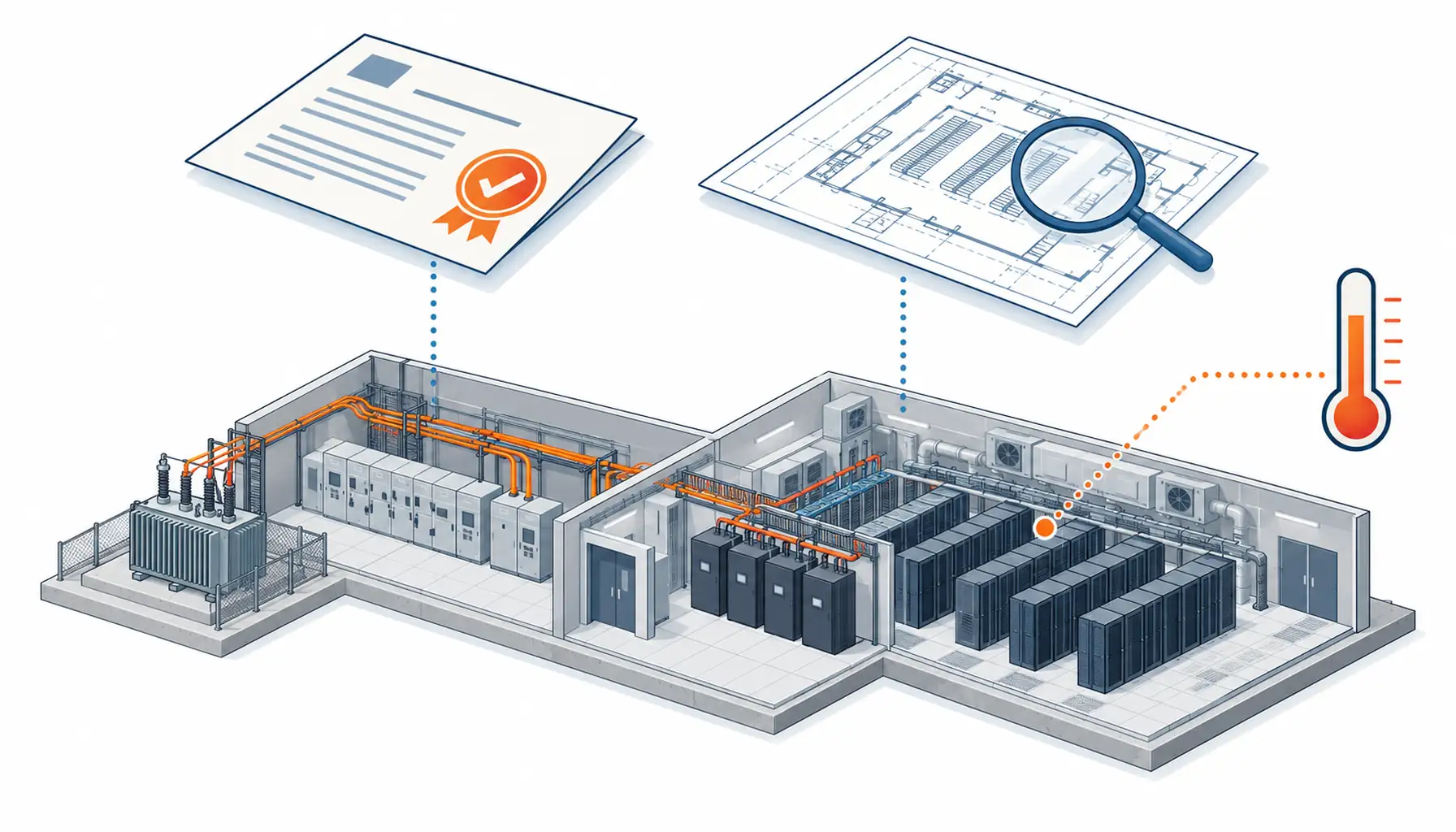
The electrical bill follows the hyperscale chain, but the UAE shapes it in three ways. Heat, first and always: summer ambients drive derating decisions on every feeder run, conductor sizing and sheath selection are calculated against site temperatures, and outdoor or buried runs add their own thermal burden. The selection arithmetic of cable size selection runs against Gulf conditions, with armored constructions where the route demands them, per the trade-offs of armored vs unarmored cable. Redundancy second: the free-zone hyperscale culture designs to international uptime tiers, and the backup architecture — sized per UPS sizing for data centers and built to the redundancy patterns of N+1 vs 2N redundancy — decides how many parallel cable runs each hall carries. Approval layers third: the utility connection and fire-safety regimes review the installation, while the consultant reviews the product file. A supplier must clear both, and the documentation that satisfies one doesn’t automatically satisfy the other.
| Layer | Cable Family | Approval Path |
|---|---|---|
| Intake and substations | MV XLPE feeder cable, compact substation link | Utility connection review; site-ambient derating stated |
| Distribution and UPS | LV power cable, parallel feeders | Consultant review against international uptime tiers |
| Halls and galleries | LSZH power and structured cabling | Fire-safety regime plus consultant specification |
| Campus routes | Armored constructions for buried and exposed runs | Installation method reviewed with the route design |
| Documentation | Certificates, type tests, batch traceability | Both layers; utility evidence and consultant file distinct |
The Free-Zone Tempo and the Buyer Map
The UAE’s buyer structure explains its tempo. The free-zone clusters — Dubai’s carrier-neutral heart above all — run on international operators who bring their own consultants, their own uptime tiers and their own vendor-qualification files, so a supplier approved by one operator inherits a warm path to the next. Abu Dhabi’s programs buy through state-backed entities with deeper institutional process: longer qualification, larger frameworks, and records that persist for years. The northern emirates add capacity through regional developers who aggregate smaller halls into repeat programs. Three buyer types, three rhythms — and one shared gate: every project, in every emirate, passes the utility and fire-safety layers at the connection point. Suppliers who build one evidence architecture that serves all three buyer types, with per-format outputs rather than per-buyer rework, are the ones who keep pace with Dubai speed without rebuilding their file for each emirate. The tempo, in other words, isn’t an invitation to cut corners. It’s a reason to build the file once, properly, and let it run.
The Two-Layer Approval Path
The UAE’s approval structure is the market’s defining gate, and it rewards suppliers who understand which layer asks which question. The utility and civil-defense layers ask about the installation: does the cable suit the route, the fire strategy, the connection design — evidence presented in the formats those authorities expect. The consultant layer asks about the product: standards alignment, type-test reports, batch traceability — the four-check discipline of the power cable certifications checklist, applied before orders are placed. The free-zone projects add their own tempo: Dubai-speed schedules mean qualification runs in parallel with tendering, and the suppliers already holding current files are the ones who make the shortlist. The recurring failure catalog of international power equipment sourcing mistakes applies with Gulf precision. The expensive mistake is not losing a bid — it’s winning one and then discovering the file doesn’t clear the utility layer.
| Stage | Action | Classic Trap |
|---|---|---|
| Qualification | Product file and authority-format evidence both assembled | One file assumed to satisfy two different reviewers |
| Specification | Heat derating and armor choices stated against site conditions | Laboratory-ambient sizing on a Gulf site |
| Tender | Qualification run in parallel; files current before shortlisting | Starting certification after the shortlist is set |
| Delivery | Batch identity reconciled per consignment across phases | Batch substitution between approval and delivery |
| Repeat | Record maintained across emirates and free zones | Treating Dubai as the whole federation opportunity |
When Gulf Speed Is Not a Shortcut
Two cautions frame the opportunity. Speed is not the absence of discipline: Dubai’s tempo compresses schedules, not standards. The projects that move fastest are the ones whose paperwork never stalled, and a supplier who cut the file to save time loses more in the stall than the time saved. And Dubai is not the federation: Abu Dhabi’s state-backed programs, the northern emirates’ capacity growth and the utility networks that bind them all buy cable on their own rhythms. The suppliers who map the whole federation serve a market several times the size of its most famous city.
RFQ Checklist: UAE Lines for the RFQ
Put the market’s questions in writing:
- Heat-derated sizing and sheath selection stated against site ambients
- Armored construction recommendations for buried and exposed routes
- Product file: standards alignment, accredited type tests, batch traceability
- Authority-format evidence for the utility and fire-safety layers
- Parallel-run quantities matched to the hall’s redundancy architecture
- Free-zone delivery schedules with clearance ownership written in
- Federation-wide framework terms across emirates and zones
Conclusion
The UAE is the Gulf’s most active data center cable market and its most layered: utility authorities, fire regimes and international consultants each hold a key, and the supplier who holds all three files wins on Dubai time. The demand is structural — connectivity, free-zone capital and state programs pulling together — and the qualification work compounds across the federation, into Saudi and Qatar, and back again.
Kexingyu Cable Group (KXYE) serves the emirates the way the market works: heat-rated engineering stated in the offer, evidence files assembled in both authority and consultant formats, and delivery calendars built for free-zone tempo — one supply chain, two approval layers, no stalled schedules. The suppliers who win treat the two layers as one evidence architecture with two output formats: built once, kept current, and presented in whichever format the next reviewer asks for.