India's Data Center Growth: Cable Imports vs Local Content Rules
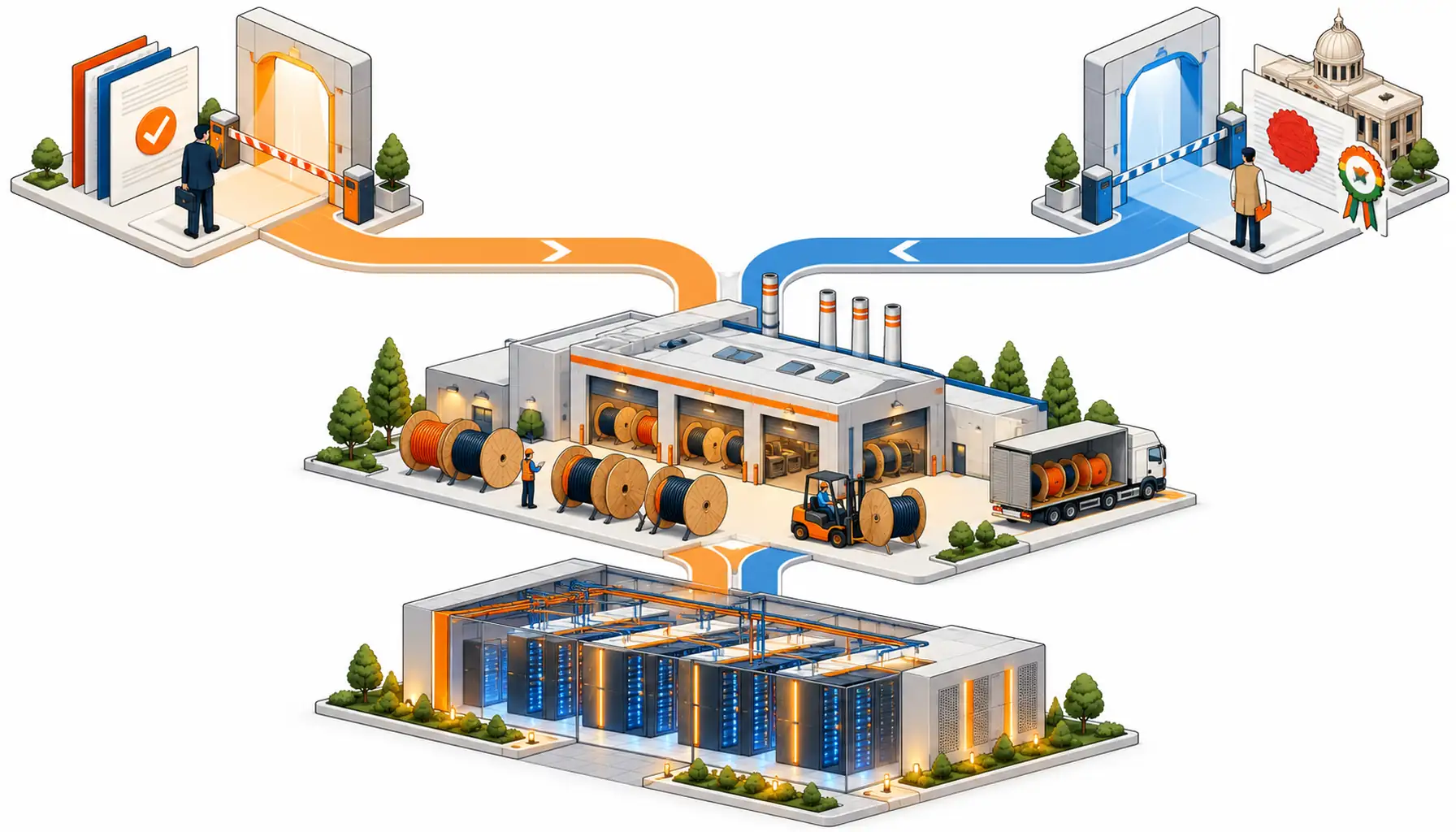
Quick Answer: India’s data center boom buys cable under a split system — private halls spec IEC standards and import freely, public tenders prefer Make-in-India, and importers who know which gate they face win the program.
India is the biggest data center story in South Asia on every count. Hyperscale campuses are rising in Mumbai and Chennai, state programs are pulling Tier-II cities onto the map, and the policy establishment treats digital infrastructure as a national priority. It is also the region’s largest market where the question “import or local?” is genuinely contested. Private data center developers spec to international standards and buy from whoever proves their file. The public side of the power system — the utilities and PSU tenders feeding those halls — carries Make-in-India preferences that tilt toward domestic factories. So for an overseas cable supplier, India isn’t one market but two, and the winning posture differs between them. This guide maps the demand, the rules, and the route through both gates.
Introduction
The demand frame is global: India sits among the fastest-growing data center markets in the demand analysis of data center power demand growth, with capacity projected to multiply over the decade as cloud regions land and AI workloads arrive. The cable bill follows the standard hall pattern. MV feeders to on-site substations, LV distribution to UPS strings and PDUs, LSZH cabling through the halls, monitoring layers throughout — all engineered to the standards framework in our MV and LV standards guide. What makes India distinctive isn’t the bill but the procurement environment around it. A private track runs on international consultants and submittal-gated specifications. A public track carries local-content preference and Indian standards that reshape who can bid. The suppliers who grow in India read the two tracks as different games with different files.
The Demand Story: Mumbai First, Then Everywhere
Mumbai remains the center of gravity. Submarine cable landings, dense enterprise demand and power availability have made it one of Asia’s largest data center clusters, and its campuses anchor the region’s cable volumes. Chennai follows on its own submarine routes and manufacturing base, Hyderabad and Pune climb with enterprise cloud, and Delhi NCR adds a large domestic-enterprise market. The pattern that matters for cable suppliers is that India’s growth is developer-led. Large campuses get built by professional operators who repeat their designs across cities, so a cable construction approved once travels through a whole pipeline of follow-on projects. Inside each hall the electrical bill is the standard one: MV intake sized by the consultant, LV distribution shaped by the redundancy architecture, UPS strings engineered per UPS sizing for data centers, and the LSZH choice in occupied halls following the fire-performance trade-offs of LSZH vs fire-retardant cable. What varies by city is the grid behind the hall, and that’s where the public track begins.
| Track | Who Buys | Rules That Decide |
|---|---|---|
| Private data centers | Developers, EPCs, international consultants | Submittal-gated specs; IEC/BS evidence accepted; import-friendly |
| Public and utility | Discoms, PSU tenders, government-funded programs | Make-in-India preference; Indian standards and BIS-listed products |
| Campus infrastructure | EPC contractors bridging hall and grid | Split bills: hall side to consultant spec, grid side to utility file |
| Follow-on programs | Operators repeating designs across cities | Approved constructions travel; first approval opens the pipeline |
The Local-Content Question: What the Rules Actually Require
India doesn’t ban cable imports. The honest reading of the rules is more layered. On the private track there’s no local-content mandate: consultants specify performance, and a foreign factory’s type-test file competes on evidence and price. The public track is different. Make-in-India procurement preference gives domestic manufacturers an advantage in government-funded tenders, and the utility side of the market — the discom programs and transmission upgrades that electrify the campuses — buys heavily through those channels. Indian standards (IS) govern much of the utility-spec cable volume, and products moving through public procurement increasingly need BIS listing to even enter the tender. For an overseas supplier, the strategic consequence is sequencing. The private data center track is open now and rewards IEC-based files. The utility track rewards either a local partnership or a factory willing to carry Indian certifications. Suppliers who conflate the two tracks either over-invest in certifications the private side never asked for, or walk away from a private-track market that was never closed. The verification discipline of the power cable certifications checklist applies with full force: match the file to the gate, not to the region.
Serving Both Tracks Without Splitting the Factory
The practical route for an overseas factory is portfolio-shaped. The private data center track buys on submittals: type-test evidence to the consultant’s named standards, batch traceability, and delivery calendars that hold across a multi-city pipeline — the coordination logic of one-stop power equipment sourcing appeals to EPCs running halls and substations on one timeline. The public-adjacent volume, meaning the MV feeders and grid-side works around the campuses, often flows through Indian partners or licensees who hold the domestic credentials. The foreign factory supplies construction know-how and capacity behind them. Both routes demand the same honesty on calendar and cost. India’s projects compete for global cable capacity like every boom market, the equipment families around cable run on the schedules tracked in regional planning guides, and the recurring failure patterns of international power equipment sourcing mistakes apply with a distinct Indian flavor: the costliest error is quoting a private-track price to win a public-track tender, or the reverse. Read the gate before you price the file.
| Stage | Action | Classic Trap |
|---|---|---|
| Track identification | Classify each opportunity: private spec or public tender | Assuming one India rule sheet covers both tracks |
| Evidence assembly | IEC/BS type-test file for private; IS/BIS path scoped for public | Certifying for the wrong gate or both at once |
| Partnering | Local partner or licensee for utility-side credentials | Building a public-track file with no domestic holder |
| Submittal | Consultant-format dossiers delivered before design freeze | Evidence assembled after the consultant has approved a rival |
| Pipeline | First approval carried into the operator's follow-on cities | Treating each city tender as a fresh, unconnected sale |
When Import-Led Growth Is Not the Whole Answer
Two cautions keep the India story honest. First, the open private track is open because consultants defend it, and consultants also reward incumbency. Once a construction is approved into an operator’s repeat design, switching to a rival file is rare and slow, so late entrants win new programs rather than displacing approved ones. Second, the policy wind on the public side blows toward localization, and it has been steady for years. A foreign supplier who builds an India strategy on public-tender volume without a domestic credential path is building on ground the rules may take back. Neither caution kills the opportunity; both shape it. Enter through the private gate with a complete file, hold the utility volume through partners, and let the operator pipelines do the compounding — not the tender headlines.
RFQ Checklist: India Lines for the RFQ
Put the market’s questions in writing:
- Track named per opportunity: private consultant spec or public tender
- Type-test evidence listed to IEC/BS per consultant requirement
- IS/BIS pathway scoped where public-side volume is targeted
- Batch traceability and marking format per operator standard
- Multi-city delivery calendar quoted as one program schedule
- Partner or licensee arrangement stated for utility-side scope
- Submittal dossiers committed before design freeze dates
Conclusion
India’s data center growth is the largest in the region, and its procurement environment is the most layered: a private track that buys on international evidence, a public track that prefers local production. The market doesn’t punish imports. It punishes suppliers who bring the wrong file to the wrong gate. Read the tracks separately, sequence the certifications accordingly, and the same factory can serve both.
Kexingyu Cable Group (KXYE) approaches India the way the market demands: IEC-based evidence files built for consultant-led submittals, a certification path scoped for public-side volume through partners, and program-level calendars held across multi-city pipelines — cable supply sized for a market where the gate decides the file, and the file decides the win.