Copper Price Volatility and Cable Procurement: How Global Buyers Manage It
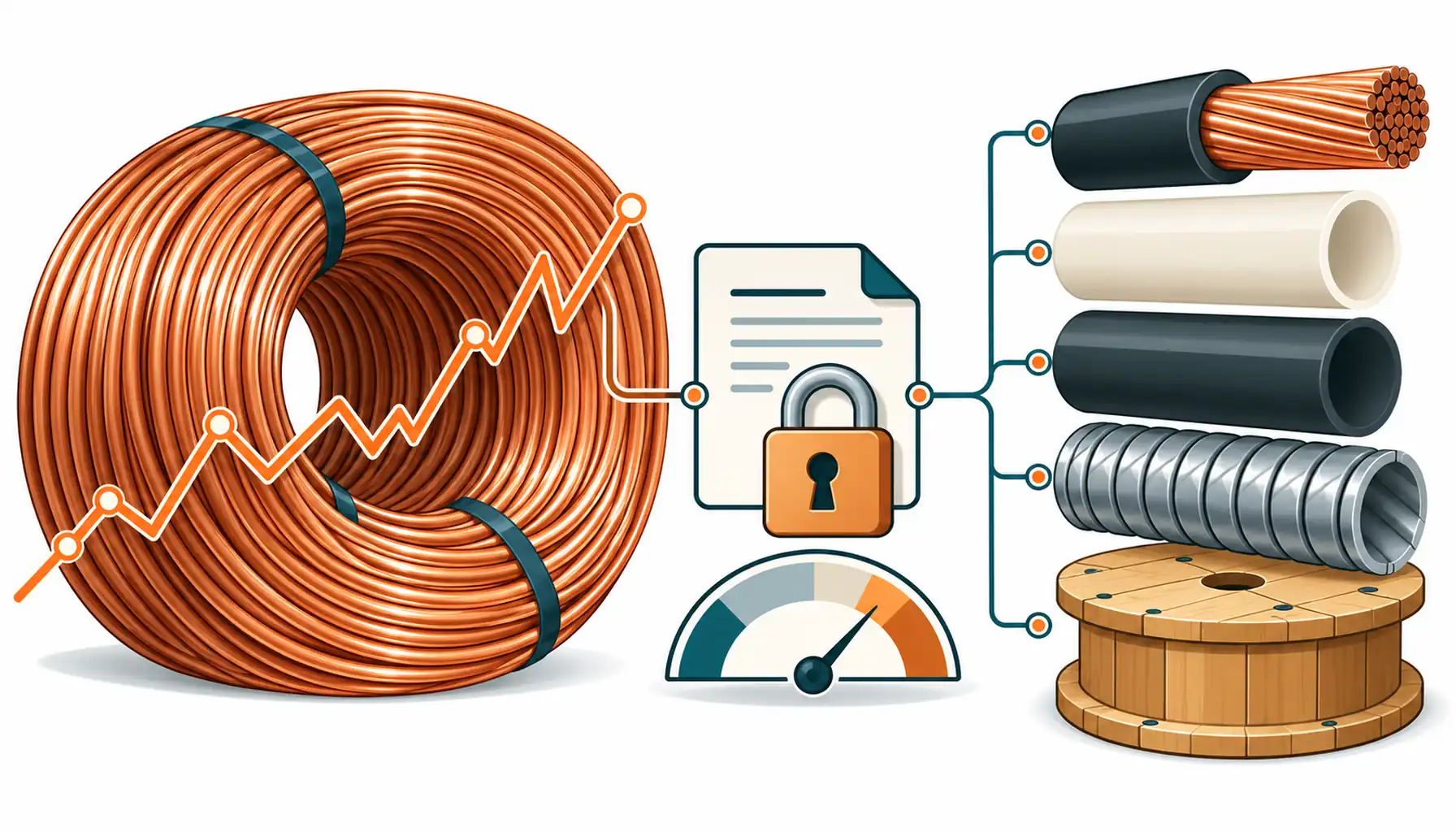
Quick Answer: Copper is roughly half the material cost of a power cable, and its price never sits still — buyers manage it with quote validity windows, copper-linked contracts and staged ordering.
No input moves a cable price like copper. The metal carries the current in nearly every power circuit, it accounts for roughly half the material cost of a typical low-voltage power cable — more in large sections, less in control and instrumentation types — and it trades on exchanges where a week can move the price by amounts that erase a negotiation margin. For procurement teams buying cable across borders, copper volatility is very concrete. It explains why two quotes differ, why a quote expires, and why a contract signed in spring can land in autumn at economics nobody budgeted. Buyers who manage it well don’t try to predict the copper price; they build contracts that work without a prediction. This guide covers how copper reaches the quote, and the mechanisms — validity windows, copper-linked pricing, staged orders — that global buyers use to keep cable procurement rational while the metal moves.
Introduction
The context matters because the demand side is expanding: the global buildout tracked in data center power demand growth pulls conductor at program scale, and AI facilities concentrate the most copper-hungry constructions — large parallel feeders, redundant runs, MV distribution deep into the hall. Rising structural demand under a supply that reacts slowly to mine and smelter cycles is the recipe in which volatility lives. The cable side of the equation is documented in the cable size selection guide: conductor cross-section is the first specification a buyer sets, and it directly sets how much copper — and how much copper risk — every meter carries. Understanding the mechanics is what turns copper from a recurring surprise into a variable you can actually manage.
Why Copper Dominates the Cable Price
The arithmetic is simple, and it doesn’t negotiate. A cable’s copper weight is its conductor cross-section times its length times the density of copper, and the market price of that metal is quoted publicly every trading day. For a large-section power feeder, the conductor alone can be half or more of the finished cable’s material cost; insulation, sheathing, armor and manufacturing share the remainder. Aluminum conductors cut the metal bill dramatically — which is why they dominate long overhead and distribution runs — but data centers specify copper for most power circuits because ampacity, flexibility and termination practice favor it in the hall. Two consequences follow. First, most of a cable quote is really a copper position with manufacturing attached. Second, every week a quote sits unaccepted, the copper inside it drifts — which is why validity windows exist, and why mature buyers read them as risk boundaries rather than seller red tape.
How Volatility Reaches the Buyer
The transmission path has three links. First, the mill: cable makers buy copper cathode or rod against the LME, SHFE or regional benchmarks, and their input cost moves daily. Second, the quote: suppliers cover the drift with validity windows — often 7 to 15 days on copper-heavy constructions — or with explicit surcharge formulas that adjust the metal component when the benchmark moves beyond a band. Third, the contract: orders signed without a metal-price mechanism simply transfer all the risk to one side, and suppliers who cannot hedge it either price a fat buffer or fail mid-production when the metal outruns the contract. The failure modes are documented in international power equipment sourcing mistakes — a supplier caught between a fixed contract price and a rising copper price will be tempted toward thinner conductor, and the buyer who specified 90°C XLPE insulation in good faith per the XLPE cable guide may receive something else entirely. Managing copper is therefore a quality-protection measure, not just a finance measure.
| Component | Share of Material Cost | What Moves It |
|---|---|---|
| Copper conductor | Roughly half for LV power; more at large sections | LME/SHFE benchmark, conductor class and cross-section |
| Insulation and sheath compounds | XLPE/PVC share falls as sections grow | Polyethylene feedstocks, LSZH and flame-retardant grades |
| Armor and screening | Project-dependent, high in direct-buried runs | Steel and aluminum prices, armor type specified |
| Manufacturing and testing | Conversion cost per meter | Run length, test scope, certification amortization |
| Freight and packaging | Drums, ocean or inland legs | Container rates, route and incoterms |
The Buyer's Toolkit: Four Contract Mechanisms
Four mechanisms cover most situations. The fixed-price quote with a short validity window suits spot orders that will be placed immediately: accept inside the window and the price holds; miss it and requote. The copper-linked contract is the workhorse for program volumes: the non-copper part of the price is fixed, and the metal component settles against a named benchmark — LME, SHFE or a domestic spot index — on a named date or date rule, with the formula written into the contract. Staged ordering breaks a multi-phase program into tranches, each priced near its production window, so no tranche carries more than weeks of metal risk. Buffer stocking moves the risk to inventory: buying a phase’s cable early when the metal is favorable, paying storage and capital for the privilege. Sophisticated buyers combine them — copper-linked pricing for the framework, staged releases for each phase, and opportunistic early buys when the market offers a clear position.
Copper-Linked Pricing in Practice
A well-drafted copper-linked clause answers five questions in writing: which benchmark (a named exchange or spot index, not “market price”), which date rule (the fixing on the order date, the production date or the bill-of-lading date), which copper content basis (theoretical weight per the drawing, which both sides can verify), which adjustment band (moves inside the band absorbed, moves beyond it shared or passed through), and which documents prove the fixing. With those five points settled, the mechanism is mechanical rather than negotiable — every invoice follows from a public number and a drawing. Kexingyu Cable Group (KXYE) runs exactly this model on program orders: the non-copper price is fixed at award, the metal component settles against the Yangtze River spot copper benchmark, and the buyer can audit every settlement against the published fixing and the theoretical copper weight of the approved drawing. The effect on the relationship is worth as much as the pricing itself: there is nothing to renegotiate, because the formula already settled it.
| Mechanism | Best When | Watch Out For |
|---|---|---|
| Fixed price, short validity | Spot orders placed within days | Requote drift between budget and PO |
| Copper-linked contract | Program volumes across months | Vague benchmark or missing date rule |
| Staged ordering | Multi-phase builds with known schedule | Later tranches priced into an unknown market |
| Buffer stocking | Favorable metal price, available capital | Storage, capital cost and design-change risk |
When a Fixed Price Is Not the Answer
Two cautions keep the toolkit honest. The first is the too-good fixed price: a quote that promises a six-month firm price on a copper-heavy construction has either hedged expensively and priced the hedge, or has not — and the second case surfaces as a quality problem or a delivery problem, per the pattern in FOB vs CIF responsibility allocation where unclear terms let risk hide between parties. The second is over-hedging a program that is not committed: locking metal on cable whose drawings have not been approved converts price risk into change-order risk. Copper management works when the contract, the schedule and the drawings are aligned; when they’re not, the mechanism that looked cheapest usually turns out to cost the most. For buyers ready to test the approach on a real bill of quantities, the RFQ page accepts specifications with the copper mechanism stated up front.
RFQ Checklist: Copper Terms Lines for the RFQ
Put the market’s questions in writing:
- Copper content basis stated per drawing with theoretical weights
- Named benchmark and fixing date rule for the metal component
- Adjustment band and pass-through formula written into the contract
- Quote validity window stated per construction, not one-size
- Non-copper price fixed at award and auditable
- Staged release quantities aligned with the phase schedule
- Settlement documents defined — fixings, drawings, invoices
Conclusion
Copper volatility isn’t a market condition to wait out; it’s a structural feature of cable procurement that the contract either manages or absorbs. Roughly half a power cable’s material cost moves on public exchanges, and the buyers who stay rational are the ones who fix the non-copper price, name the benchmark, write the date rule and let a public number settle the metal.
Kexingyu Cable Group (KXYE) offers copper-linked program pricing settled against the Yangtze River spot copper benchmark, with the copper basis drawn from the approved drawing and every settlement auditable against published fixings — cable procurement where the metal moves and the relationship stays steady.