Single-Mode vs Multimode Fiber: Selection for Data Center Interconnect
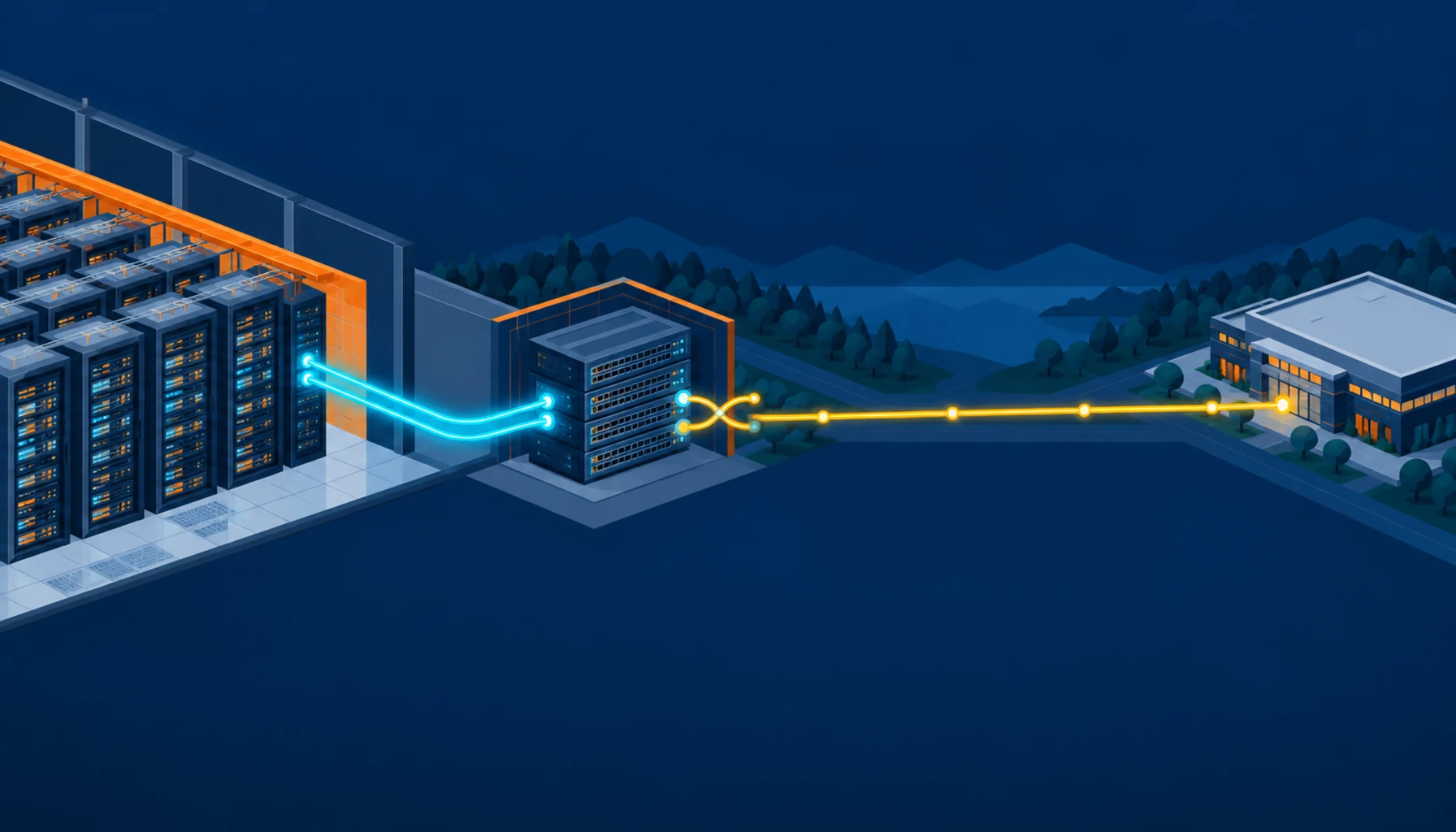
Quick Answer: Multimode (OM4/OM5) wins short runs where cheap transceivers dominate; single-mode (OS2) wins distance and every future speed tier. Modern halls increasingly run single-mode end to end — the split is a cost question per tier.
The single mode vs multimode data center decision is often remembered as glass versus glass, but the real currencies are distance and transceivers: multimode fiber carries light in many paths and pays for it with reach that shrinks as speeds rise, while single-mode carries one path and pays for it with laser transceivers that cost more at a given speed. Every fiber tier in a data hall — the links inside a rack row, the spine between rows, the campus link to a second building — sits somewhere on that trade, and the wrong placement shows up either as reach the glass cannot hold or as transceiver budgets that never needed to be that large. The physics also has a direction: each speed generation erodes multimode’s reach faster than single-mode’s, which is why newly built halls increasingly standardize on single-mode and let WDM multiply its wavelengths. This guide reads the trade tier by tier, with the cost arithmetic that makes the split deliberate.
Introduction
The two glasses differ in how they guide light. Multimode fiber — OM3, OM4, OM5, the aqua and lime jackets — has a wide core, 50 microns, through which light travels in many modes simultaneously; the modes arrive at slightly different times (modal dispersion), which caps how far a given data rate can travel before pulses blur. Its compensation is transceiver economics: VCSEL lasers that are cheap, tolerant and power-efficient, which is why multimode has owned the short-reach tier for decades. Single-mode fiber — OS2, the yellow jacket — has a nine-micron core carrying essentially one mode; dispersion barely scales with distance, so reach extends from hundreds of meters to tens of kilometers at the same data rate. Its cost sits in the transceivers: precision lasers that historically priced at multiples of the multimode equivalent. The decision is therefore a per-tier calculation: link length against transceiver price against the upgrade path each glass offers — read from the components’ own documents with the discipline of the datasheet reading guide, because the reach tables are where the honest numbers live. The tier-by-tier reading:
The Short Tier: Where Multimode Earns Its Keep
Inside the hall — rack row to leaf switch, row to row, the links under about 100 meters — multimode remains a legitimate, budget-rational choice at 10G, 25G and even 100G with parallel optics: OM4 at 100 meters carries 100G over parallel lanes, and OM5 extends the story toward wavelength-division short reach. The economics: multimode transceivers cost a fraction of their single-mode equivalents at the same speed, the patching ecosystem is mature, and the handling tolerances are forgiving in dense panels. The erosion is equally measurable: each speed generation cuts multimode’s reach — 10G OM4 runs 400 meters, 25G runs 100, 100G parallel runs 70 or less — so a hall designed on multimode at one generation may find its glass short of reach at the next. The practical split that survives contact with budgets: multimode for the fixed, short, dense tier where transceiver count is enormous and the speed roadmap is stable; and a hard rule that any link whose length or speed future is uncertain defaults to single-mode, because re-pulling glass costs more than any transceiver saving ever gets back. The rack-density context that makes the short tier enormous — and the power that feeds it — is covered in the rack power distribution comparison.
The Distance Tier: Single-Mode and the Upgrade Path
From the spine outward — hall to hall, building to building, campus edges — single-mode stops being a choice and becomes a boundary: multimode simply does not reach. OS2 carries 10G to 10 kilometers and beyond, 100G over multi-kilometer spans with standard optics, and through wavelength-division multiplexing it becomes many fibers in one — 8, 16, 40 wavelengths on a strand pair, which is how modern interconnect tiers buy capacity without buying trench. The transceiver premium that once argued for multimode everywhere has compressed at the common speeds, and the total-cost crossover now happens earlier every generation: beyond a few hundred meters at current speeds, single-mode’s cheaper long-reach transceivers and intact upgrade path beat multimode’s transceiver savings. The operational argument compounds it: a single glass type end to end means one splicing practice, one test standard, one spare set — an operations simplification that multi-site operators, who manage the same logic across buildings in the multi-site UPS supplier analysis, recognize immediately as a maintenance dividend. The demand trajectory — speeds doubling on the cadence documented in the demand growth analysis — keeps moving the crossover in single-mode’s favor.
| Tier | Typical Reach | Glass Choice |
|---|---|---|
| Rack row to leaf | Under 100 m | Multimode OM4/OM5 or single-mode by roadmap |
| Spine between rows | 100-500 m | Crossover zone — decide by speed roadmap |
| Hall to hall | 500 m - 2 km | Single-mode OS2 |
| Campus and edge | 2 km and beyond | Single-mode OS2, WDM for capacity |
| Interconnect to cloud | Kilometers | Single-mode with the carrier |
| Upgrade rule | Any uncertain future | Default single-mode — re-pulling is the cost |
The Cost Arithmetic Done Honestly
The comparison should be run as a total per link, not a glass price per meter. Fiber cost: single-mode and multimode cable differ modestly; the glass is rarely the decider. Transceivers: the real lever — at 10G the multimode optic is cheap and the single-mode optic costs more; at 25G and 100G the gap narrows and the parallel-lane optics shift the arithmetic again; the honest comparison prices the actual transceiver list per tier at the target speed. Patching and testing: both glasses terminate with mature ecosystems, though single-mode splicing and testing demand tighter discipline. Future capacity: WDM on single-mode is capacity without construction — the strand already buried can multiply its wavelengths for the cost of optics — while multimode’s upgrade path runs out at the reach table. Run the arithmetic per tier and most halls converge on the split: multimode in the fixed short tier where its transceivers dominate, single-mode from the spine out where reach and upgrade headroom dominate, and the regional buildout context — where interconnect distances and construction costs shape the choice — recurs in the Southeast Asia data center power review, where the fiber and power plans are drawn on the same maps.
When Multimode Everywhere Is Not the Answer
The multimode-everywhere instinct fails on two grounds. Reach: at current speeds, multimode’s ceiling has fallen into the range the spine tier actually occupies, so the glass runs out mid-plan and the “saving” becomes a mixed-glass estate with two splicing practices and two spare inventories — the worst of both. Upgrade: every future generation shortens multimode’s reach again, while single-mode’s response to a speed generation is new transceivers on existing glass. The symmetric error — single-mode everywhere including the densest short tier — is milder: it costs transceiver premium on hundreds of links, but it buys a uniform estate, and at compressed optic prices it is increasingly defensible. The honest method stays per-tier: measure the lengths, price the transceivers at the target speed, project one speed generation forward, and let the crossover — not the habit — place each glass. The full cable plan where these glasses live, copper and fiber together, is assembled in the data center power hub.
| Factor | Multimode OM4/OM5 | Single-Mode OS2 |
|---|---|---|
| Core and modes | 50 µm, many modes | 9 µm, one mode |
| Reach at speed | Shrinks each generation | Kilometers, stable |
| Transceiver cost | Low — VCSEL economics | Higher, compressing |
| Upgrade path | Reach-limited per generation | WDM multiplies existing glass |
| Best tier | Fixed short-reach, dense | Spine, campus, interconnect |
| Estate effect | Mixed-glass operations if split late | One practice, one spare set |
RFQ Checklist: Fiber Selection Lines for the RFQ
Put the tier map in writing:
- Link lengths measured per tier, not assumed
- Glass per tier stated: OM4/OM5 short, OS2 distance
- Transceivers priced per tier at the target speed
- One speed generation projected in the reach check
- WDM capacity planned on single-mode spans
- Connector and polish grades stated per panel
- Test requirements per glass at acceptance
Conclusion
Single-mode versus multimode looks like a glass preference but is really a per-tier cost calculation: multimode’s cheap transceivers win the fixed short tier, single-mode’s reach and WDM headroom win everything beyond it — and the boundary moves toward single-mode with every speed generation. Measure the lengths, price the optics, project one generation forward, and place each glass where its economics actually win.
Kexingyu Cable Group (KXYE) manufactures both glasses to grade: OS2 single-mode and OM4/OM5 multimode in tight-buffered indoor, armored outdoor and pre-terminated trunk constructions, with the fiber class stated on every drum and datasheet — glass chosen by tier, delivered to specification.