Flex Testing: How Bend Cycle Testing Actually Works in the Lab
Quick Answer: Bend cycle testing runs a cable sample through a rig that bends it to a fixed radius over a fixed travel, at a fixed speed, until failure or a target count, and the fine print, radius, travel, speed, failure definition, decides whether the number means anything.
Every high-flex cable datasheet carries a number that looks like a promise: millions of cycles at some bend radius. The number is only as good as the rig behind it, and rigs differ more than marketing admits. Two suppliers quoting twenty million cycles may be testing at different radii, different travel, different speeds and different definitions of failure, which makes the comparison between them roughly meaningless until the fine print comes out. This guide walks through how bend cycle testing is actually done: the common rig types, the parameters that shape the result, how a test is run and judged, and how a buyer can read a flex test report well enough to ask the two or three questions that separate data from decoration.
Introduction
Flex testing exists because cable failure in motion is a fatigue process, not an event. Conductors work-harden and break strand by strand, insulation cracks under repeated deformation, jackets abrade, and the cable gives out at the point where its construction concentrates stress. A static bend test cannot see any of that, and neither can the electrical factory tests that verify a new cable, which is why dynamic testing grew into its own discipline with its own rigs and its own vocabulary. The failure mechanisms the tests are chasing are cataloged in the guide to common cable failure causes, and the rigs are essentially machines for reproducing those mechanisms on a schedule a lab can watch.
This guide stays on the buyer’s side of the bench: what the rigs do, what the parameters mean, and how to read the report. It deliberately does not rank constructions, because that is the datasheet’s job; it gives you the tools to check whether the datasheet’s number deserves its font size.
The Rigs: Three Ways to Bend a Cable Repeatedly
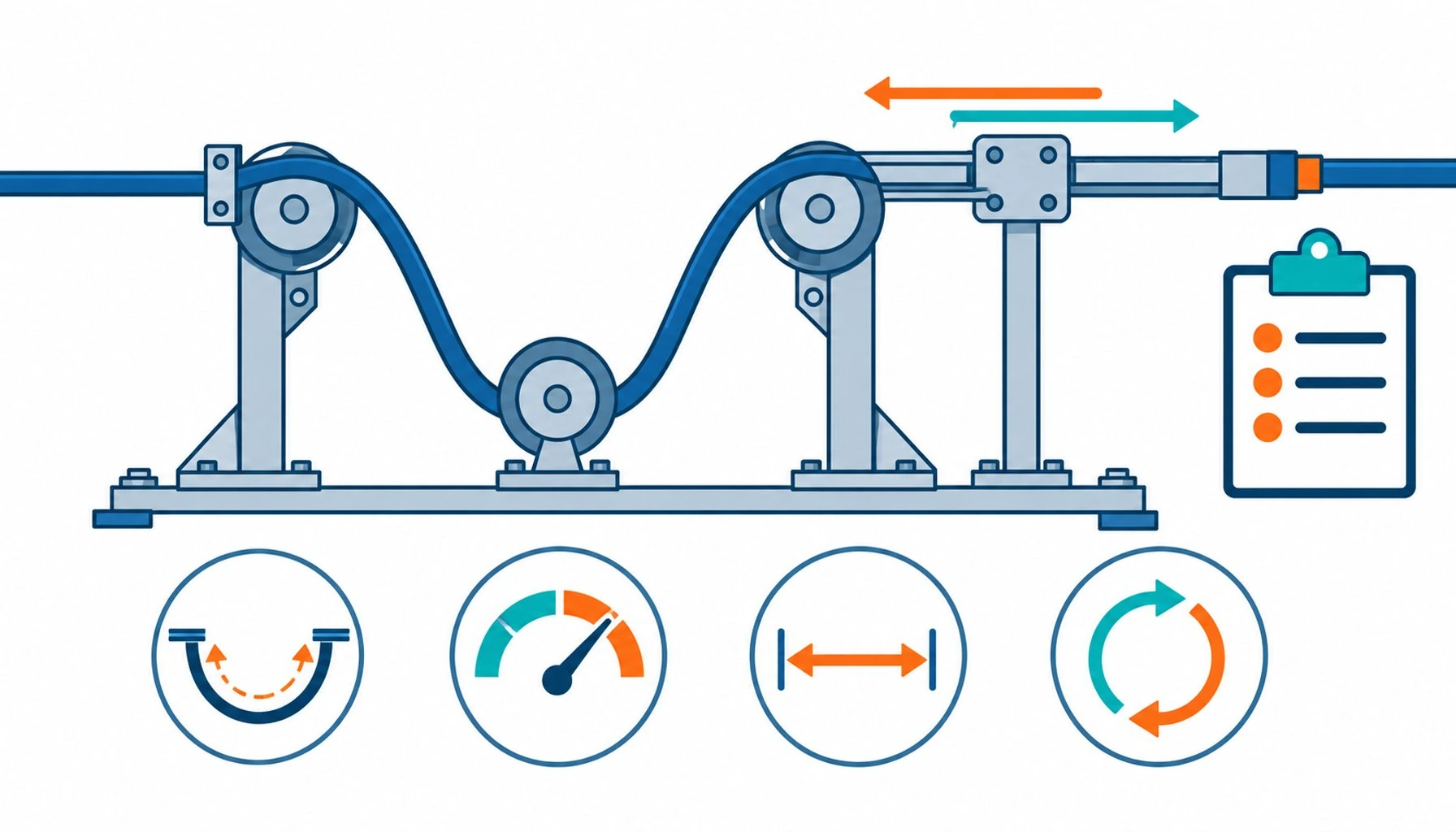
The workhorse is the drag chain simulator: a short length of real chain, or a rig reproducing a chain’s worst bend, with the cable traveling back and forth through it while power and signals stay live. It reproduces the dominant real-world duty, a repeated U-bend with the cable’s own weight and torsion along the travel, and it is the rig most high-flex ratings trace back to. The rolling flex rig bends the cable around a series of rollers in a rolling motion, which suits cables whose duty is continuous bending rather than linear travel, such as robot arm dress packs. The torsion rig adds twist, rotating one end of the cable against the other through each cycle, which is the only honest test for cables that must bend and rotate together.
Each rig type produces numbers that only make sense on the same rig type. A drag chain rating does not transfer to a torsion duty, and a rolling flex number says little about a chain application. The first question for any flex rating is therefore not how many cycles but on what rig.
The Parameters That Decide the Result
Four parameters dominate. Bend radius is the loudest: fatigue life scales steeply with radius, so a rating at a generous radius collapses when the application bends tighter. Halving the radius does not halve the life; it can cut it by an order of magnitude. Travel length and speed shape the duty per cycle: longer travel with higher speeds adds inertia, torsion and heat, and two tests at the same radius can differ sharply at different speeds. The load matters too, a cable carrying its own weight flexes differently from one dragging a heavy cross-section, and electrical loading adds heat that softens insulation exactly where it bends.
The fifth parameter is the least printed and the most important: the failure definition. Some tests run until electrical failure, a broken conductor or a short. Others stop at visual jacket damage, a resistance drift threshold, or signal integrity limits on data pairs. A twenty-million-cycle rating that counts a cracked jacket as a pass means something different from a ten-million-cycle rating that stops at the first conductor anomaly, and the first rating is not the better cable.
| Parameter | What it controls | Why it matters | What to compare across suppliers |
|---|---|---|---|
| Bend radius | The severity of each bend cycle | Fatigue life scales steeply; small radius differences change results by orders of magnitude | Exact radius of the rating, against your application's real minimum |
| Rig type | The duty reproduced | Chain, rolling and torsion rigs model different duties; numbers do not transfer | Rig type against the application's motion pattern |
| Travel and speed | The duty per cycle, inertia and heat | Same radius at different speeds produces different lives | Speed and travel stated, not just cycles |
| Load and environment | Weight, cross-section, temperature | Heavier and hotter duty shortens life at identical bending | Whether the test included representative load |
| Failure definition | When the test counts as ended | Electrical failure, signal drift and jacket damage are different end points | The exact end point behind the headline number |
How a Test Actually Runs
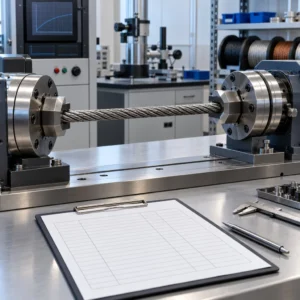
A credible run starts with a representative sample, full production construction rather than a hand-made prototype, conditioned at the test temperature, and installed on the rig at the stated radius with the stated travel. Monitoring runs continuously: continuity and resistance on power conductors, signal integrity on data pairs, and periodic visual inspection of the jacket at the bend zone. The test ends at the defined failure or the target count, whichever comes first, and a credible report records what happened along the way, not only the end number. Interruptions, temperature excursions and sample replacements belong in the report; a smooth round number with no history behind it is a marketing artifact, not a test result.
Repetition matters more than length. One sample to a very high count tells you less than several samples to the same count, because fatigue scatters, and a single lucky sample can double a headline. Suppliers who test in small batches and report the batch behavior are showing you engineering; suppliers who show one best-case number are showing you a calendar, and the buying questions that surface the difference are covered in the guide to vetting equipment manufacturers.
| Report line | What it tells you | The trap to check |
|---|---|---|
| Cycles and radius | The headline endurance at the stated severity | Radius rounded up relative to your application's routing |
| Rig description | Which duty the number models | Chain rating quoted for a torsion or robotic duty |
| Speed and travel | Duty intensity per cycle | Missing or stated only as a range |
| Failure definition | What ended the test | Jacket-only end point presented as electrical endurance |
| Sample count | How much scatter the number carries | A single sample behind a very round number |
| Monitoring record | Evidence the test was watched, not assumed | No interim data between start and finish |
Turning Test Numbers Into a Duty Specification
The point of reading reports is to close the gap between the datasheet and your machine. Start from the application: the tightest radius on any axis, the cycle count per shift, the speed, the load and the environment. Then compare against the test conditions on the same five parameters, and apply the comparison honestly: a rating tested at a larger radius than your routing does not cover you, and a rating tested slower than your duty is unproven at your speed. Where the conditions match, the number transfers; where they do not, ask the supplier for a test at your conditions, which reputable makers of high-flex cable will do or will have already done for similar duty. The acceptance culture that surrounds this kind of evidence on delivered equipment is treated in the guide to factory acceptance testing, and the same logic applies to cable samples.
When Flex Testing Is Not the Answer
Honest limits: a rig is a model, and models leave things out. Real installations add installation damage, edge abrasion at poor-radius transitions, chemical exposure and operator behavior that no rig reproduces, which is why two machines with identical cable and duty can see different lives. Torsion combined with high speed and tight radius is a corner where lab data thins out, and very long travel applications stress weight and tension behaviors the rigs approximate poorly. The honest use of test data is as a screening tool and a common language with the supplier, not as a guarantee; the guarantee comes from matching the construction to the duty with margin, and from the installation discipline that gives good cable its chance.
RFQ Checklist: Asking for Flex Data That Means Something
Attach these items to the RFQ:
- Duty statement: minimum bend radius, cycles per shift, travel speed and load per moving axis
- Rig requirement: test data on the rig type matching the duty, chain, rolling or torsion
- Failure definition: specify electrical or signal end points for the rating you will accept
- Sample basis: batch-tested data with scatter noted, not single-sample best cases
- Monitoring evidence: interim records available, not just the final count
- Application match: supplier confirmation that test conditions cover your routing and speed
The broader discipline of reading supplier documents critically is treated in the guide to reading equipment datasheets, and flex ratings are the classic case where the fine print outranks the headline.
Conclusion
Bend cycle testing is the only laboratory window into how a cable dies in motion, and it works when five parameters, rig, radius, speed and travel, load, and failure definition, are stated and matched to the application. Buyers who read the fine print before the headline, and who ask for data at their own duty, buy cables that arrive with evidence instead of adjectives. Buyers who compare big numbers across different rigs buy marketing.
Kexingyu Cable Group (KXYE) supplies high-flex cable with test data stated the way this guide reads: rig, radius, speed, load and end point, all on the table. Send your motion duty through the RFQ page, and we will quote against the conditions your cable will actually see.