Abrasion and Notch Testing for Cable Jackets: Methods and Pass Criteria
Quick Answer: Abrasion tests rub cable jackets against standardized surfaces until damage appears, notch tests start a cut and see how far it spreads under bending, and together they measure the two ways sheaths actually die on machines: slow wear and one sharp edge.
A cable jacket leads a thankless life. It drags across tray edges, collects swarf, rubs against its neighbors in the chain, and waits for the day a machined burr or a dropped tool gives it a cut. Jacket testing therefore comes in two flavors that buyers often blur: abrasion resistance, which measures how the surface survives rubbing, and notch behavior, which measures how a small cut grows into a failure. They are different materials properties, they are tested differently, and a sheath can score well on one and poorly on the other. This guide walks the common methods, what the pass criteria mean, and how to combine the two results into a realistic judgment about how a sheath will live on your machine.
Introduction
The reason two tests exist is that jacket failure has two distinct mechanisms. Wear is gradual: every cycle removes a little material, and the failure shows up as thinning, scuffing and eventual exposure of what lies beneath. Notch failure is sudden in effect: a sharp object or edge creates a stress concentration, and repeated bending drives the cut deeper until it penetrates. Wear tests model the first mechanism, notch tests model the second, and machine reality delivers both, swarf and tray edges and neighbor friction on one side, one bad burr on a fixture on the other. The broader catalog of how cables actually die in service is treated in the guide to common cable failure causes, and jacket damage is one of its most preventable chapters.
Jacket material choice is the first lever for both properties, and the compound families most often compared for wear duty are discussed in the material guides, including the comparison of XLPE and PVC insulation families and the PUR sheaths that dominate high-abrasion specifications.
Abrasion Testing: Rubbing a Jacket Until It Complains
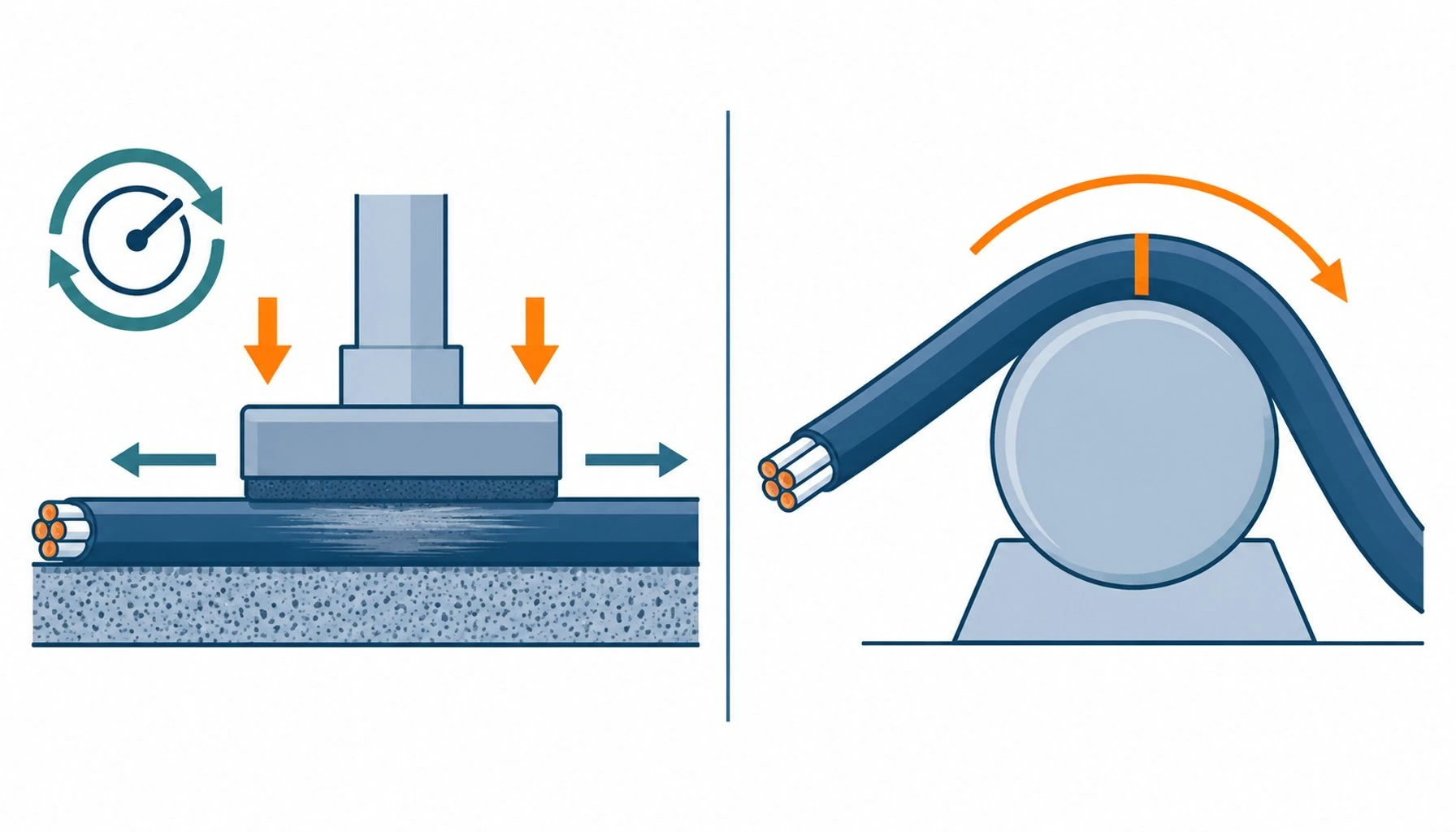
Abrasion methods share a logic: press the jacket against a defined abrasive surface, move it in a defined pattern, and count or measure until damage. Implementations differ across the standards landscape, rotating drum rigs, reciprocating rub heads and weighted stroke machines among them, but the outputs converge on either the number of cycles to a defined damage state or the depth of wear after a defined number of cycles. The critical phrase is defined damage: some procedures call the test at first base-material visibility, others at jacket breakthrough, others at a measured thinning percentage. Two abrasion numbers are only comparable when the damage definition matches, which makes the fine print, once again, the place where claims live or die.
What abrasion results predict is fair wear performance: cable moving against tray liners, cable in bundles where neighbors rub, drag chain runs with rough return paths. What they do not predict is the sharp-edge scenario, because wear resistance and cut resistance are related but distinct material properties, and the second is what notch testing exists to measure.
Notch Testing: One Cut, Repeatedly Bent
Notch methods start where wear ends: with the damage already done. A standardized cut is made in the jacket of a specimen, often to a defined fraction of the wall thickness, and the specimen is then bent repeatedly around a mandrel. The measurement is whether the cut propagates through the remaining wall, and after how many cycles. The test models the machine’s most common sharp-edge story: a burr, a machining mark, a tray edge or a tool nick, followed by the bending that turns it into a hole. A compound with good notch behavior arrests small cuts; a compound with poor notch behavior lets a scratch become a failure in a shift.
The practical asymmetry matters for buyers: abrasion resistance is a bulk property that formulation can buy, while notch resistance often tracks the compound’s toughness and elasticity more than its hardness. This is why a sheath can be marketed on abrasion numbers while failing quietly at the first cut, and why serious specifications ask for both.
| Test family | Method in brief | What it measures | What it predicts |
|---|---|---|---|
| Abrasion, cycle-based | Rub jacket against defined abrasive under load until damage state | Cycles to defined damage | Survival against tray edges, bundling and route friction |
| Abrasion, depth-based | Rub for a fixed cycle count, measure wear | Thinning or depth after fixed cycles | Rate of material loss in chronic rubbing duty |
| Notch propagation | Standardized cut, then repeated bending around a mandrel | Whether and when the cut penetrates | Survival after burrs, tool nicks and sharp edges |
| Cut-through variants | Press a blade or edge through the jacket under load | Force to penetrate | Relative sharp-edge tolerance at installation and in service |
Reading Pass Criteria Honestly
Pass criteria in this territory come in three shapes, and each invites a different misread. Cycle counts to damage sound absolute but depend entirely on the rig and load; compare them only within the same method. Depth-after-cycle results sound scientific but hide the load and abrasive spec; a gentle rub produces flattering numbers for almost any compound. Penetration thresholds, such as a cut that must not reach the conductor side within a cycle count, are the most service-relevant shape, because they speak the machine’s language: survive a real cut under real bending. When a datasheet quotes one number without its method, load or damage definition, the honest response is to ask for the test record, and the reading discipline for such documents is covered in the guide to reading equipment datasheets.
| Claim | What it might mean | Question to ask |
|---|---|---|
| High abrasion cycle count | Strong wear resistance on the stated rig | Which method, load and damage definition? |
| Wear depth after fixed cycles | Measured material loss rate | What load and abrasive surface were used? |
| Notch test passed | Cuts do not propagate under bending | Cut depth fraction and mandrel radius, stated? |
| "Highly abrasion resistant" with no data | Marketing adjective | Request the test record with conditions |
| No notch data at all | The sharp-edge question is unanswered | Ask for notch propagation results before drag chain duty |
Beyond the Test: Installation Still Decides
Even the best jacket numbers inherit the installation. A notch-resistant sheath run against a fresh-machined edge still loses eventually; an abrasion champion dragged over a steel lip every cycle is being tested by the machine, not the lab. The mitigation is routing and protection: liners on rough surfaces, generous radii at transitions, separation from sharp media, and inspection of exposed runs during early service. Suppliers with real machine experience will discuss routing without being asked, because they know the jacket test score is a margin, not a license; the vetting questions that surface that experience are covered in the guide to vetting equipment manufacturers. And for buyers assembling a complete acceptance file on a delivered cable, the guide to factory acceptance testing frames where jacket data belongs among the other evidence.
When Jacket Testing Is Not the Answer
Honest limits: jacket tests model surfaces and cuts, not whole environments. They do not cover chemical attack, which oil and coolant methods address; they do not cover thermal degradation; and they say nothing about the construction inside, a flawless sheath on a flex-hostile construction still fails in the chain. Abrasion and notch results also transfer poorly between laboratories unless the method, load and damage definition match, which limits their use as cross-supplier comparisons. Their honest role is screening and margin evidence: proof that the sheath has a fair buffer against the wear and the sharp edge it will certainly meet.
RFQ Checklist: Jacket Durability Requirements on a Cable RFQ
Attach these items to the RFQ:
- Route description: surfaces the jacket contacts, with the harshest edges and media named
- Abrasion evidence: test method, load and damage definition stated with the cycle result
- Notch evidence: propagation results for bending duty, with cut depth and mandrel radius
- Compound identification: sheath material by type, with the role of any blends explained
- Combined duty: abrasion plus oil plus flex considered together, accepted in writing
- Inspection plan: checks on exposed runs during early service, before the margin is spent
Conclusion
Jacket durability has two faces, and the tests keep them separate on purpose: abrasion methods measure how a sheath wears down, notch methods measure how it fails from one bad cut. Buyers who ask for both, with methods and damage definitions attached, buy jackets with real margins. Buyers who accept an adjective buy the first sharp edge on the machine a story about what went wrong.
Kexingyu Cable Group (KXYE) supplies machine cable with jacket data stated both ways, abrasion and notch, and routing advice that keeps the margins intact. Send your machine’s worst route through the RFQ page, and we will quote the sheath against the edges it will actually meet.