Cold Flex Testing: Why "Flexible at -40°C" Needs Proof
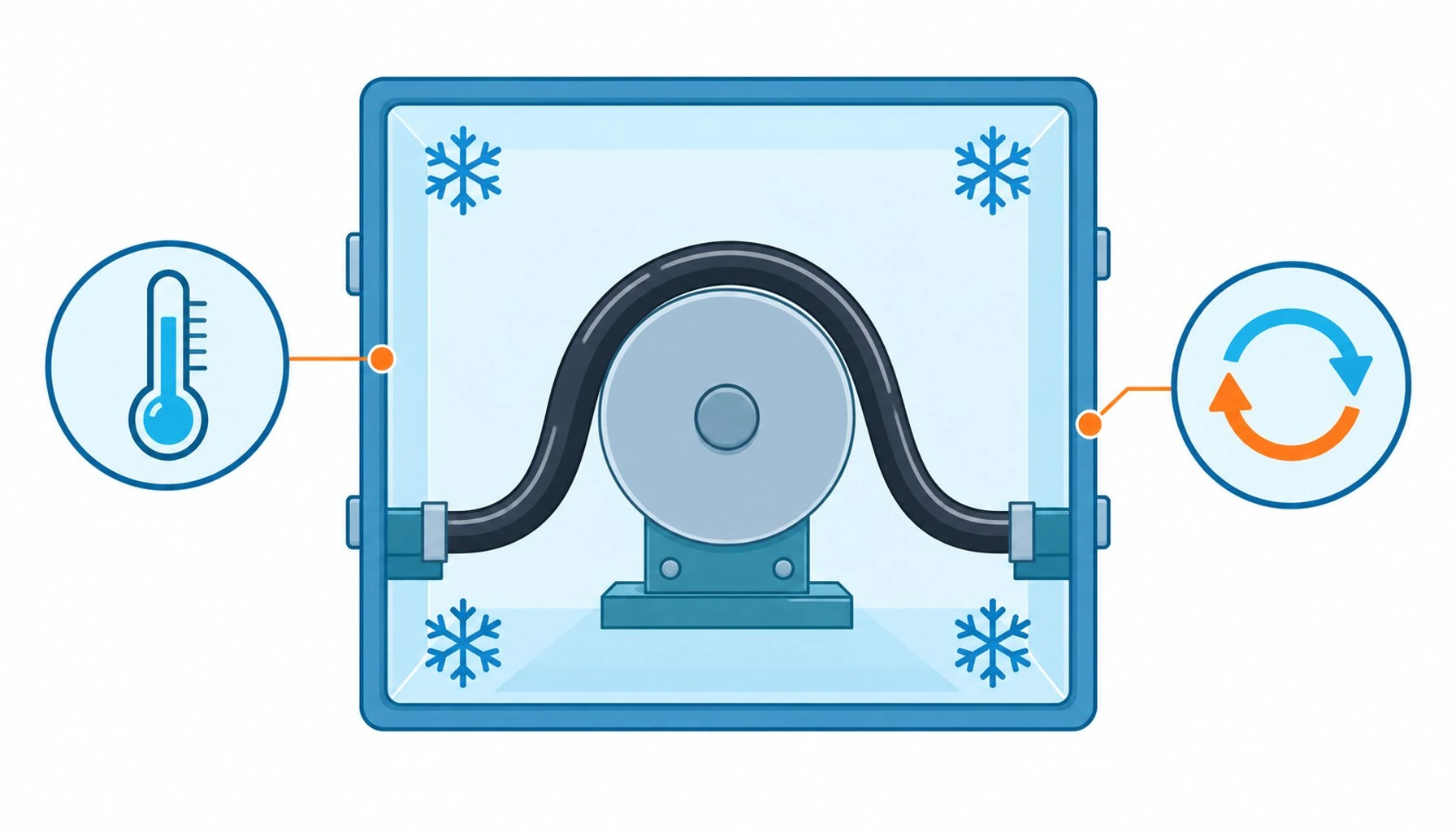
Quick Answer: A -40°C flexibility claim means the compound passed a cold bend or cold impact test at that temperature, not that it will survive motion there for years, and the difference between those two statements is exactly what cold flex testing exists to measure.
Low-temperature flexibility is one of the most quoted, least examined claims in cable purchasing. Cold rooms, outdoor automation, arctic equipment and unheated logistics facilities all need cables that bend at temperatures where ordinary compounds turn to plastic pipe, and datasheets answer with confident numbers. The numbers are real, but they describe specific tests with specific meanings, and the distance between “bent without cracking, once, at -40” and “moved through millions of cycles at -40” is the distance between many a satisfied purchase and many a frozen failure. This guide walks how cold testing actually works, what each test promises, and how to buy a cable that genuinely works where the thermometer reads lower than most engineers’ patience.
Introduction
Cold changes cable materials in a way heat does not. Compounds that are soft and rubbery at room temperature stiffen as temperature falls, because their polymer chains lose mobility; at some point each compound crosses from flexible toward brittle, and the crossing is gradual but unforgiving. Cable applications care at two moments: at installation, when the cable must be pulled and bent into place, and in service, when a moving axis asks the same question continuously. A compound that passes the first and fails the second produces the classic cold-room failure, a cable installed successfully in a thaw, run for months, and cracked at the bend after a deep freeze. The failure mechanisms at play are part of the broader catalog in the guide to common cable failure causes, and cold cracking is among the least dramatic and most avoidable.
The Standard Cold Tests: What Each One Measures
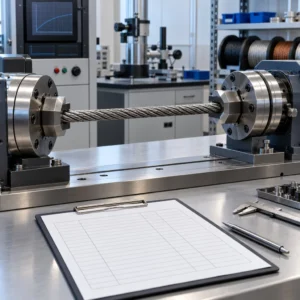
The low-temperature test family contains three workhorses. The cold bend test conditions a specimen at the target temperature, then wraps it around a mandrel, typically within seconds of removal from the cold chamber; the pass is no cracking visible at inspection. The cold elongation test stretches a cold specimen and measures whether it tolerates defined elongation without failure. The cold impact test drops a weighted striker on a conditioned specimen and checks for damage. Each is a snapshot: the material was flexible enough, once, at that temperature, to survive that single deformation. That is a real and useful result, it screens out compounds that would crack on the first cold morning, but it is a screening result, not a duty rating.
The gap between snapshot and duty is where the honest suppliers differ from the comfortable ones. A cable rated by cold bend alone has proven installation flexibility; a supplier who additionally runs repeated bending at temperature, or who can show flex test data at low temperature, has addressed the service question. The two claims look identical on a datasheet line and differ completely on a cold-room floor.
| Test | Method in brief | What it proves | What it does not |
|---|---|---|---|
| Cold bend | Wrap the cold specimen around a mandrel, inspect | No cracking at one installation-grade bend | Does not prove repeated motion survives |
| Cold elongation | Stretch the cold specimen to a defined elongation | Toughness under tensile deformation when cold | Does not model bend cycles |
| Cold impact | Strike the cold specimen with a weighted striker | Resistance to mechanical shock when cold | Does not rate flexing or torsion |
| Repeated cold bending | Cycle bending at low temperature until failure or target | Service-grade flexibility at temperature | Rarely quoted; usually must be requested |
| Brittleness point | Find the temperature where impact cracking begins | Material's stiffening threshold | A material property, not a cable duty rating |
What a -40°C Rating Does and Does Not Promise
Read precisely, a temperature rating on a datasheet states the floor at which the cable passed its referenced cold test, and nothing more automatic follows. It does not state that the cable survives motion at that temperature, that its bend radius holds at temperature, that its jackets and insulation age gracefully through cold-warm cycles, or that the rating applies to every layer of the cable, some cables carry a cold-rated sheath over a filler and insulation package with narrower cold tolerance. It also says nothing about transition conditions, the condensation and ice that follow a thaw, which stress terminations and connectors more than the cable itself. None of this makes the rating meaningless; it makes the rating the opening question rather than the closing one.
The compound families used for cold service, TPE-based sheaths and certain rubbers among them, bring the property along with trade-offs in abrasion and oil behavior, and the material comparisons in the guide to XLPE versus PVC insulation give the broader context. The questions below turn the rating into a buying screen, and the reading discipline behind them is treated in the guide to reading equipment datasheets.
| Question | Why it matters | What a good answer looks like |
|---|---|---|
| Which cold test backs the rating? | Bend, elongation and impact prove different things | The test named, with temperature and conditions |
| Does flex data exist at low temperature? | Motion duty is the service question, not the snapshot | Repeated bending data at or below the service temperature |
| Is the rating per layer or overall? | A cold sheath over warm-limited layers is a trap | Rating covers insulation, sheath and construction |
| What is the bend radius at temperature? | Cold compounds tolerate less bending | A stated cold bend radius, usually larger than room temperature |
| How does the cable handle cold-warm cycling? | Real freezers thaw; condensation finds terminations | Cycling behavior addressed or connectors and glands specified |
Where Cold Cables Actually Work: The Applications
The demand comes from a recognizable set. Cold storage and food logistics, where cables ride moving doors, transfer cars and automated storage systems through deep-freeze aisles. Outdoor automation, where gantries, stacking cranes and rooftop equipment see winter unheated. Cold-climate industry, from Scandinavian and Canadian plants to high-altitude operations, where the cold season is simply part of the duty cycle. And transport equipment, refrigerated trailers and cold-chain machinery, where vibration and cold arrive together. Each application combines cold with motion, which is why the repeated-bending question matters in all of them, and each adds its own companions, condensation in food logistics, wind and ice loading outdoors, abrasion in storage systems. The acceptance culture that verifies delivered equipment in its real environment is treated in the guide to factory acceptance testing, and cold-service cables deserve exactly that verification.
When Cold Ratings Are Not the Answer
Honest limits: a cold rating is a material snapshot, not a duty warranty, and it does not substitute for flex data, oil data or construction sense. It does not cover the whole cable unless stated per layer, and it does not survive wishful thinking about bend radius, cold compounds need more radius, and the routing that ignores this spends the rating’s margin in a week. Where service temperatures approach the rating’s floor, the honest specification asks for application-side evidence, flex testing at temperature or supplier experience in comparable installations, and the vetting questions that extract such evidence are covered in the guide to vetting equipment manufacturers. Cold performance, like every performance, is bought with evidence or paid for in failures.
RFQ Checklist: Cold Service Requirements on a Cable RFQ
Attach these items to the RFQ:
- Temperature profile: minimum service temperature, dwell times and cycling pattern
- Motion duty: axes that move in the cold, with cycle counts and radii
- Rating basis: cold test named per layer, with the referenced conditions
- Cold flex evidence: repeated bending data at temperature for moving axes
- Companions: oil, abrasion and condensation conditions in the same environment
- Installation note: cold bend radius and handling rules for installation season
Conclusion
Cold flex testing exists because “flexible at -40” is a claim with a test behind it, and the test is a snapshot, not a service history. Buyers who ask which cold test backs the rating, whether flex data exists at temperature and whether the rating covers every layer buy cables that work through the deep freeze; buyers who read the number alone buy the first cold morning a lesson about what the fine print was for.
Kexingyu Cable Group (KXYE) supplies cold-rated machine cable with the tests named and the flex evidence attached, rated per layer and stated plainly. Send your cold-service duty through the RFQ page, and we will quote the cable against the thermometer it will actually meet.