Japan: Robot Imports and Cable Expectations in the Home Market of FANUC
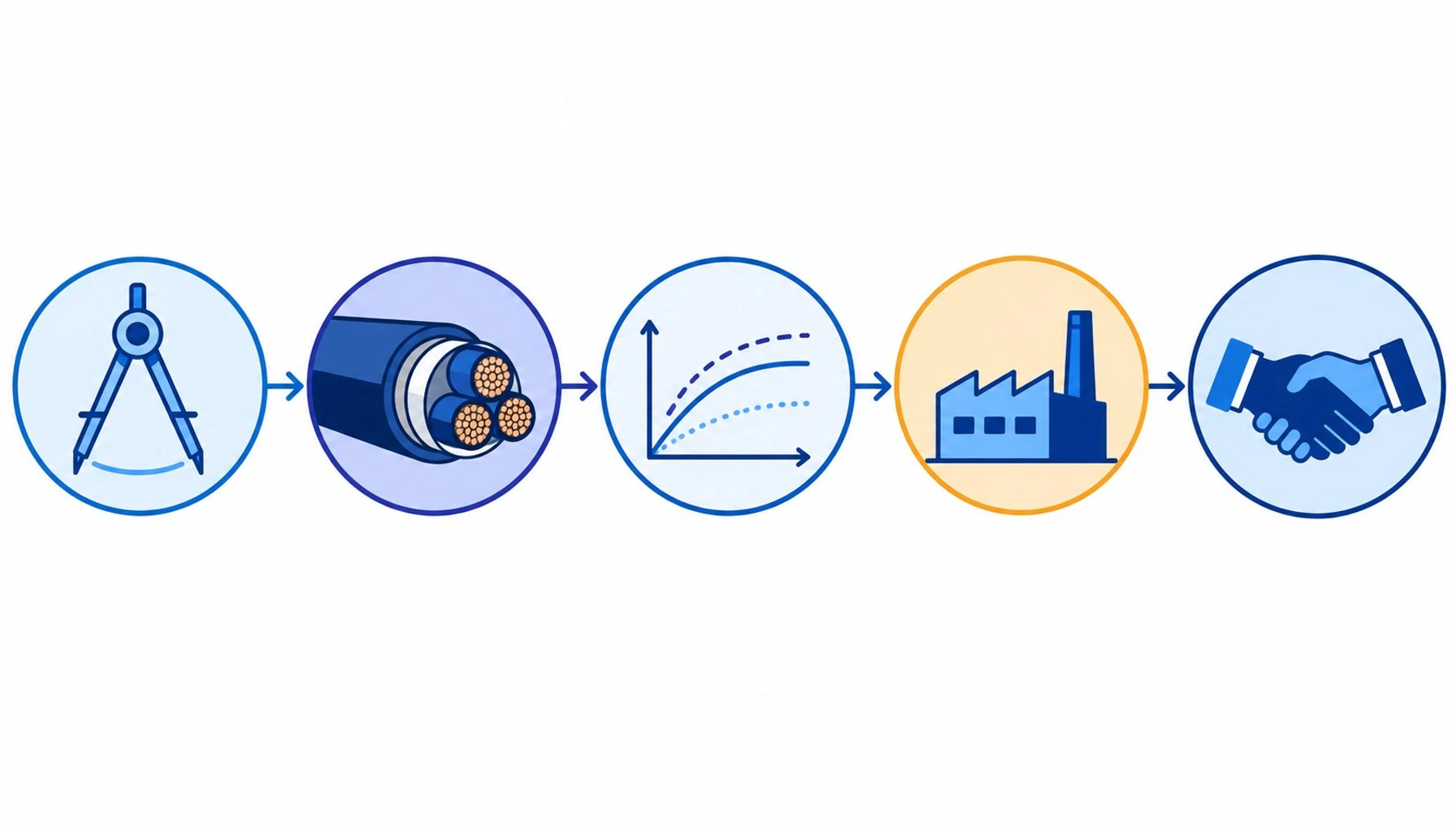
Quick Answer: Japan does not license the cable inside a machine, so the barrier is not a certificate. It is a specification sheet, and the suppliers who answer it precisely are the ones who win the business.
Japan is the home market of the industrial robot industry, and it is built on density rather than size. The country ranks fourth in the world for robot density with 446 installations per 10,000 manufacturing employees, growing about five percent a year since 2019, and it holds the second-largest operational stock of robots anywhere. Its builders supply the world, and its factories buy from everyone. What surprises suppliers arriving for the first time is that none of this translates into a certification regime for machine wiring. The gate is commercial, and it is guarded by engineers with drawings.
Introduction
Nothing in Japanese practice requires a general pre-market approval for industrial machinery, and cable used inside a machine is not a universally certified category. What exists is a safety regime for electrical appliances and materials that covers defined products, including cords and plugs, and a body of national industrial standards that appear in specifications alongside company standards. Above both sits the customer’s own engineering, which is where the real requirement lives.
That structure has a consequence suppliers underestimate. A certificate that satisfies a purchasing department somewhere else in Asia will not move a Japanese project forward, because the question being asked is not whether the cable is certified but whether it matches the specification, dimension by dimension, with documentation the receiving engineer can file. The evidence a buyer needs for this kind of qualification is close to what an incoming inspection programme would demand, as set out in the guide to reading technical documentation.
The Market That Writes Its Own Specification
Japanese machine builders and their tier-one customers work from drawings. A cable specification typically names the construction, the conductor class, the insulation and sheath compounds, the shield arrangement, the dimensional tolerances, the print legend and the packaging. It references national standards where they exist and company standards where they do not. Responding to it is a document exercise before it is a manufacturing one, and a supplier who returns a catalogue page instead of a point-by-point response is finished before the price is discussed.
This is also a market with long supplier relationships and correspondingly high switching costs. Qualification takes time, often across a trial order and a period of monitoring, and once a supplier is approved the relationship tends to persist for years. For a new entrant the implication is patience: the first order is a qualification exercise, and treating it as a profit opportunity is how a promising introduction stalls.
What Is Actually Regulated
The regulatory surface is narrower than most exporters expect, which is precisely why it gets misread in both directions. Some suppliers assume nothing applies and ship without documentation. Others assume everything applies and buy certification they do not need. The table sets out where the obligations genuinely land, and the wider set of certificates a cable project accumulates market by market is surveyed in the guide to cable certification checklists.
| Requirement | Scope | How it touches cable | Evidence expected |
|---|---|---|---|
| Electrical appliance safety regime | Defined products including cords, plugs and cord sets | Covers what connects to the supply, generally not the wiring inside a machine | Conformity inspection and marking for products in the specified scope |
| National industrial standards | Referenced by customer and company specifications | Fix construction details, test methods and marking practice | Test data answered against the standard named in the specification |
| Customer specification and drawing package | The buyer's own engineering | The operating requirement for dimensions, materials, shield and print | A point-by-point compliance response with measured values |
| Machinery safety practice | The machine as a system | Sets expectations for safety-related circuit wiring | Design documentation and construction data for those circuits |
| Substance and material declarations | Customer and onward export requirements | Restricted materials and material identity in each compound | Declarations with supporting analytical data |
| Quality system and traceability | Production | Batch records and material certificates behind each delivery | Audit evidence and lot-linked documentation |
Two Grid Frequencies and a 200 V Industrial Norm
Japan runs on two supply frequencies, with the eastern region at 50 Hz and the western region at 60 Hz, and a single machine platform may be installed in either. Industrial installations commonly work at 200 V three-phase, with higher voltages appearing in larger plants. None of this changes how a cable is built, and all of it changes what the documentation has to say.
The frequency split matters because it travels into the machine’s design: motor characteristics, drive settings and protection coordination all shift with it, and a specification that quietly assumes one frequency will produce questions in a factory on the other side of the country. For cable, the practical requirement is that the stated voltage and temperature ratings cover the actual supply, and that the file makes clear which supply the design was prepared for. A rating quoted without a supply context invites a re-submission.
Specifications, Drawings and the Language Question
Documentation is expected in Japanese for anything the customer’s engineers and maintenance teams will use, and drawings are usually expected to follow Japanese drafting conventions rather than international ones. This is not a formality. A dimensional drawing that a maintenance technician cannot read is a support burden for the customer, and customers price that burden into their supplier choice.
The other practical feature is dimensional discipline. Tolerances on overall diameter, concentricity and print placement are enforced because the cable has to fit a carrier, a gland or a connector that already exists. A construction that meets the electrical specification but sits outside the dimensional window is not a candidate, however good its flex data. Suppliers who build a Japanese project around a single agreed drawing, with revision control and written confirmation of each change, find the relationship becomes straightforward after the first approval. Where those changes touch safety-related circuits, the wiring expectations follow the machine’s safety architecture, and the circuit-level distinction between control and instrumentation is drawn out in the comparison of control and instrumentation cable.
| Topic | What the customer expects | Where suppliers lose |
|---|---|---|
| Specification response | A point-by-point answer with measured values, not a catalogue extract | Generic datasheets submitted as the reply |
| Trial order | A qualification run, monitored before volume commitment | Pricing the first order for margin rather than for entry |
| Documentation | Japanese-language material and conventional drawings | English-only files with drafting conventions the customer does not use |
| Change control | Written confirmation before any compound or source change | Silent substitutions that surface in an incoming inspection |
| Traceability | Lot-linked records behind every delivery | Batch references that cannot be connected to a test report |
| Continuity | Stable supply over years, with notice of any disruption | Availability surprises that force the customer to re-qualify |
When Certification Is Not the Answer
Three limits are worth being blunt about. First, the appliance safety regime is largely irrelevant to the cable inside a machine, so buying that marking for a robot’s internal wiring solves a problem the project does not have. Second, and in the opposite direction, no certificate substitutes for a specification response: the customer’s drawing is the requirement, and a compliance statement against a standard the customer did not ask for is not an answer.
Third, the qualification does not transfer. An approval earned with one machine builder does not travel to another, and a construction approved for one platform may need re-testing for a successor with a tighter radius or a different connector. Suppliers who assume their Japanese approval is portable discover otherwise at the worst possible moment. The China-side documentation that supports submissions like these is collected in the guide to Chinese electrical equipment certification, and the questions that establish whether a supplier can sustain this kind of relationship over time are gathered in the guide to vetting equipment manufacturers.
RFQ Checklist: Cable for a Japanese Machine Project
Send these with the inquiry so the specification response is complete on the first pass:
- The drawing or specification the construction has to satisfy, with the revision number
- Supply voltage and frequency for the destination region, so ratings are stated in context
- Dimensional tolerances on overall diameter, concentricity and print placement
- Required documentation language and drawing conventions
- Test data to be supplied: which properties, at what conditions, and whether per batch
- Material and substance declarations the customer’s file requires
- Change control expectations, including how a compound or source change will be notified
- Trial order expectations and the qualification evidence the customer will review
Conclusion
Japan rewards accuracy over paperwork. The regulation is narrow, the standards are referenced rather than imposed, and the actual requirement arrives as a drawing that has to be answered point by point. Suppliers who approach it as a certification exercise prepare the wrong documents; suppliers who approach it as an engineering submission with documentation in the customer’s language and discipline on tolerances find that the door, once open, stays open.
Kexingyu Cable Group (KXYE) supplies control, servo and robot cable with the dimensional data, batch-linked test reports and material declarations a Japanese specification response needs, and we will tell you plainly which parts of a specification we can meet from our own production and which require a partner arrangement. Send the drawing and the supply conditions through the RFQ page.